
Neon vs LED, explained for business buyers. “Neon” is three different technologies: hand-blown glass neon running on high voltage, LED neon built into an 8 mm acrylic panel with a CNC groove and silicone diffuser, and bendable LED neon flex tube. They look similar at a distance and differ sharply in safety, cost and lifespan — here is how to tell them apart and choose the right one.
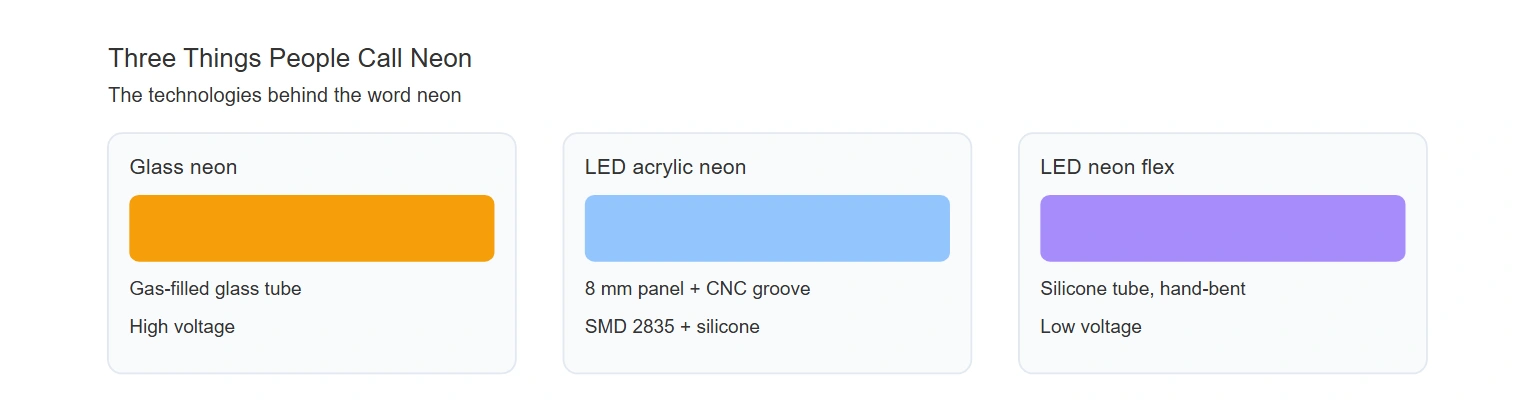
When people ask “neon vs LED”, they are usually comparing three things that all get called “neon”: traditional glass neon (gas-filled tubes), LED acrylic neon (an LED strip seated in a CNC-routed acrylic panel — the method we build), and LED neon flex (a bendable silicone tube). Most consumer articles only compare glass neon against LED flex and miss the third option entirely — the one that matters most for a commercial sign. Here is the honest, engineering-level comparison.
Glass neon is the original. A skilled glassblower heats and hand-bends a glass tube, seals electrodes into the ends, evacuates the air and fills it with neon (which glows red-orange) or argon with a trace of mercury (for the other colours). It runs on a transformer that steps mains voltage up to thousands of volts — typically 3,000 to 15,000 V — and the tube gets warm in use. It is beautiful, genuinely handmade, and also fragile, heavy, power-hungry and expensive to repair. It is still the right choice for a restoration or a prestige installation where the classic handcraft is the point.
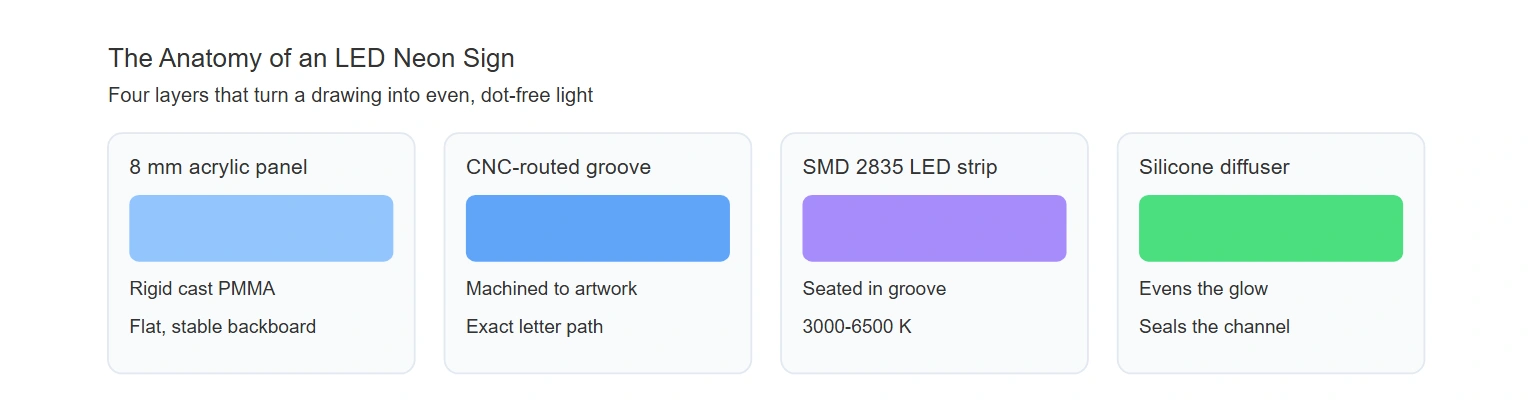
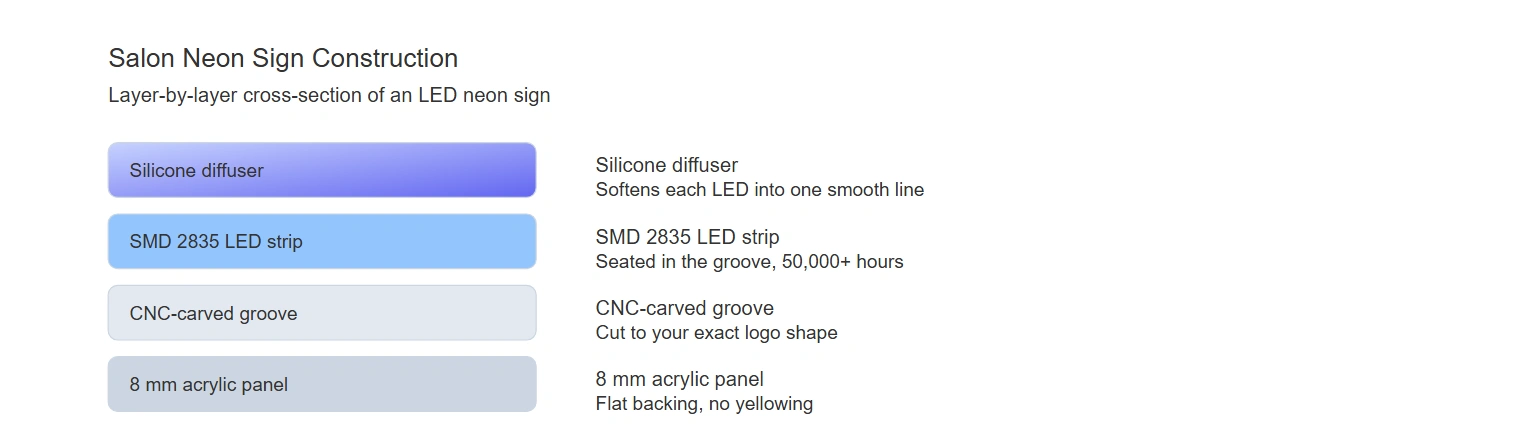
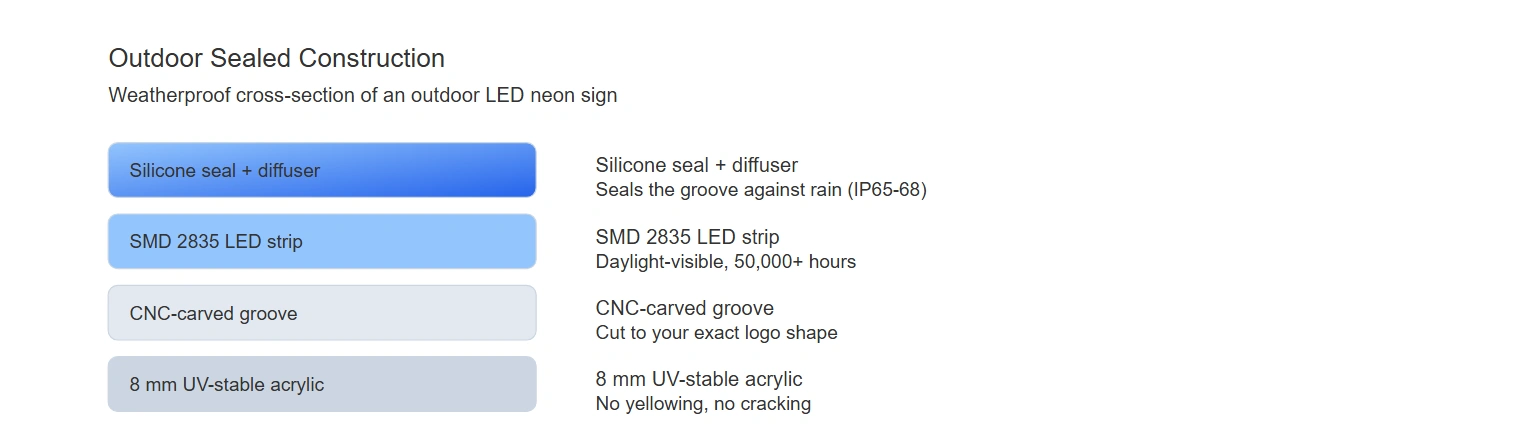
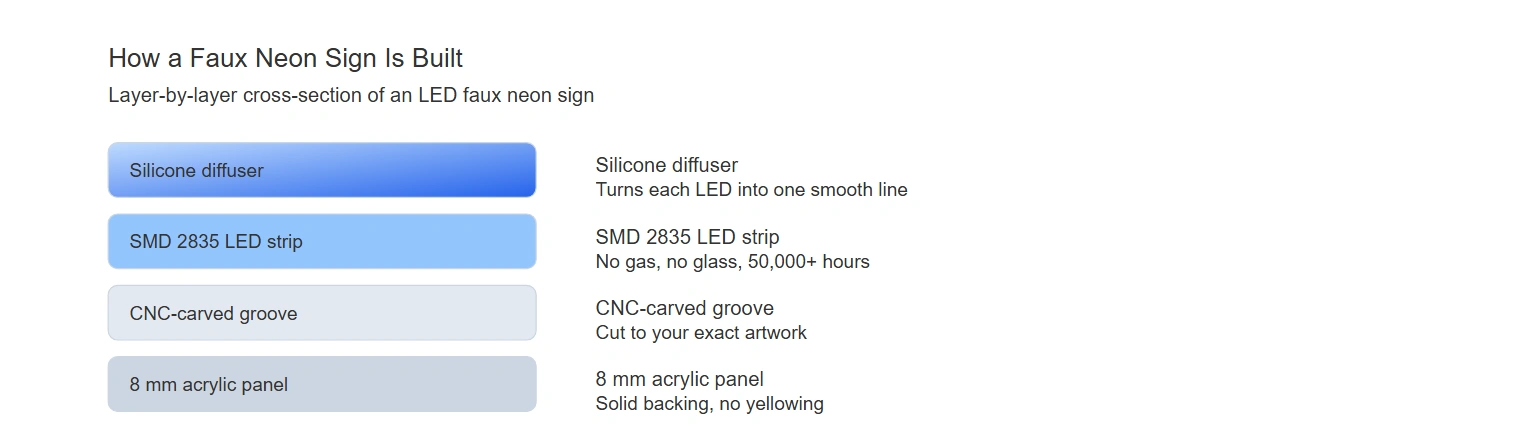
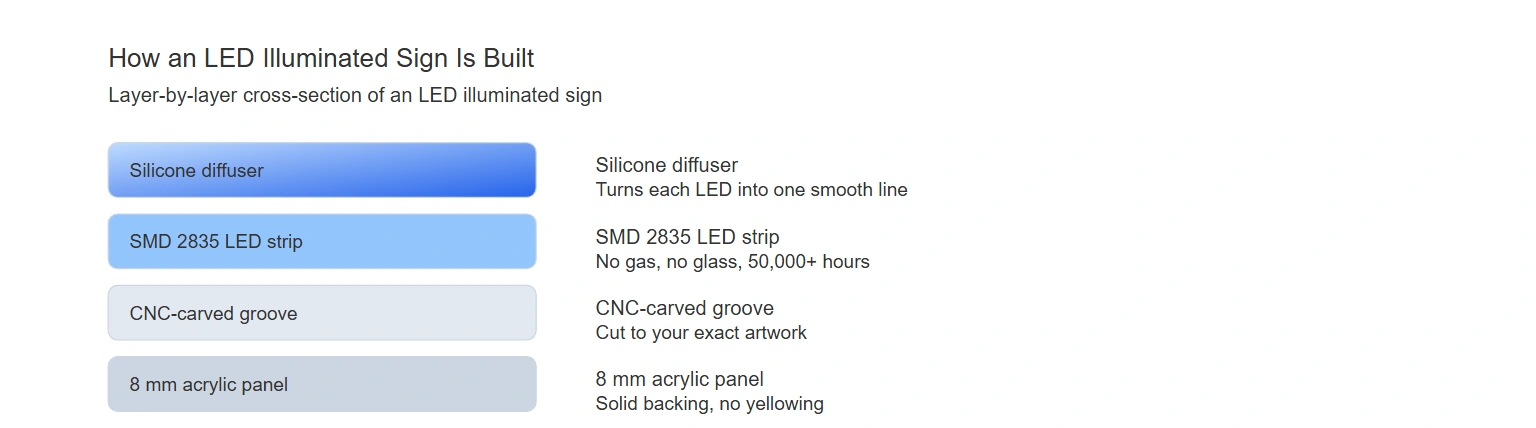
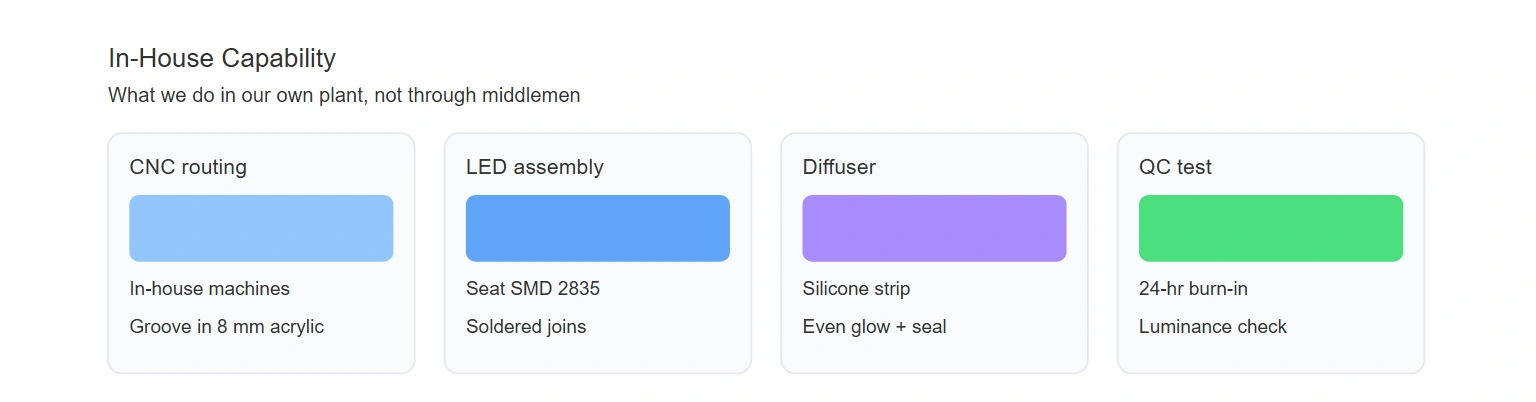
LED acrylic neon is a different construction altogether: a flat, rigid 8 mm acrylic panel, a groove CNC-routed to follow the artwork, an SMD 2835 LED strip seated in that groove, and a silicone diffuser that evens the light and seals the channel. It runs on a Class 2 low-voltage DC output (12 V / 24 V) through a driver. Because the panel is machined to a drawing rather than bent by hand, every reorder is identical — which is exactly what a franchise or multi-site brand needs. This is the construction our factory uses, and it is the option we recommend for almost all commercial signage.
LED neon flex is the product most people see on consumer marketplaces: a bendable silicone tube with small LEDs inside, shaped by hand and stuck to a board. It is cheap, low-voltage and easy to make at home, but it trades away precision — the LED dots can show through as bright spots, the silicone can yellow with UV exposure, and the result is soft and wobbly compared to a machined acrylic panel. It is fine for a bedroom or a one-off decorative piece; it is rarely what a business wants above its door.
| Factor | Glass neon | LED acrylic neon | LED neon flex |
|---|---|---|---|
| Construction | Hand-bent gas-filled glass tube | CNC-routed 8 mm acrylic + LED strip + silicone | Hand-bent silicone tube on a board |
| Voltage | 3,000–15,000 V (transformer) | AC 110-220 V input (Class 2) · 12/24 V DC output | 12 V / 24 V DC |
| Safety | High voltage, hot, breakable glass | Low-voltage, cool, no exposed glass | Low-voltage, soft |
| Lifespan | 10,000–30,000 h, degrades with use | 50,000+ h (LM-80 LED) | Varies; silicone yellows |
| Energy | High (constant transformer draw) | Low (~80% less) | Low |
| Light evenness | Very even | Very even (silicone diffuser) | Can show LED dots |
| Colour consistency | Varies tube to tube | Locked chip + CCT, identical reorders | Fair |
| Fragility | Very fragile, breaks in transit | Robust flat panel | Robust but soft |
| Repair | Skilled tube re-bending | Board-level or re-make | Replace the tube |
| Upfront cost | High (labour) | Moderate | Low |
| 5-year TCO | High (energy + repair) | Lowest | Moderate |
| Best for | Prestige, restoration, handcraft | Commercial storefronts, franchises, logos | DIY / consumer decor |
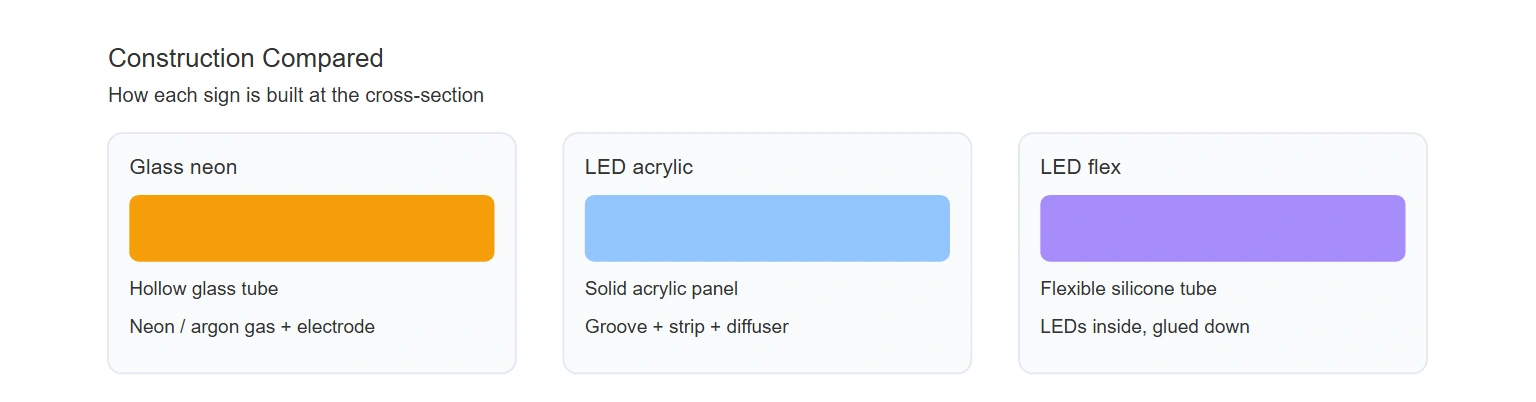
At the cross-section the difference is stark. Glass neon is a hollow tube you look into, where a gas discharge produces the light. LED acrylic neon is a solid panel you look at, where a seated LED strip glows through a silicone diffuser. LED flex is a flexible tube glued down in a pattern. That single difference — hollow glass vs machined acrylic — drives everything else: safety, durability, energy and how consistently the sign can be reproduced.
Glass neon runs on thousands of volts and must be installed by a licensed sign electrician, with clearance from flammable surfaces and a protected transformer. LED neon — both acrylic and flex — runs on a Class 2 low-voltage DC output, so the sign is safe to touch, cheap to insure and far simpler to sign off with a landlord or local authority. For a business, that is usually the deciding factor on its own.
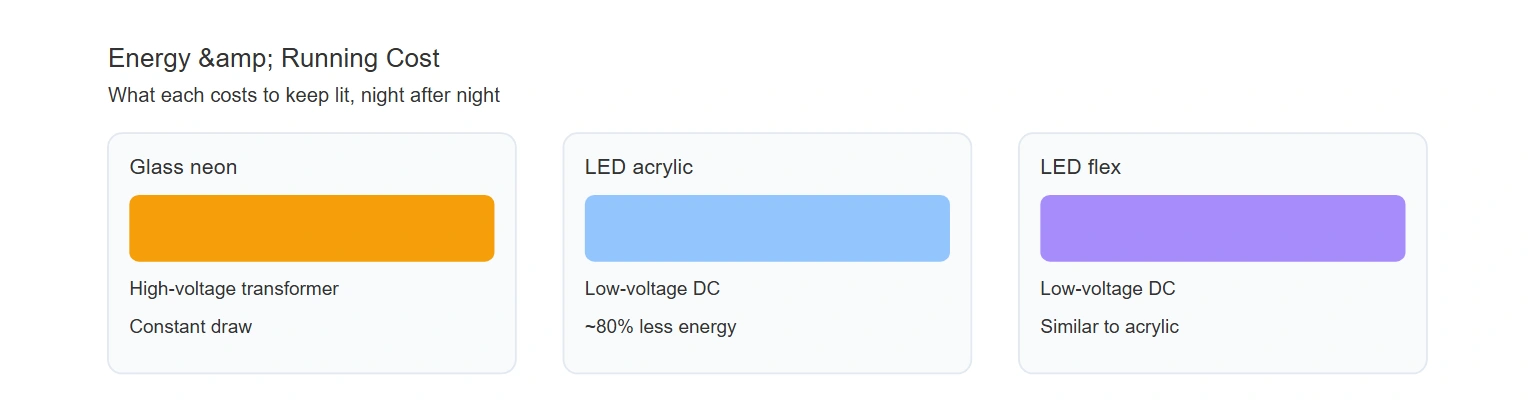
A neon transformer draws power constantly, whether the sign is dimmed or not, and a large glass sign can draw hundreds of watts. LED neon runs at a fraction of that — typically around 80% less energy for the same visual impact — and dims cleanly with a wall dimmer, RF remote or app. Over five years of evening use, the energy saving alone often pays the difference in upfront cost.
Glass neon tubes slowly dim as the phosphors age and the gas degrades, and a single cracked tube means a specialist re-bend. The LED in our acrylic signs is rated for 50,000+ hours under LM-80, and because it is a solid panel there is no gas, no mercury and no tube to break — a wipe-clean sealed surface that lasts for years with essentially no maintenance.
Glass neon is renowned for a warm, even glow, but matching the same colour across two hand-blown tubes is hard — each is a one-off. LED acrylic neon reproduces the same colour from a locked LED chip and colour temperature, so sign number ten matches sign number one exactly. That repeatability is what a brand needs when it rolls a logo out across many locations.
Glass signs travel badly — tubes break, gas leaks, and the sign can arrive dead. LED acrylic signs are a flat rigid panel that ships in a carton (or a plywood crate for export) and arrives intact. If you are buying signs to ship to multiple sites, this is a hidden cost you feel in the first delivery.
Glass neon is expensive up front because it is hand-blown, and it keeps costing — energy, transformer service and tube repairs. LED acrylic costs more than LED flex up front but less than glass, and then it just runs, which makes it the cheapest option over a five-year ownership. Compare total cost of ownership, not the sticker price. See our custom neon sign cost guide for the full breakdown.
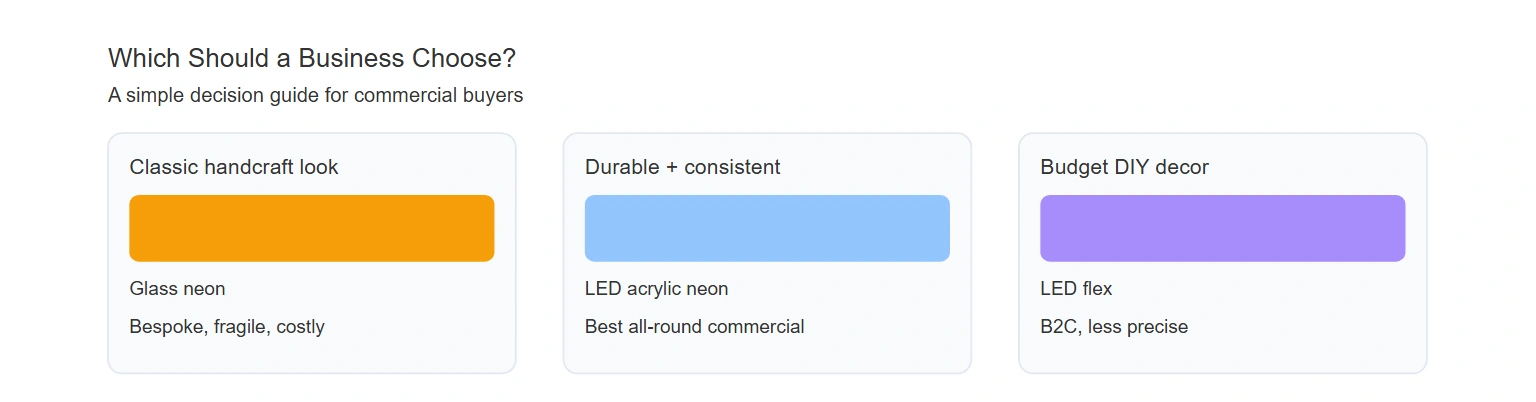
For most business buyers, the answer is LED acrylic neon. If you want to see exactly how it is built, read our neon sign manufacturer page, or browse faux neon signs for the LED-versus-glass distinction in a commercial context.
Technically no, and that is the point. Glass neon is a gas discharge in a glass tube; LED neon uses an LED strip to reproduce the look without the high voltage, gas or glass. In the trade, LED neon is the standard term for an LED sign built to look like neon.
LED is far safer. Glass neon runs on 3,000-15,000 V and needs a licensed electrician, while LED neon runs on a Class 2 low-voltage DC output that is safe to touch and simpler to insure.
LED. The SMD 2835 LED in our acrylic signs is rated for 50,000+ hours, where glass neon tubes slowly dim and need specialist re-bending when they fail.
LED neon uses roughly 80% less energy than an equivalent glass neon sign, because the high-voltage transformer in glass neon draws power continuously.
Glass neon is the genuine article, but a well-built LED acrylic sign with a silicone diffuser is hard to tell apart at normal viewing distance — without the fragility and running cost.
LED acrylic neon is an LED strip seated in a CNC-routed 8 mm acrylic panel, so it is flat, rigid and precisely reproduced. LED neon flex is a bendable silicone tube, cheaper but less precise and prone to showing LED dots and yellowing.
Whether you need a single storefront sign, a multi-site brand rollout, or an OEM and wholesale partner, we are ready to support your business.