
Trimless Channel Letters (Borderless)
— Rimless LED Sign Letters
Edge-to-edge acrylic face with no trim cap — a clean, architectural LED letterform. A factory-level engineering reference for sign resellers, architects, procurement teams, distributors and project contractors — with material, optical, thermal, MOQ and QC specifications you can place an order against.
Acrylic face · aluminium return · SMD 2835 IP65 LEDs · CE / RoHS / UL · MOQ 1 pc
A full brand name in trimless (borderless) channel letters mounted on a modern retail or office façade; clean edge-to-edge acrylic face, no visible trim cap, lit at dusk.
Recommended size: 1600 × 1067 px
Trimless channel letters — also sold as borderless letters, rimless channel letters and channel letters without a trim cap — are illuminated, three-dimensional sign letters in which the acrylic face runs edge-to-edge over the aluminium return with no visible plastic trim cap or border. The result is a seamless, architectural letterform that reads as one continuous glowing surface by day and night. This is a factory-level engineering reference for sign resellers, architects, procurement teams, distributors and project contractors — with material, optical, thermal, MOQ, QC and failure-mode specifications you can place an order against.
What you can expect from our factory
- ISO 9001:2015 quality system; CE / RoHS / UL 48-certified LED modules and power supplies
- True trimless fabrication — laser-welded aluminium returns, precision-bonded acrylic faces, no visible trim cap
- MOQ 1 piece (samples) · 10+ pieces (bulk, tiered pricing); 3–7 working-day production after artwork approval
- Free dimensioned engineering drawing + written quote within 24 hours
What Is a Trimless (Borderless) Channel Letter?
A conventional channel letter holds its acrylic face in place with a flexible plastic trim cap — a visible border that clips the face to the aluminium return. A trimless channel letter removes that part entirely: the acrylic face is cut to wrap the letter’s full outline and is bonded or screwed flush to the return edge. Nothing frames the face, so the illuminated letter appears to float against the façade. The industry’s dominant term is trimless, but you will see the same product described as rimless, borderless, or no-trim-cap channel letters — they all refer to the same construction.
Trimless letters are widely regarded as the premium finish in dimensional signage — one manufacturer describes them as “the Ferrari of business signs” for the clean, contemporary edge they give to architectural, retail and hospitality branding. They sit beside trim-cap channel letters and flat-cut acrylic letters in our catalogue, differentiated by this single construction decision — and it changes the engineering, not just the look.
Construction Anatomy — How a Trimless Letter Is Built
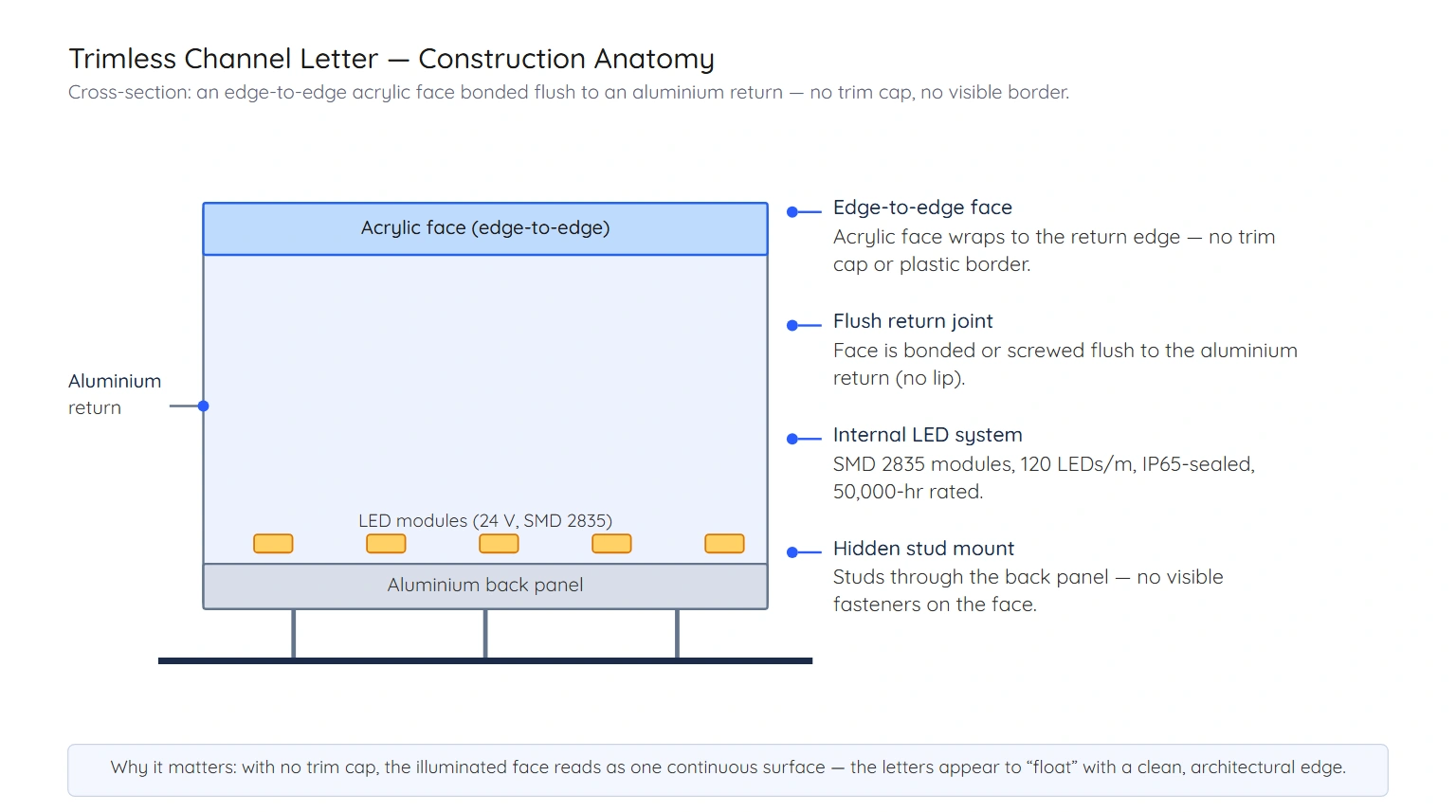
Cross-section of a trimless letter: an edge-to-edge acrylic face bonded flush to an aluminium return, with internal LED modules and a hidden stud mount — no trim cap, no visible border.
Macro shot of a single trimless letter showing the acrylic face wrapping flush to the aluminium return edge with no trim cap — demonstrates the seamless edge.
Recommended size: 1600 × 1067 px px
Trimless vs. Trim Cap — The Engineering Trade-off
The trim cap is not cosmetic. It provides mechanical forgiveness: it clamps the face to the return, absorbs dimensional tolerance, and gives the installer a removable face. Removing it trades that forgiveness for a cleaner edge — which is why trimless letters demand tighter fabrication, a controlled bond line and better sealant discipline. The trade-off is well documented across the industry (Signs of the Times).
| Factor | Trim-cap channel letter | Trimless (borderless) letter | Why it matters |
|---|---|---|---|
| Face retention | Plastic trim cap clips face to return | Bonded or screwed flush to the return | Trimless needs a precise, controlled joint |
| Edge appearance | Visible border around every letter | No border — face reads edge-to-edge | Cleaner, more architectural look |
| Weathering | Trim cap fades, cracks and peels under UV | No plastic trim cap to degrade | Removes the most common outdoor failure point |
| Water ingress | Trim cap can funnel water inside the face | Flush seal; drainage engineered in | Fewer water paths when sealed correctly |
| Servicing | Face pops off easily | Screw-mount faces are removable; bonded faces need back access | Specify removable face for serviceability |
| Fabrication cost | Lower — forgiving assembly | Higher — tighter tolerance + bond/seal QC | Trimless carries a small premium |
| Best for | Large letters, budget builds, harsh exposure | 6–28 in. letters, up-close viewing, premium brands | Match the construction to the project |
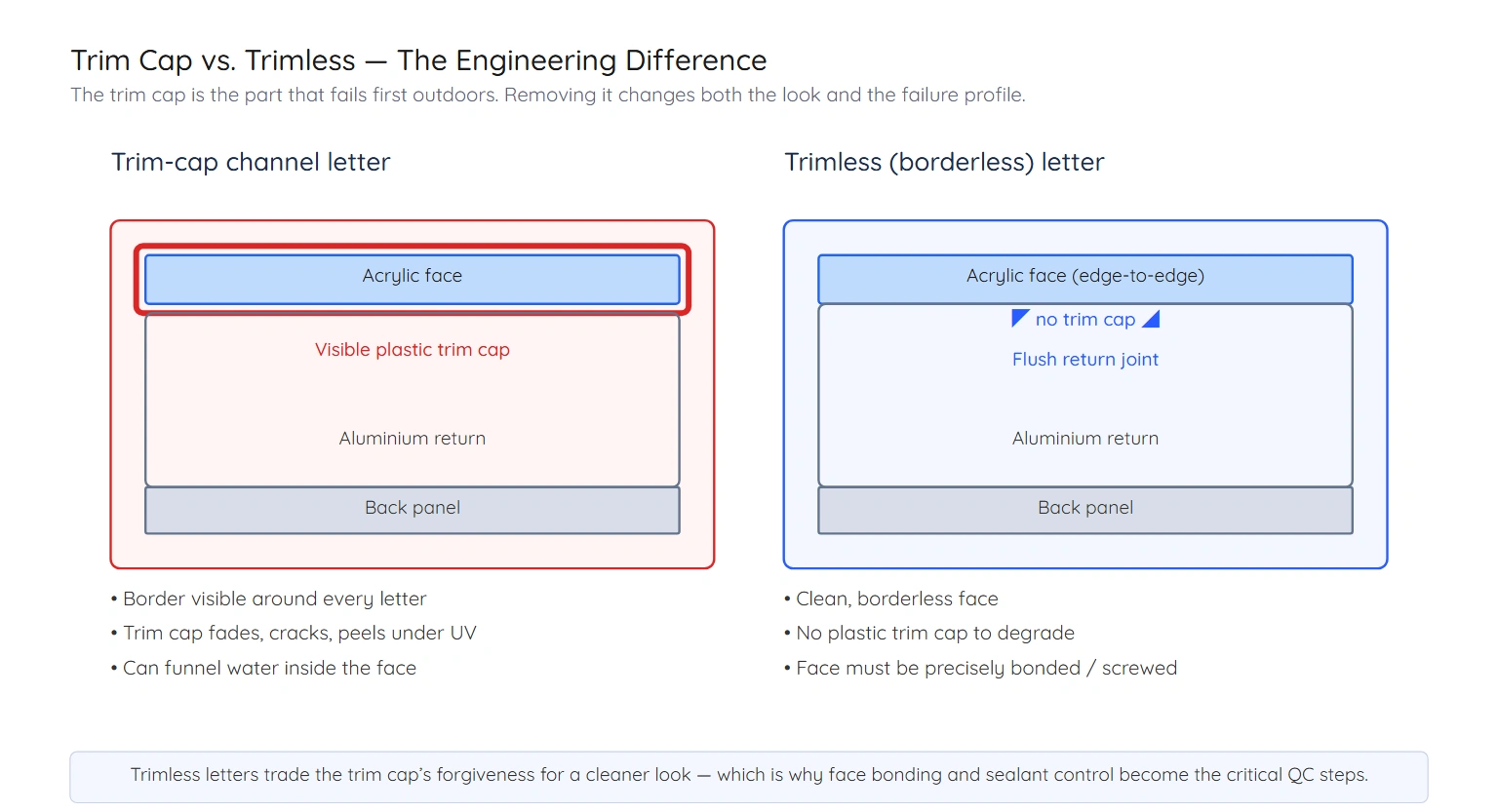
Side-by-side: a trim-cap letter shows a visible plastic border that fades and cracks outdoors; a trimless letter shows a clean flush joint with no trim cap to degrade.
Three Trimless Constructions
“Trimless” describes which edge loses its trim cap. The three standard builds are:
| Construction | How it is built | Illumination | Best for |
|---|---|---|---|
| Front trimless | Acrylic face wraps the front edge; return keeps a rear lip | Face-lit | The workhorse — clean front-lit storefront and interior signage |
| Back trimless | Face keeps a trim cap; back edge is trimless | Halo (reverse-lit) | Halo glow that escapes cleanly around the return |
| Double trimless | Both front and back are trimless | Face-lit + halo combined | Premium architectural brands wanting layered night impact |
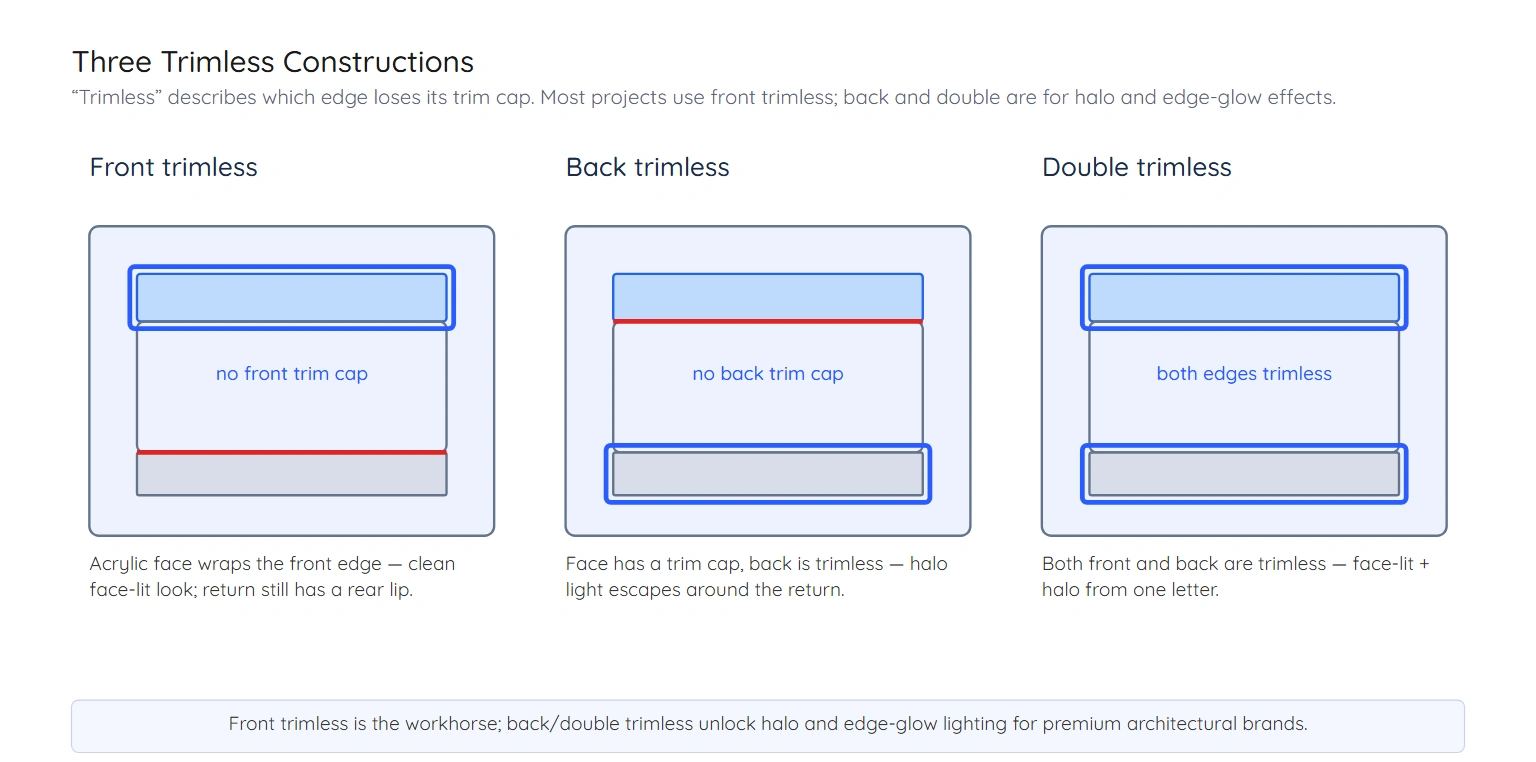
The three trimless builds: front trimless is the workhorse; back and double trimless unlock halo and edge-glow lighting.
Material Engineering — Acrylic Face & Aluminium Return
Two materials carry the entire product. The face is acrylic (PMMA) and the return is aluminium. Each has a specification decision that determines longevity and light quality.
| Component | Material options | Specification | Engineering notes |
|---|---|---|---|
| Face | Cast acrylic (PMMA) | 3 mm / 6 mm (1/8″–1/4″) face; 1/4″ or 1/2″ visible edge | Cast acrylic machines to a clean, non-hazing edge and diffuses light evenly |
| Face | Extruded acrylic | 3 mm / 6 mm, budget option | Lower cost; softer edge; slightly more thermal movement — flag for indoor use |
| Return | Aluminium (3003/5052) | 0.040″–0.090″ (1.0–2.3 mm) gauge | Laser-welded or folded; anodised or painted to match brand colour |
| Return | 304 stainless steel | Optional for coastal / marine sites | Higher corrosion resistance; premium upcharge |
| Back | ACM / aluminium | 3 mm ACM or 0.040″ white aluminium | Painted white inside to reflect LED output forward |
| Face bonding | Structural adhesive / screws | Polyurethane or structural silicone bead; or removable screws | See Thermal Engineering below — the joint is the critical detail |
A flat-lay of cast acrylic face samples and aluminium return swatches (anodised, painted, brushed) with edge-finish options (polished / frosted / coloured).
Recommended size: 1600 × 1067 px px
Optical Engineering — Edge Glow & Hotspot Control
The borderless face is also an optical element. With no trim cap to hide the LED array, hotspot control becomes a fabrication variable, not a given. We tune LED pitch, diffuser density and face thickness together so the face glows evenly instead of showing bright dots.
| Parameter | Specification | Why it matters |
|---|---|---|
| LED type | SMD 2835 modules, 120 LEDs/m | High lumen density for even face illumination |
| Colour temperature | 2700K – 6500K white (RGB / RGBW on request) | Match warm hospitality or cool tech branding |
| Lifespan | 50,000-hour rated | Matches the 50,000-hr industry benchmark for LED channel letters |
| Protection | IP65 / IP67 modules | Sealed against dust and water for outdoor use |
| Voltage | 12 V / 24 V DC, Mean Well Class-2 driver | Low-voltage, safe, energy-efficient |
| Diffusion | Opal acrylic face or diffuser film | Eliminates LED hot spots across the face |
| Face thickness | 1/4″ (1/8″ visible edge) or 1/2″ (3/8″ visible edge) | Thicker face = softer, deeper edge glow |
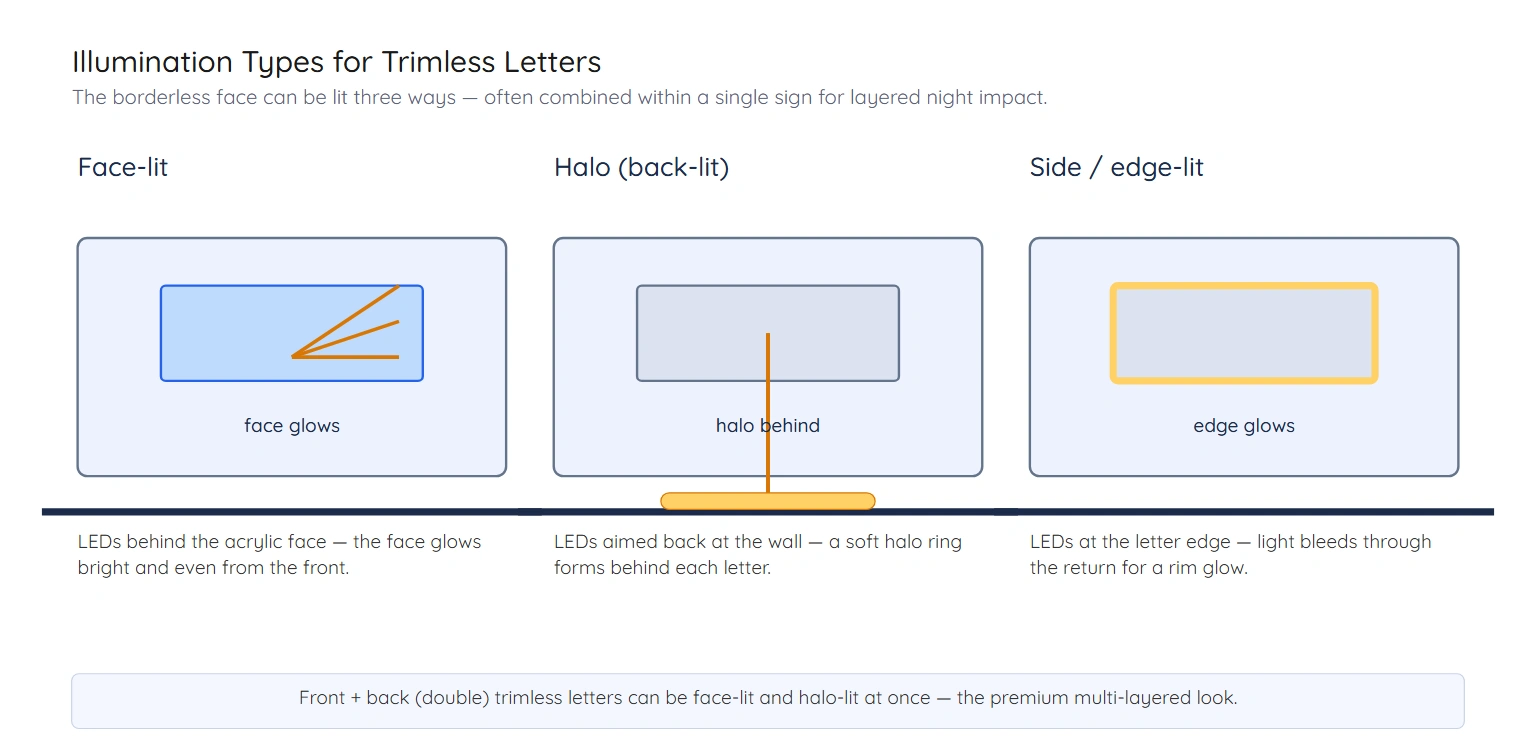
A borderless face can be lit face-lit, halo-lit or side-lit — and double-trimless letters can be face-lit and halo-lit at once.
The same trimless letter set shown face-lit and halo-lit at night — demonstrates the two illumination modes and the clean halo ring.
Recommended size: 1600 × 1067 px px
Thermal Engineering — CTE & Expansion Management (the detail most suppliers skip)
This is the engineering reason cheap trimless letters fail in the field. Acrylic and aluminium expand at very different rates: acrylic’s coefficient of thermal expansion is roughly 70–77 × 10⁻⁶ /K, while aluminium’s is about 23 × 10⁻⁶ /K — a ~3× differential (Professional Plastics, thermal properties of plastics). Over a hot afternoon-to-night cycle, the acrylic face “walks” over the fixed aluminium return by a small but real amount on every letter. A rigid adhesive joint cannot absorb that movement — it eventually cracks, the face lifts, and water enters.
Our fix is a three-part expansion joint: a flexible structural adhesive or silicone bead, a computed expansion gap sized to the letter and climate, and a face that is free to move without lifting or cracking. We specify this on every order and document it in the drawing set — the difference between a sign that survives ten seasons and one that fails in two.
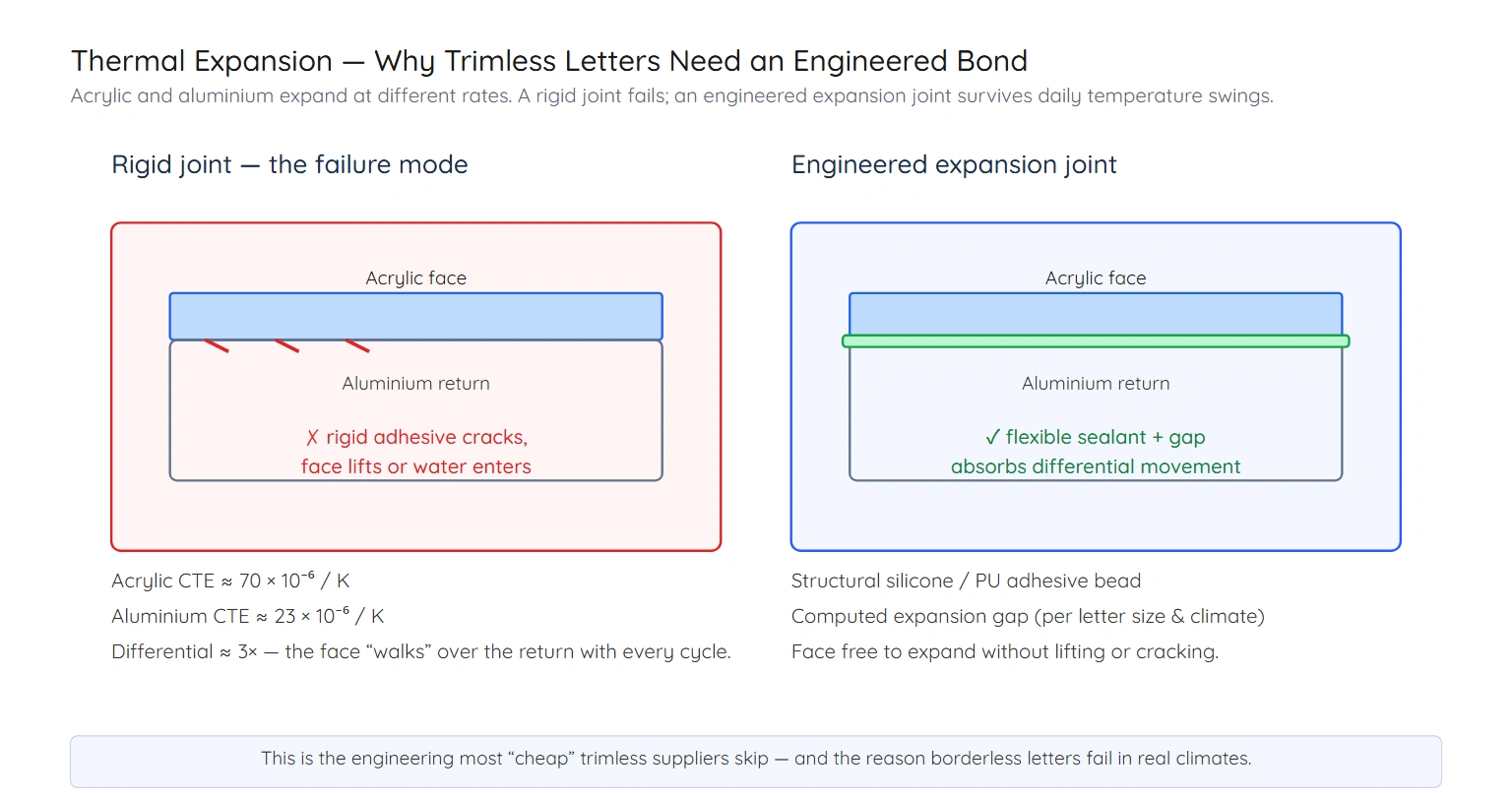
Acrylic expands ~3× faster than aluminium — an engineered expansion joint (flexible bead + gap) is what keeps borderless letters intact through temperature cycles.
Edge & Surface Finishes
Because the edge is exposed in a trimless letter, edge finish is a design lever, not an afterthought.
| Finish | Effect | Notes |
|---|---|---|
| Polished edge | Clear, glossy edge; maximum sparkle | Base finish — contemporary, catches light |
| Frosted edge | Matte edge; soft, even light diffusion | Softens the edge glow; hides minor machining marks |
| Coloured edge | Tinted acrylic edge matched to brand colour | Adds a coloured halo; +5–10% upcharge |
| Matte face | Low-glare face | Preferred for up-close interior viewing |
| Gloss face | High-gloss, reflective face | Maximum brightness and punch |
Technical Specifications & Product Parameters
| Parameter | Specification | Notes |
|---|---|---|
| Product | Trimless (borderless / rimless) channel letters | Front, back or double trimless |
| Face material | Cast acrylic (PMMA); extruded on request | UV-stabilised for outdoor use |
| Return material | Aluminium (3003/5052); 304 SS optional | Anodised or painted, any RAL / Pantone |
| Letter height | 150 mm – 710 mm (6″ – 28″ ideal); up to 1,070 mm (42″) | Custom sizes outside range on request |
| Letter depth | 30 – 100 mm (1.5″ / 2.5″ / 3.25″ / 4″) | Depth matched to stroke width |
| Face thickness | 3 mm / 6 mm; 1/4″ (1/8″ edge) or 1/2″ (3/8″ edge) | Thicker face = softer edge glow |
| LED | SMD 2835, 120 LEDs/m, 50,000-hr rated | IP65 / IP67 modules |
| Colour temperature | 2700K – 6500K white; RGB / RGBW | CRI ≥ 80 on request |
| Working voltage | 12 V / 24 V DC | Mean Well / CE-certified Class-2 driver |
| Illumination | Face-lit / halo / side-lit / front + back | Double trimless = face + halo |
| Mounting | Hidden stud / stand-off / flush / raceway / adhesive | 1:1 drilling template supplied |
| Certifications | CE, RoHS, UL 48 (components), ISO 9001 | Documentation on request |
Applications by Industry
| Industry | Typical use | Why trimless letters fit |
|---|---|---|
| Retail & malls | Storefront logos, brand walls, directory signage | Clean edge reads premium and photographs well |
| Corporate & offices | Lobby logos, reception walls, wayfinding | Architectural, minimalist look conveys permanence |
| Hospitality & F&B | Restaurant, hotel and bar branding | Warm halo or face-lit glow suits interior ambience |
| Tech & showrooms | Product launches, flagship façades | Borderless face matches sleek tech branding |
| Airports & casinos | Interior wayfinding, feature walls | Recommended protected/interior use where trim cap stability is not required |
Trimless letters on an interior brand wall (lobby, showroom or restaurant), warm interior lighting, face-lit glow.
Recommended size: 1600 × 1067 px px
Customization Options
- Fonts & logos — any vector file (.ai, .eps, .cdr, .svg) or font + text; we reproduce brand geometry exactly
- Size & depth — any letter height; depth matched to stroke width for the trimless proportion matrix
- Face & edge colour — acrylic face, painted or anodised return, tinted edge; exact RAL / Pantone match
- Illumination — face-lit, halo, side-lit, or front + back; RGB / RGBW colour-changing
- Mounting — hidden stud, stand-off, flush, raceway or adhesive; 1:1 drilling template included
- Vinyl / digital-print overlays and diffusers for special effects
Total Cost of Ownership — Trimless vs. Alternatives
Trimless letters cost more up front than trim-cap letters (a tighter fabrication process and bond/seal QC). The TCO argument is that they remove the trim cap — the part that degrades first — and deliver a premium look that supports a higher-margin brand position.
| Option | Up-front cost | Lifespan | Maintenance | 10-yr TCO verdict |
|---|---|---|---|---|
| Trimless channel letters (this product) | Medium | 10–15+ years (LED 50,000 hr) | Minimal; LEDs serviceable; no trim cap to replace | Low — no recurring trim-cap failure |
| Trim-cap channel letters | Low–medium | 8–12 years (trim cap degrades first) | Trim cap replacement / repaint | Medium — trim cap failure in harsh sun |
| Flat-cut acrylic letters | Low | 5–10 years (non-lit) | Re-gluing, cleaning | Medium — replaced 1–2× |
| Neon (gas discharge) | High | 8–15 years (tube + transformer) | Tube / transformer replacement | High — fragile, high-voltage servicing |
Quality Control & Test Methodology
Every batch passes a documented QC gate before packing. For trimless letters, the bond line and light uniformity are the two checks that matter most — they are the two things that fail first in a poorly made letter.
| Test | Standard / method | What it verifies |
|---|---|---|
| Bond-line inspection | Visual + pull test (ASTM D4541-style adhesion) | Face is securely bonded; no voids or weak spots |
| Light uniformity | Visual + luminance spot-check | No LED hot spots or dark corners across the face |
| LED burn-in | 24-hour continuous run | Early-failure screening; colour-temperature stability |
| IP / water ingress | IP65 spray test (outdoor builds) | Sealed against rain and condensation |
| Thermal cycling | −20 °C to +60 °C cycle test | Expansion joint absorbs movement without cracking |
| Colour match | Pantone / RAL vs. colour meter | Face, edge and return match the approved swatch |
| Dimensional accuracy | Template vs. drawing | Letter geometry matches the approved artwork |
Failure Modes & Prevention (What to Watch For)
These are the field failures engineers and procurement teams see in trimless letters — and how to specify against them at order time.
| Failure mode | Root cause | Detection | Prevention (specify at order) |
|---|---|---|---|
| Face lifting / delamination | Rigid adhesive can't absorb CTE differential | Face lifts off return; water enters | Specify flexible structural adhesive + expansion gap |
| Water ingress | Incomplete seal or drainage | Condensation, LED failure, corrosion | IP65 sealing + drainage weep holes |
| Uneven glow / hot spots | LED pitch too wide or missing diffusion | Visible bright dots through face | Specify opal diffusion + correct LED pitch |
| Edge haze / yellowing | Non-UV-stabilised acrylic outdoors | Colour shift over 2–3 years | Specify UV-stabilised cast acrylic |
| Bond-line voids | Insufficient adhesive bead or clamp time | Intermittent adhesion, rattling | Specify full-perimeter bead + documented clamp/cure |
| Fastener shadowing | Visible screws through face | Dark spots at screw heads | Use hidden stud mount or back access |
MOQ, Pricing Factors & Lead Time
| Item | Detail |
|---|---|
| MOQ | 1 piece (samples and single letters) · 10+ pieces (bulk, tiered pricing) |
| Production | 3–7 working days after artwork approval (larger orders: confirm at quote) |
| Free proof | Dimensioned engineering drawing + written quote within 24 hours |
| Pricing factors | Letter height, depth, face thickness, return material, illumination, finish, quantity |
| Shipping | Express 5–7 days · air ~10 days · sea 40–65 days · DDP available |
| Payment | T/T, L/C, PayPal — 50% deposit / 50% before shipment |
| Warranty | 2-year LED / 5-year body (extended on request) |
Production Process
- Artwork intake — vector file (.ai/.eps/.cdr/.svg) or font + text; letter height and depth confirmed
- Return forming — aluminium return laser-cut and welded/bent to the letter outline
- Face cutting — cast acrylic face cut to wrap the full outline edge-to-edge
- LED layout — SMD 2835 modules spaced for even illumination; driver specified
- Face bonding / mounting — face bonded (or screwed) flush to the return; expansion joint formed
- QC — bond-line pull test, 24-hr burn-in, light-uniformity check, colour match
- Packing & ship — foam-lined export crate; express / air / sea / DDP
A technician bonding or screwing an acrylic face to an aluminium return on the production line, or running the light-uniformity QC check.
Recommended size: 1600 × 1067 px px
Supplier Evaluation Checklist (Procurement)
Use this checklist when vetting any trimless-letter manufacturer — it is written to expose the two things that separate a factory that ships a reliable borderless letter from one that ships a problem:
- Does the supplier actually fabricate returns and bond faces in-house, or just trade finished signs?
- Can they document the CTE expansion-joint spec (adhesive type, gap size, climate rating)?
- Do they specify cast vs extruded acrylic — and UV stabilisation for outdoor builds?
- What is the LED module spec (SMD type, LEDs/m, IP rating, driver brand)?
- Do they offer a removable (screw-mount) face for serviceability?
- Can they show bond-line pull-test and thermal-cycle QC evidence?
- What is the real MOQ, lead time and free-proof policy — and is the quote written?
- Do certifications (CE / RoHS / UL / ISO 9001) cover the LED and power supply, not just the metal?
Market Intelligence: Trimless Letters in Dimensional Signage
Trimless letters sit at the premium end of the channel-letter segment, which itself is a meaningful slice of a growing illuminated-signage market. The global illuminated signs market is projected to reach about USD 52.9 billion by 2032 (5.82% CAGR), with LED signs holding roughly 65% of the market (P-Market Research, illuminated signs market). Within channel letters specifically, LED modules account for nearly 95% of newly installed channel-letter signage, and combination front + halo-lit letters — the premium multi-layer build trimless letters enable — already represent ~12% of the market with dual illumination improving visibility by roughly 53% (360 Research Reports, channel letter lighting market).
The demand driver is architectural: retail, hospitality and corporate brands are moving toward cleaner, low-profile, borderless letterforms for façades, malls, airports and interiors — a trend the industry has documented as the shift from trim-cap to trimless construction (Signs of the Times). For B2B buyers the practical takeaway is margin: trimless letters command a premium over trim-cap equivalents while carrying a lower long-term failure profile when the thermal joint is engineered correctly — the combination resellers and distributors can sell at a healthy margin.
Frequently Asked Questions
What is the difference between trimless and trim-cap channel letters?
A trim-cap channel letter holds its acrylic face in place with a visible plastic trim cap that clips the face to the aluminium return, creating a border around every letter. A trimless (borderless) channel letter removes that trim cap: the acrylic face is cut to wrap the full letter outline and is bonded or screwed flush to the return edge, so no border is visible. Trimless letters look cleaner and more architectural, but they require tighter fabrication and a properly engineered bond line, which is why they carry a small premium.
Are trimless channel letters suitable for outdoor use?
Yes, with the right build. Because a trimless letter lacks the extra stability of a trim cap, we seal it to IP65, use UV-stabilised cast acrylic, and engineer the thermal expansion joint so the face doesn’t lift in temperature swings. They are equally at home in protected outdoor locations and interiors such as malls, airports, casinos and lobbies. For very large letters (over ~48 inches) we recommend a trim-cap or reinforced build, and we will advise you at quote stage.
What is the minimum order quantity and lead time?
The minimum order is 1 piece — you can order a single letter, logo or full sign. Production is typically 3–7 working days after artwork approval, with larger orders confirmed at quote. We provide a free dimensioned engineering drawing and written quote within 24 hours, and ship by express (5–7 days), air (~10 days) or sea (40–65 days), with DDP available.
Can you match my brand font, logo and exact colours?
Yes. We reproduce any vector logo or typeface (.ai, .eps, .cdr, .svg) and match face, edge and return colours to exact RAL / Pantone references. Edge finishes (polished, frosted or coloured) and face finishes (matte or gloss) are all selectable, and we supply a 1:1 drilling template so your installer can mount the letters precisely.
How do you prevent the face from lifting or cracking in temperature changes?
Acrylic expands about three times faster than aluminium (roughly 70–77 × 10⁻⁶ /K vs ~23 × 10⁻⁶ /K). We build a three-part expansion joint into every trimless letter: a flexible structural adhesive or silicone bead, a computed expansion gap sized to the letter and climate, and a face that is free to move without lifting. This is the single most important quality difference in a borderless letter — and we document it in the drawing set.
What lighting and voltage options are available?
Standard is 12 V / 24 V DC SMD 2835 LED modules (120 LEDs/m, 50,000-hour rated, IP65/67) in 2700K–6500K white, with RGB / RGBW colour-changing on request, driven by a Mean Well or CE-certified Class-2 power supply. Illumination can be face-lit, halo (reverse-lit), side-lit, or front + back on a double-trimless letter.
What certifications and QC do your letters carry?
LED modules and power supplies are CE / RoHS / UL 48 compliant, and our factory operates under an ISO 9001:2015 quality system. Every batch passes bond-line pull tests, a 24-hour LED burn-in, light-uniformity checks, and thermal-cycle testing for outdoor builds, with documentation available on request.
How are trimless letters mounted?
Four ways: hidden stud mount (no visible fasteners), stand-off spacers (floating effect), flush wall mount, or raceway mount for multiple letters on one backer. We also support silicone-adhesive mounting for interior work. Every order includes a 1:1 drilling template so installation is precise and fast.
Key Takeaways
- Trimless (borderless / rimless) channel letters = an edge-to-edge acrylic face with no visible trim cap — the premium finish in dimensional signage
- Three builds — front trimless, back trimless, double trimless — cover face-lit, halo and combined lighting
- The differentiator is the thermal expansion joint: acrylic expands ~3× faster than aluminium, and only an engineered bond survives real climates
- Cast acrylic face + laser-welded aluminium return + SMD 2835 IP65 LEDs, 50,000-hr rated, CE / RoHS / UL 48 / ISO 9001
- MOQ 1 piece; 3–7 day production; free dimensioned drawing + written quote within 24 hours; express / air / sea / DDP shipping
Get a Free Engineering Drawing & Quote
Send your logo, text and size requirement — our engineering team returns a dimensioned shop drawing, a written quote with MOQ, lead time and certifications, and an expansion-joint spec within 24 hours.