
RGB Channel Letters
— Color-Changing LED Sign Letters
Programmable, color-changing channel letters built with RGB, RGBW and addressable (per-pixel) LED control. A factory-level engineering reference for sign resellers, architects, procurement teams, distributors and project contractors — with IC-chip, DMX512, waterproofing, MOQ and QC specifications you can place an order against.
A lit night shot of color-changing channel letters cycling through colors on a retail or entertainment facade — shows the RGB glow and depth.
Recommended size: 1600 × 1067 px
RGB Channel Letters — A Factory Engineering Reference
RGB channel letters — also sold as full color channel letters, color-changing letters and RGB LED letters — are illuminated, three-dimensional sign letters whose internal LED system can reproduce any color and, at the addressable tier, animate color across the face in gradients, chase and flow. Structurally they are built like standard front-lit, halo-lit or dual-lit channel letters; the difference is entirely in the LED type, the control chip and the control protocol. This page is written for sign resellers, architects, procurement teams, distributors and project contractors — it gives the IC-chip, DMX512, waterproofing, power, MOQ and QC specifications you can place an order against, not retail marketing copy.
What you can expect from this factory
- ISO 9001:2015 quality system; CE / RoHS / UL 48-certified LED modules and power supplies
- Three control tiers — RGB (group color), RGBW (true white) and addressable / per-pixel (WS2811 / WS2812B / SK6812 / GS8208)
- MOQ 1 piece (samples) · 10+ pieces (bulk, tiered pricing); 3–7 working-day production after artwork approval
- Free dimensioned engineering drawing + written quote within 24 hours, with a video proof of your exact color program before shipping
Wide shot of the LED sign workshop and assembly floor, showing the CNC cutting, aluminium bending and LED assembly workstations.
Recommended size: 1600 × 1067 px
What Are RGB Channel Letters? (And How They Differ from Single-Color Letters)
A single-color channel letter uses fixed white, red or blue LED modules and can never change. An RGB channel letter replaces those with red-green-blue LED modules whose three channels are mixed by pulse-width modulation (PWM) — at 8-bit depth that is 256 levels per channel, or 256 × 256 × 256 = 16.7 million colors. The same physical letter can therefore switch from a daytime brand color to a holiday or promotion color, run a slow cross-fade, or (at the addressable tier) animate color across individual pixels. The key engineering decision is not “RGB or not” — it is which control architecture the sign needs.
Three properties separate a color-changing letter that works outdoors for a decade from one that fails in a season: the LED IC chip (group vs per-pixel control), the control protocol (SPI single-wire vs DMX512 differential), and the white-point engineering (whether the letter uses pure RGB or adds a dedicated white channel). The sections below cover each.
The Three Tiers of Color-Changing Letters — RGB vs RGBW vs Addressable
Most color-changing signage is sold as “RGB” with no further distinction. In practice there are three genuinely different builds, and confusing them is the most common cause of a wrong purchase:
| Tier | Control | What it can do | White quality | Typical use |
|---|---|---|---|---|
| RGB (group) | Whole letter changes color together | Solid color switching, cross-fade | Cool / blue-green cast | Storefronts, bars, brand color changes |
| RGBW (group + white) | Whole letter + dedicated white channel | Solid color + accurate white & pastels | True 3000–6500 K white | Brand-accurate retail, food & cosmetics |
| Addressable (per-pixel) | Each pixel has its own IC | Gradient, chase, flow, logo animation | White depends on chip (SK6812 = RGBW) | Entertainment, events, flagship facades |
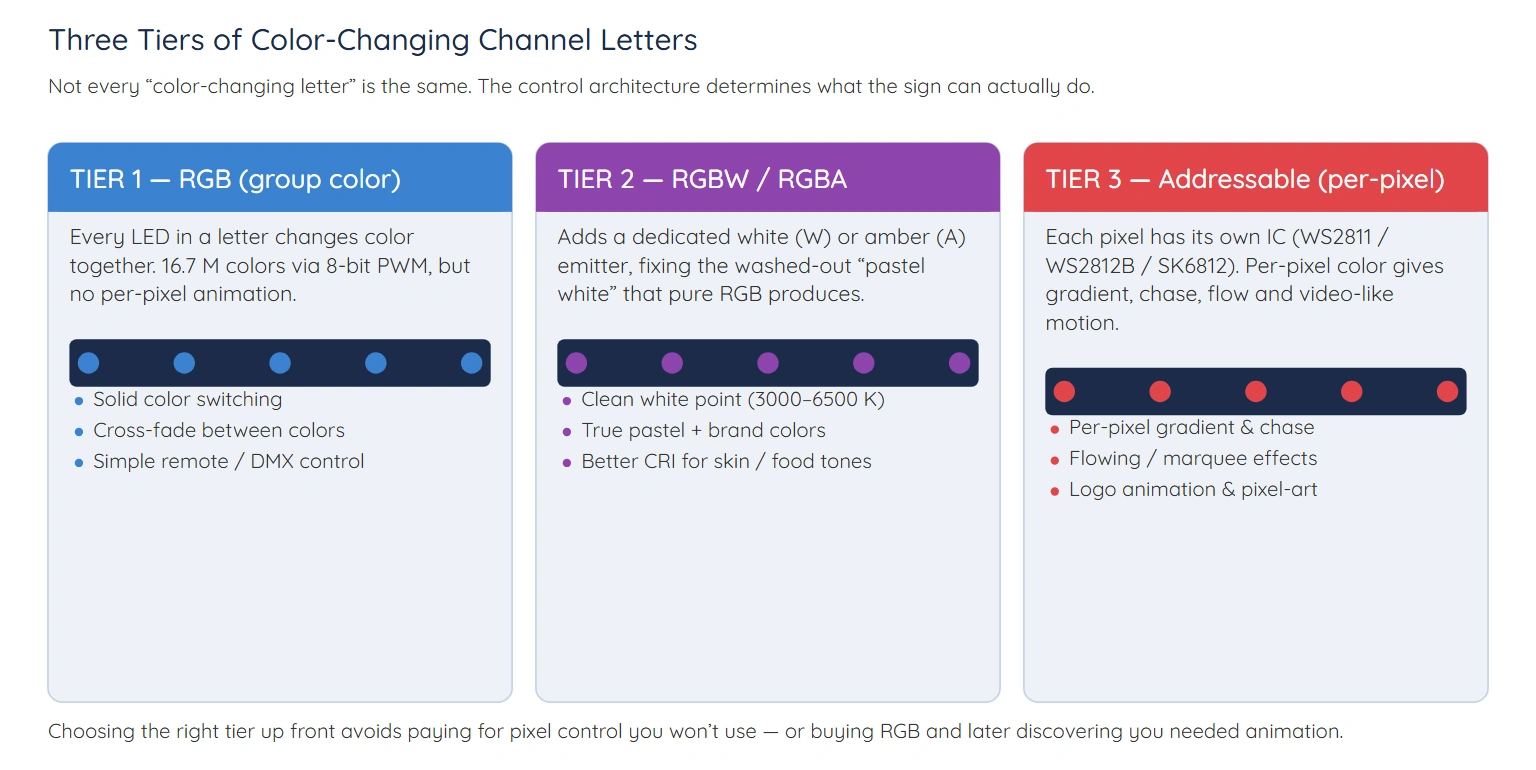
The three control tiers of color-changing channel letters. RGB changes the whole letter together; RGBW adds a true white point; addressable control animates color per pixel.
Close-up of three LED strips — a plain RGB strip, an RGBW strip (with a white chip) and an addressable pixel strip — so buyers can see the IC density difference.
Recommended size: 1600 × 1067 px
Control & Protocol Engineering — DMX512 vs SPI vs Art-Net
The control system decides how the color instruction reaches each LED, and therefore how large and how synchronized a project can be. Two topologies dominate channel-letter work:
- SPI (single-wire / NZR) — addressable strips. The controller sends one data wire (plus a clock line on APA102). Each IC re-times the signal to the next pixel. Low cost and simple for a single letter or logo, but signal is unidirectional and a failed IC in a standard chain can stop everything downstream.
- DMX512 (RS-485 differential) — the sign-industry standard. Balanced pair, 512 channels per universe (ANSI E1.11). Immune to electrical noise over long runs; each RGB letter consumes 3 channels (R+G+B). Scales to full facades through Art-Net / sACN (E1.31) over Ethernet.
- Rule of thumb: SPI for a single sign; DMX512 / Art-Net when many letters or zones must change in sync and remain serviceable over distance.
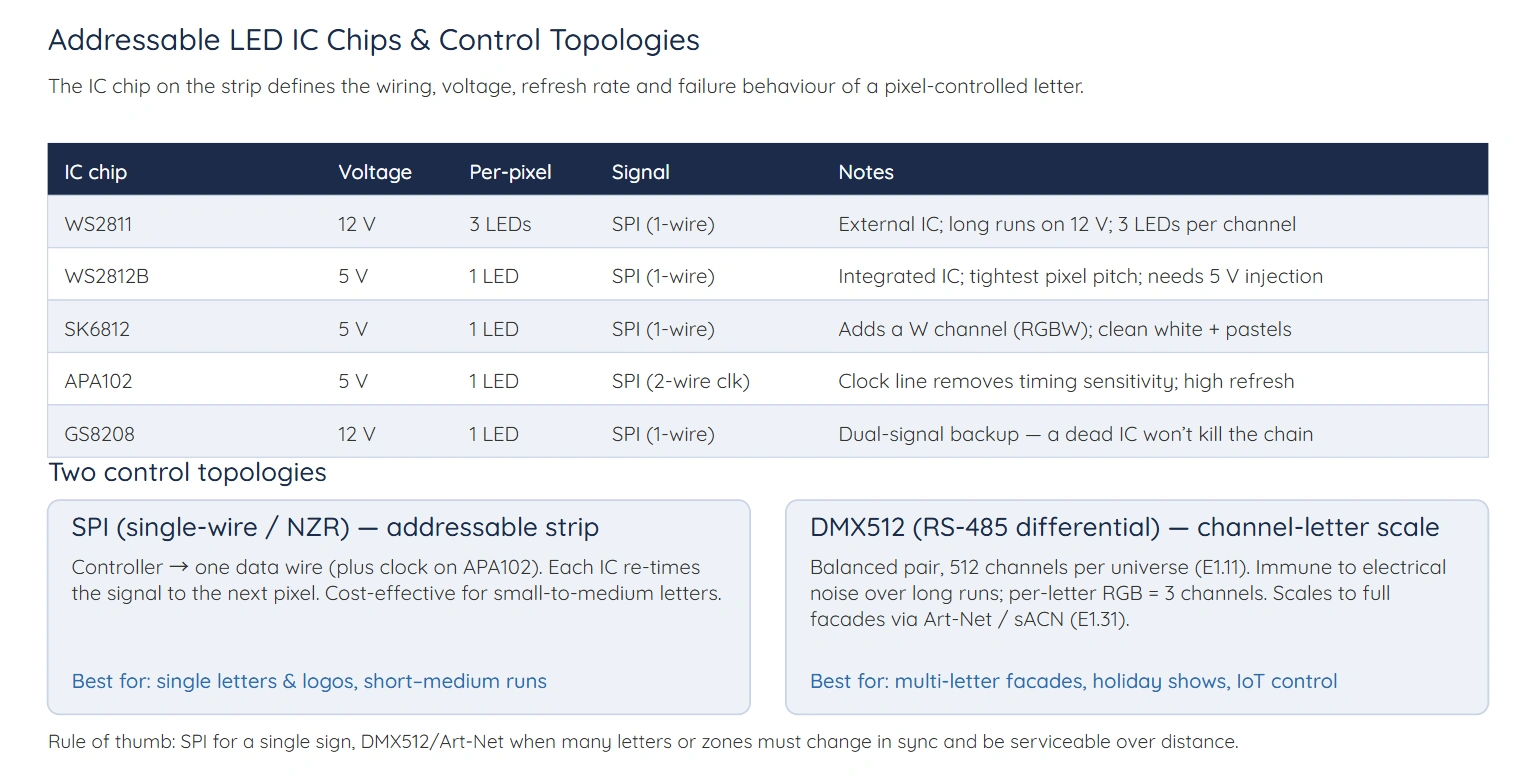
The five addressable IC chips you will actually be offered, plus the two control topologies (SPI vs DMX512) and when to choose each.
LED IC Chip Deep-Dive — WS2811, WS2812B, SK6812, APA102, GS8208
For addressable (per-pixel) letters, the IC chip on the strip defines the operating voltage, pixel pitch, refresh rate and failure behavior. Choosing the right chip up front is the single most important specification decision for an animated letter:
| IC chip | Voltage | Pixels per IC | Signal | Why it matters |
|---|---|---|---|---|
| WS2811 | 12 V | 3 LEDs | SPI (1-wire) | External IC; long runs on 12 V with fewer injection points — the channel-letter workhorse |
| WS2812B | 5 V | 1 LED | SPI (1-wire) | Integrated IC in each LED; tightest pixel pitch for fine gradients; needs frequent 5 V injection |
| SK6812 | 5 V | 1 LED | SPI (1-wire) | Adds a W channel (RGBW) — clean white and accurate pastels from a per-pixel strip |
| APA102 | 5 V | 1 LED | SPI (2-wire, clock) | Separate clock line removes timing sensitivity; highest refresh for smooth fast motion |
| GS8208 | 12 V | 1 LED | SPI (1-wire) | Dual-signal backup — a single dead IC does not kill the rest of the chain (the fix for the classic series-failure mode) |
Optical Engineering — White Point, Diffusion & Uniformity
Three optical choices decide whether the brand color looks right, white looks white, and the face glows evenly — and none of them are visible in a daytime product photo:
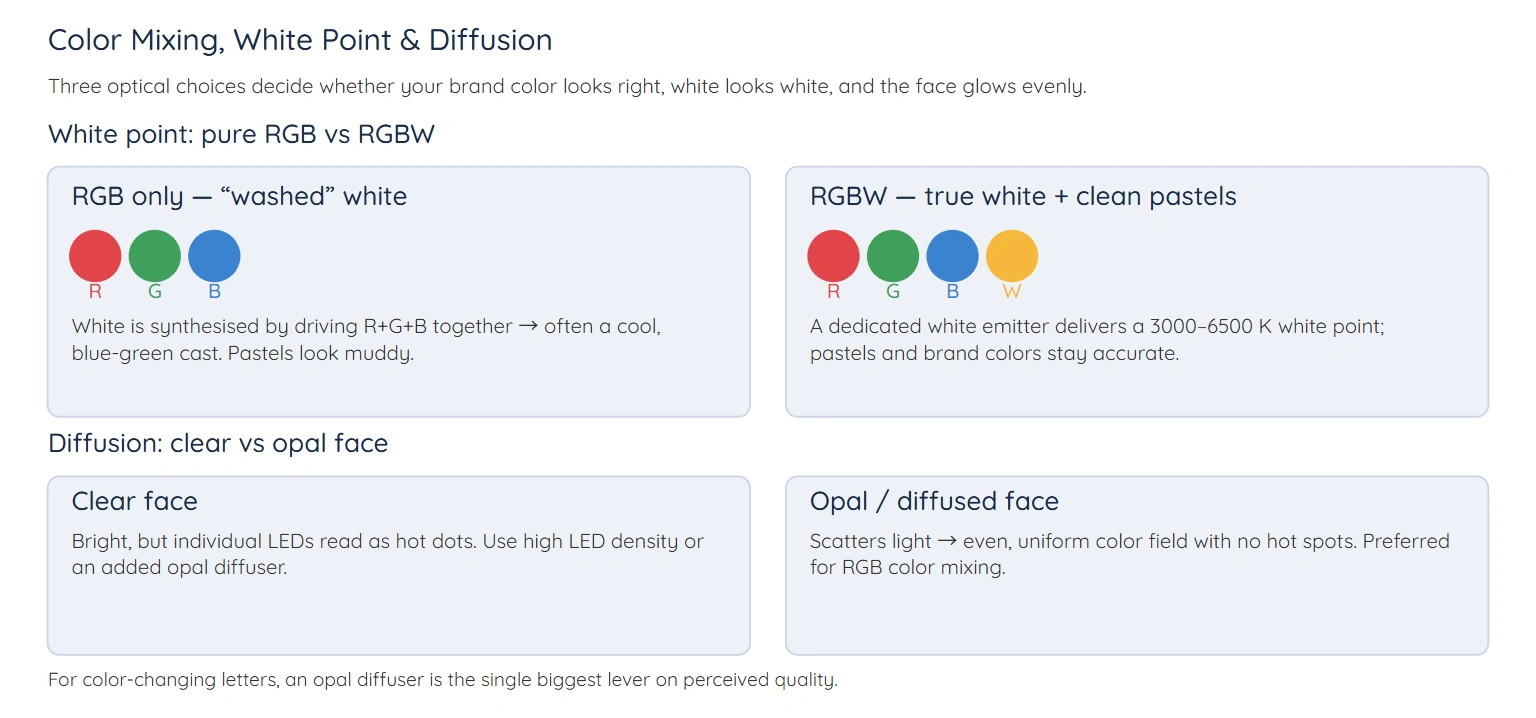
Pure RGB synthesizes a cool, blue-green white; RGBW adds a dedicated white emitter for a 3000–6500 K white point. An opal diffuser is the single biggest lever on perceived quality.
- White point: pure RGB drives all three channels together to “make” white, which usually reads as a cool, blue-green cast. RGBW (a dedicated white LED) fixes this and keeps brand pastels accurate.
- Diffusion: a clear acrylic face shows individual LEDs as hot dots. An opal / diffused face scatters the light into an even color field with no hot spots — preferred for RGB mixing.
- Uniformity: LED module pitch must be sized to the letter depth (typically 50–100 mm) so the face glows evenly without visible banding.
A straight-on night shot of a color-changing letter mid-transition between two colors, showing even face illumination with no hot spots.
Recommended size: 1600 × 1067 px
Construction & Materials — Face, Return, Back & LED
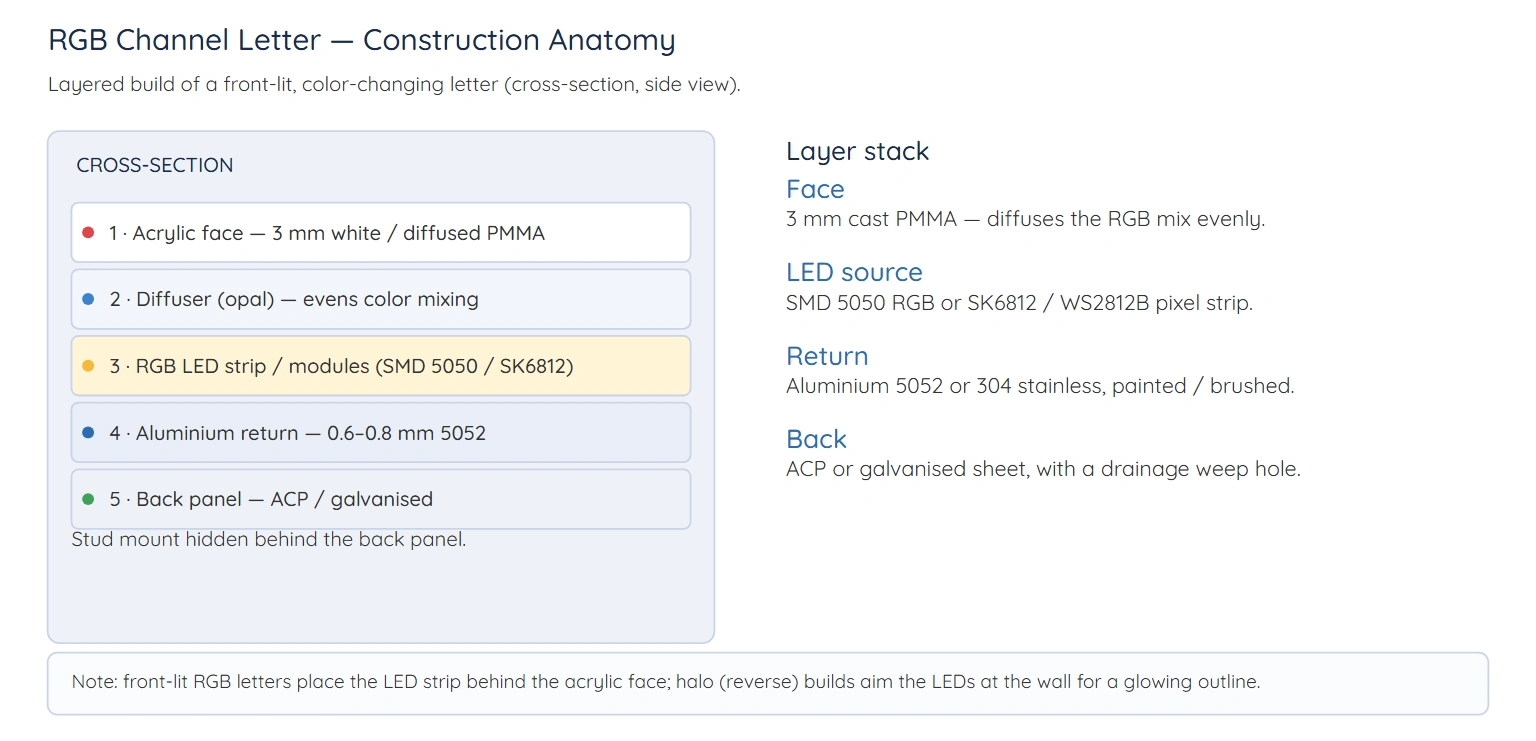
Cross-section of a front-lit color-changing letter: acrylic face, opal diffuser, RGB LED strip, aluminium return and back panel, with a hidden stud mount.
| Component | Specification | Notes |
|---|---|---|
| Face | 3 mm cast acrylic (PMMA), white / opal | Diffuses the RGB mix into a uniform field; cast grade resists UV yellowing (e.g. PLEXIGLAS® LED sign-grade) |
| Return (side wall) | 0.6–0.8 mm 5052 aluminium / 304 stainless / galvanised | Painted, brushed or mirror; trim-cap or trimless edge |
| Back panel | 1/8” ACP / PVC / galvanised sheet | Removable for LED servicing; drainage weep hole at the base |
| LED source | SMD 5050 RGB / SMD 2835 / SK6812 / WS2812B strip | 60–120 LEDs/m on strip, or 50–100 mm module pitch |
| Diffuser | Opal acrylic or PET film | Removes hot spots for even color mixing |
Macro shot of a single letter showing the acrylic face, the aluminium return and the internal LED strip — demonstrates the layered build and finish quality.
Recommended size: 1600 × 1067 px
Technical Specifications & Product Parameters
| Parameter | Specification |
|---|---|
| Face material | 3 mm white / opal cast acrylic (PMMA) |
| Return material | 0.6–0.8 mm 5052 aluminium / 304 stainless / galvanised sheet |
| Back material | ACP / PVC / galvanised sheet (removable) |
| LED type | SMD 5050 RGB, SMD 2835 RGB, SK6812 RGBW, WS2812B / WS2811 / GS8208 addressable |
| LED density | 60 / 120 LEDs per metre (strip); 50–100 mm module pitch |
| Color range | 16.7 million colors (8-bit PWM); RGBW adds a true white channel |
| Control | RF remote / DMX512 / SPI controller / Wi-Fi app / SD card / Art-Net (E1.31) |
| IC chips | WS2811, WS2812B, SK6812, APA102, GS8208 |
| Operating voltage | 5 V / 12 V / 24 V DC; 110–240 V AC input, Class 2 power supply |
| Letter depth | 76–127 mm (3–5”) standard; 60–80 mm custom |
| Letter height | 100–2000 mm (4–72”+) |
| IP rating | IP65 standard; IP66 / IP67 / IP68 on request |
| Working temperature | −40 °C to +60 °C |
| Rated life | ≥ 50,000 hours |
| Warranty | 2 years LED · 5 years acrylic · 3 years power supply |
| Certifications | CE, RoHS, UL 48 (electric signs) / UL 879 (components), ISO 9001 |
Every letter is built to order from your vector artwork (.ai, .eps, .cdr, .svg). A 1:1 drilling template, wiring diagram and (for addressable builds) a controller programming sheet ship with each order.
Controller & Dimming Options (RF / DMX / Wi-Fi / SD / Art-Net)
| Controller | Best for | Limits |
|---|---|---|
| RF remote | A single sign, simple color / mode changes | Short range; no scheduling or networking |
| DMX512 console / decoder | Multi-letter facades, live shows | Needs a DMX source or decoder per universe |
| Wi-Fi / app | Owner-controlled color from a phone | Depends on local network; limited sync across many letters |
| SD card controller | Pre-programmed animations run standalone | Changes require re-authoring the card |
| Art-Net / sACN (E1.31) | Ethernet control of large synchronized installs | Higher setup cost; for flagship / architectural work |
Power & Voltage-Drop Engineering
Addressable LED strips lose voltage along their length; beyond a threshold the far end dims and shifts color — the number-one field failure on long runs. The fix is power injection: feeding power at both ends (or every few metres), while data continues to flow one way.
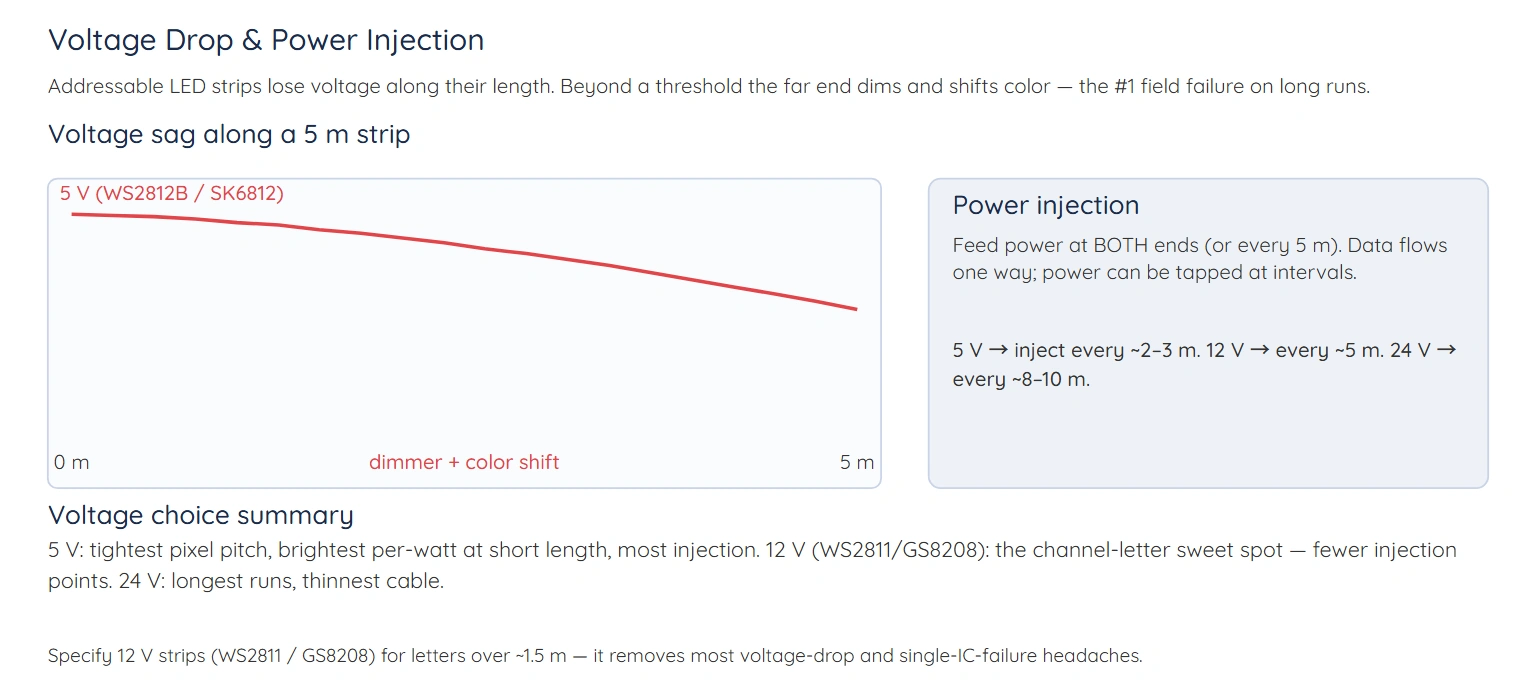
Voltage sag along a 5 V strip versus power injection. Specify 12 V (WS2811 / GS8208) for letters over ~1.5 m to remove most voltage-drop and single-IC-failure headaches.
- 5 V (WS2812B / SK6812): tightest pixel pitch, brightest per watt at short length, but the most injection — roughly every 2–3 m.
- 12 V (WS2811 / GS8208): the channel-letter sweet spot — fewer injection points, longer runs, and GS8208 adds breakpoint-resume.
- 24 V: longest runs and thinnest cable, used for large facade work.
- Power supplies are Class 2, sized with 20–30% headroom (we standardise on Mean Well or equivalent certified drivers).
Waterproofing & Outdoor Ratings (IP65–IP68)
| Rating | Protection | Suitable for |
|---|---|---|
| IP65 | Dust-tight, low-pressure water jets | Standard outdoor storefront letters |
| IP66 | Dust-tight, powerful water jets | Exposed facades, heavy rain regions |
| IP67 | Dust-tight, temporary immersion | Ground-level letters, flood-prone areas |
| IP68 | Continuous immersion (depth/spec agreed) | Special marine / fountain applications |
Ratings follow IEC 60529. Outdoor builds use silicone-sealed or resin-potted LED strips, a sealed back panel and a drainage weep hole at the base so condensation can escape without pooling.
Applications by Industry
- Retail & hospitality — switch brand colors for promotions, seasons and holidays without new hardware
- Bars, clubs & entertainment — chase, gradient and pulse modes that draw foot traffic at night
- Convenience, petrol & smoke shops — high-visibility storefronts that change color by campaign
- Events & exhibitions — addressable letters that run logo animation and pixel-art
- Corporate & flagship facades — DMX512 / Art-Net synchronized multi-letter shows
Wide shot of color-changing letters installed on a bar, club or entertainment venue at night, mid color-transition.
Recommended size: 1600 × 1067 px
Customization Options
- Any font, logo or shape reproduced from vector artwork (.ai / .eps / .cdr / .svg)
- Face, return and back in any RAL / Pantone color; brushed, mirror or painted finishes
- Front-lit, halo (reverse) or dual-lit illumination with RGB / RGBW / addressable LED
- Letter height 100–2000 mm; depth 60–127 mm; stud, rail, pad or threaded-rod mounting
- Controller of choice (RF / DMX512 / Wi-Fi / SD / Art-Net) with your color program pre-loaded and video-proofed
Total Cost of Ownership vs Alternatives
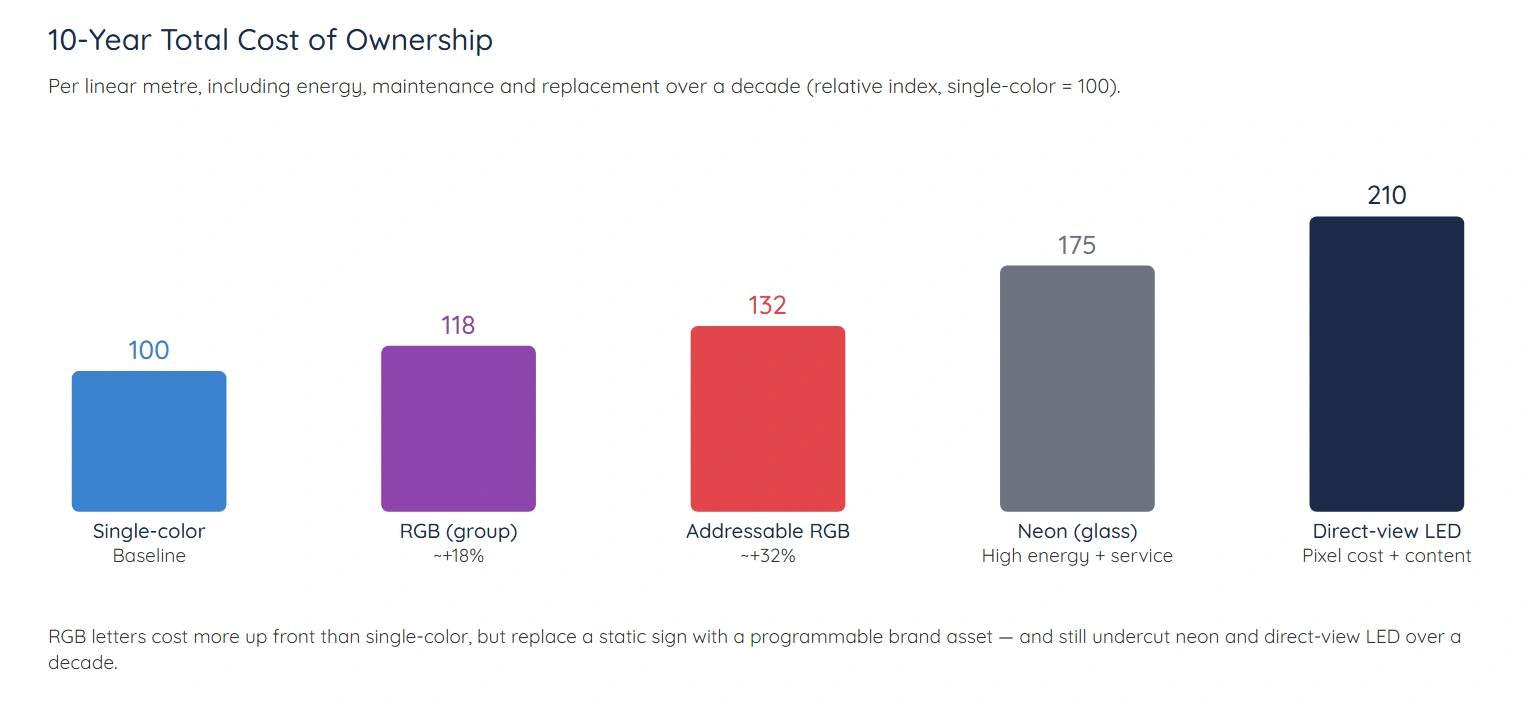
Ten-year total cost of ownership per linear metre. RGB letters cost more up front than single-color but replace a static sign with a programmable brand asset, and still undercut neon and direct-view LED.
| Alternative | 10-yr cost (relative) | Key trade-off |
|---|---|---|
| Single-color channel letter | 100 (baseline) | Lowest cost; fixed color, no animation |
| RGB channel letter | ~118 | Modest premium; full color, group control |
| Addressable RGB (per-pixel) | ~132 | Animation and video-like effects; needs injection planning |
| Neon (glass tube) | ~175 | High energy and frequent servicing |
| Direct-view LED display | ~210 | Per-pixel cost plus a content-management system |
Quality Control & Test Methodology
Every order passes a documented QC sequence before it is packed, so a color-changing letter that leaves the factory does not arrive with a dead pixel, a dim tail or a shifted color:
| Test | Standard / method | What it verifies |
|---|---|---|
| 24-hour burn-in | Continuous on, full color cycle | Early IC / solder failures (infant mortality) |
| Brightness uniformity | Photometric scan, ±10% target | No hot spots or dim tail-end letters |
| Color consistency | MacAdam ellipse binning of LED lots | Uniform color across the whole sign |
| Water ingress | IEC 60529 (IP65/66/67) spray / immersion | Sealed joints and drainage behavior |
| Voltage-drop check | Load test at full brightness | Far-end color/brightness stability |
| Power-supply safety | Class 2, UL-listed driver verification | Electrical safety & overload protection |
Failure Modes & Prevention (What to Watch For)
Color-changing letters fail differently from single-color letters. These are the failure modes we engineer against — and the questions to ask any supplier:
| Failure mode | Root cause | Prevention |
|---|---|---|
| Far end dims / shifts color | Voltage drop over long strip runs | 12 V strips, power injection, load test at full brightness |
| One dead pixel kills the chain | Series IC failure (standard SPI strip) | GS8208 dual-signal backup, or 12 V WS2811 with shorter chains |
| “White” looks blue/green | Pure RGB white point | RGBW (SK6812) or a dedicated white channel |
| Hot dots / banding on the face | Clear face, sparse LED pitch | Opal diffuser + module pitch sized to letter depth |
| Water inside the letter | Poor sealing, no drainage | IP65+ sealing and a weep hole at the base |
| Controller loses the program | No schedule backup, power loss | Controller with non-volatile memory; SD / DMX fallback |
MOQ, Pricing Factors & Lead Time
| Item | Value |
|---|---|
| MOQ | 1 piece (sample) · 10+ pieces (bulk, tiered pricing) |
| Production | 3–7 working days after artwork approval |
| Proof | Free video proof of your color program before shipping |
| Pricing factors | Letter height, depth, LED tier (RGB < RGBW < addressable), finish, controller, IP rating, quantity |
| Shipping | Express (5–7 days), air (~10 days), sea (40–65 days); FOB / CIF / DDP available |
| Payment | T/T, L/C, Trade Assurance |
Pricing is calculated by letter height and depth, then adjusted by LED tier and finish. Addressable (per-pixel) builds carry a small premium over group RGB because of the IC strip and controller — request a like-for-like quote rather than comparing list prices across suppliers.
Production Process
- Design & proof — vector artwork converted to a cut file; dimensioned drawing and color program confirmed
- Cut & fabricate — aluminium / stainless return laser-cut and bent; acrylic face router-cut to the letter outline
- Finish — paint / brush / mirror the return; polish the acrylic face
- LED assembly — RGB / RGBW / addressable strip installed to the engineered pitch; power injection planned
- Wire & program — power supplies, controller and driver wired; color program loaded and tested
- QC & burn-in — 24-hour full-color burn-in, uniformity, waterproof and voltage-drop checks
- Pack & ship — foam + bubble wrap, wooden crate, 1:1 drilling template and wiring diagram included
Shot of a technician assembling the RGB LED strip inside a letter return, showing the module pitch and power-injection wiring.
Recommended size: 1600 × 1067 px
Supplier Evaluation Checklist (Procurement)
Use this 16-point checklist when comparing RGB channel letter suppliers — most of it cannot be read off a spec sheet and must be asked for directly:
- Which IC chips do you use for addressable builds (WS2811 / WS2812B / SK6812 / GS8208) and at what voltage?
- Do you offer RGBW / dedicated-white for an accurate white point, and can you match a specific Kelvin?
- What is your LED module pitch for a given letter depth, and do you document it?
- Do you support DMX512 and Art-Net (E1.31), or only SPI / RF?
- How do you handle voltage drop and power injection on long letters?
- Can you supply GS8208 dual-signal backup for critical signs?
- What diffuser do you use to prevent hot spots, and can you show a lit uniformity test?
- What IP rating do you certify to (IEC 60529), and where is the weep hole?
- Do you run a 24-hour full-color burn-in before shipping, and can you provide the report?
- What UL / CE / RoHS certifications do the LED modules and power supplies carry?
- Will you send a video proof of my exact color program before shipping?
- What is the warranty split (LED vs acrylic vs power supply)?
- What are your MOQ and lead time for a sample versus a bulk order?
- Do you provide a 1:1 drilling template and wiring diagram with the order?
- How are letters packed (foam, crate) to survive sea freight?
- Can you handle DDP shipping and after-sales support for dead modules?
Market Intelligence — Why Color-Changing Signs Are Growing
The global signage market was valued at USD 37.8 billion in 2025 and is projected to reach USD 60.06 billion by 2036, growing at a 4.3% CAGR — with LED technology already accounting for about 60% of the technology segment (Future Market Insights).
The LED display segment — of which RGB / color-changing illumination is a part — was worth USD 19.28 billion in 2025 and is forecast to reach USD 32.23 billion by 2034, a 5.88% CAGR, with RGB LED tracked as an explicit type segment (The Insight Partners).
Separately, the broader digital signage market is forecast to reach USD 58.42 billion by 2033 at an 8.2% CAGR (Grand View Research). The commercial takeaway for buyers: color-changing capability is no longer a novelty — it is becoming table stakes for retail and hospitality storefronts, and the sign resellers who can engineer it properly (not just sell it) will capture the margin.
Frequently Asked Questions
What is the difference between RGB, RGBW and addressable RGB channel letters?
RGB letters change the whole letter’s color together and reproduce 16.7 million colors via 8-bit PWM, but their synthesized white has a cool, blue-green cast and there is no per-pixel animation. RGBW adds a dedicated white LED, giving a true 3000–6500 K white point and accurate pastels. Addressable (per-pixel) letters put an IC chip on every pixel (WS2811 / WS2812B / SK6812 / GS8208) so color can animate across the face in gradients, chase and flow.
Can I set my RGB channel letters to just one color?
Yes. Most clients run one to three brand colors in rotation rather than a constant light show. You are never obligated to animate — a single solid color (or a slow cross-fade) is a common, refined choice, and you can change it any time via the controller.
Which controller should I choose — RF, DMX512, Wi-Fi or Art-Net?
For a single sign, an RF remote or Wi-Fi app is simplest. For multiple letters that must change in sync, or for live shows, use DMX512 (512 channels per universe, ANSI E1.11) or Art-Net / sACN over Ethernet. We supply the controller pre-programmed with your color sequence and a video proof before shipping.
How do you prevent the far end of a long letter from dimming or shifting color?
Voltage drop is the number-one field failure on addressable strips. We specify 12 V strips (WS2811 / GS8208) for letters over about 1.5 m, inject power at both ends or every few metres, and run a load test at full brightness so the far end matches the near end.
Are RGB channel letters waterproof for outdoor use?
Yes. We seal to IP65 as standard (dust-tight and protected against low-pressure water jets), with IP66 / IP67 / IP68 on request, following IEC 60529. Outdoor builds use sealed or resin-potted LED strips and a drainage weep hole at the base so condensation escapes without pooling.
What is the minimum order quantity and lead time?
The minimum order is 1 piece (samples), with bulk orders of 10+ pieces at tiered pricing. Production is 3–7 working days after artwork approval, and we provide a free dimensioned engineering drawing and written quote within 24 hours. Shipping is express (5–7 days), air (~10 days) or sea (40–65 days), with DDP available.
Can you match my exact brand font, logo and brand colors?
Yes. We reproduce any vector logo or typeface (.ai, .eps, .cdr, .svg) and match face, return and back colors to exact RAL / Pantone references. For the white point, an RGBW build lets us hold a specific Kelvin so your brand reads correctly at night.
What certifications and quality checks do your letters carry?
LED modules and power supplies are CE, RoHS and UL 48 / UL 879 certified; the factory runs an ISO 9001:2015 quality system. Every order passes a 24-hour full-color burn-in, brightness-uniformity, color-consistency, waterproof and voltage-drop check before packing.
Key Takeaways
- RGB ≠ addressable. Confirm which tier you need — group RGB, RGBW, or per-pixel addressable — before comparing prices.
- The IC chip and voltage decide reliability. 12 V WS2811 / GS8208 is the channel-letter workhorse; GS8208’s dual-signal backup prevents a single dead IC from killing the chain.
- White point and diffusion are invisible on a spec sheet. RGBW for accurate white, an opal diffuser to remove hot spots.
- Plan power injection for long letters — it is the number-one field failure and the easiest to engineer out.
- Color-changing signage is a growth segment (signage market to USD 60.06 B by 2036; RGB LED displays growing at 5.88% CAGR) — engineering it properly is the differentiator.
Get a Free Engineering Drawing & Quote
Tell us your artwork, letter height, LED tier (RGB / RGBW / addressable) and controller preference — we will return a dimensioned drawing, a color-program video proof and a written quote within 24 hours. MOQ is 1 piece, production is 3–7 working days, and we ship worldwide by express, air or sea.