
Advertising Light Boxes & Signs
— LED Illuminated & Ultra-Thin
Ultra-thin edge-lit and high-brightness back-lit advertising light boxes, fabricated to order with aluminum extrusion frames, optical PMMA light guide panels and 50,000-hour LEDs. A factory-level engineering reference for sign resellers, architects, procurement teams, distributors and chain brands — with material, lighting, IP, MOQ and QC specifications you can place an order against.
Edge-lit 8–50 mm · back-lit 80–150 mm · IP65–IP67 outdoor · CE / RoHS / UL · MOQ 1 pc
What Is an Advertising Light Box?
An advertising light box is an internally illuminated sign cabinet: a translucent graphic face mounted in a frame, backlit by an LED system so the artwork glows evenly day and night. It is the workhorse of commercial signage — used for storefront identification, menu boards, retail window displays, mall wayfinding, transit advertising and trade-show backdrops. Unlike channel letters (which light only the letterform) or digital screens (which need power and content management), a light box lights an entire graphic panel uniformly, so it communicates a full logo, product image or menu at a fraction of a digital screen’s cost.
This page is a factory-level engineering reference written for sign resellers, architects and project specifiers, procurement teams, distributors and chain-brand managers. It covers the construction, the edge-lit vs back-lit lighting decision, LED and light-guide-panel engineering, IP and regulatory compliance, failure modes, QC methodology, total cost of ownership and market data — the specifications you need to place an order against, not a retail sales pitch.
What you can expect from this factory
- ISO 9001:2015 quality system with in-line and pre-shipment inspection at every stage
- CE, RoHS and UL compliance options; IP65–IP67 outdoor builds
- 50,000-hour LED sources (L70) with uniform, hot-spot-free illumination
- MOQ from 1 piece and custom sizes, shapes, finishes and graphics
- Edge-lit and back-lit engineering plus SEG fabric and flex-face systems
- 7–15 day sample and production lead times with export packaging
Construction & Anatomy — Five Layers That Determine Quality
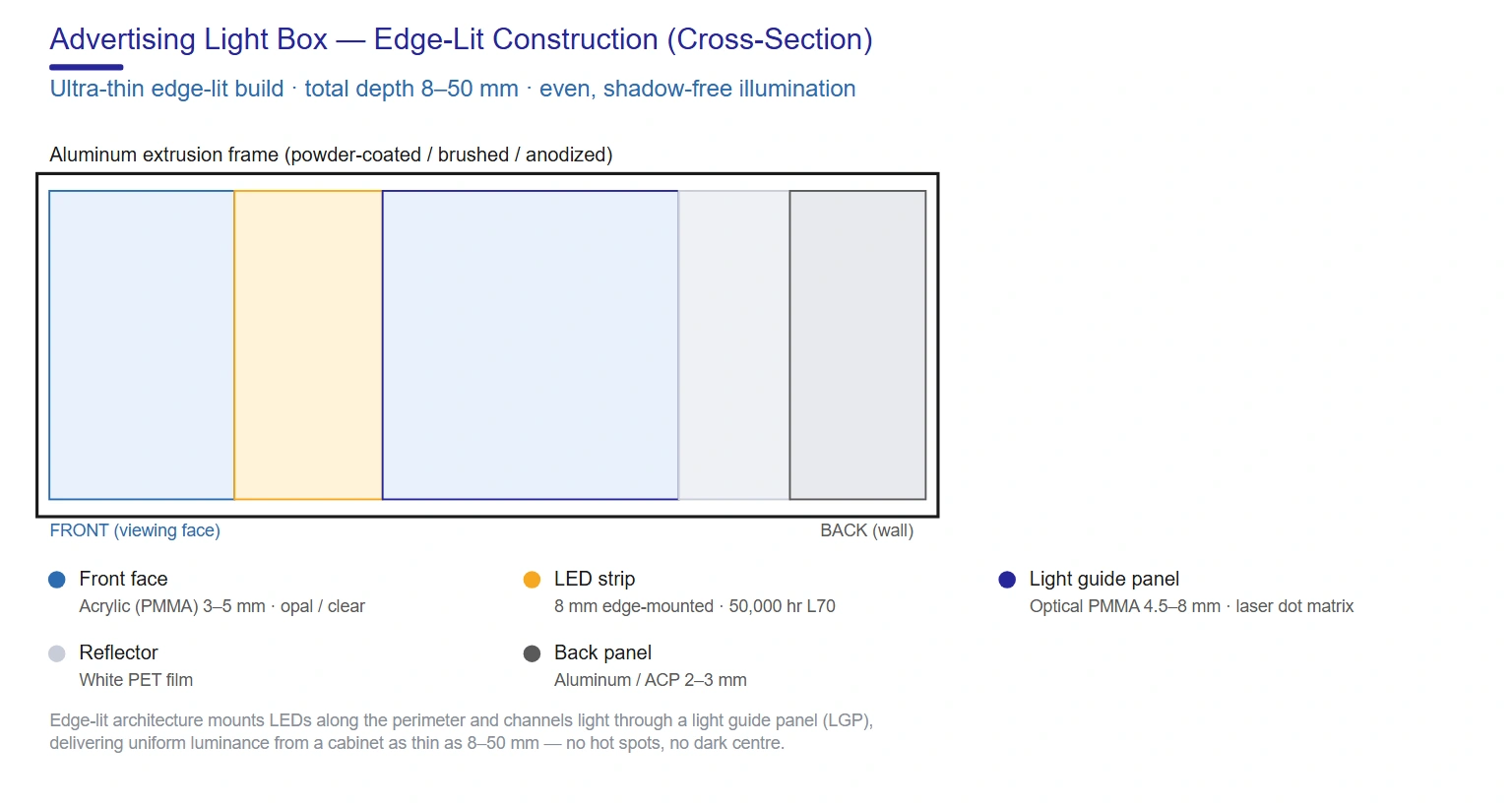
Every light box is a stack of layers. Cheap boxes cut corners on the light guide panel and the diffuser — the two layers that decide whether your graphic glows evenly or shows bright bands and dark patches. Understanding the stack is how a buyer separates a sign that lasts a decade from one that fails in a season.
| Layer | Material options | Function | Typical spec |
|---|---|---|---|
| Front face / graphic | Acrylic (PMMA), flex-face vinyl, SEG fabric, polycarbonate | Carries the printed graphic and controls light transmission | 3–5 mm acrylic; backlit film or UV print |
| LED source | SMD 2835 / 3030 modules or edge strips | Provides the light | 8 mm strip or 1–3 W modules; 50,000 hr L70 |
| Light guide panel (edge-lit) / diffuser (back-lit) | Optical PMMA with laser dot matrix, or opal / micro-prismatic diffuser | Spreads light evenly, eliminates hot spots | PMMA 4.5–8 mm; diffuser with 1–2× mixing distance |
| Reflector | White PET film or reflective coating | Recovers rear light and boosts efficiency | >95% reflectance |
| Back panel & frame | Aluminum extrusion, ACP, galvanized steel | Structure, heat sinking, weather sealing | Powder-coated / brushed / anodized aluminum |
Lighting Technology — Edge-Lit (LGP) vs Back-Lit (Direct)
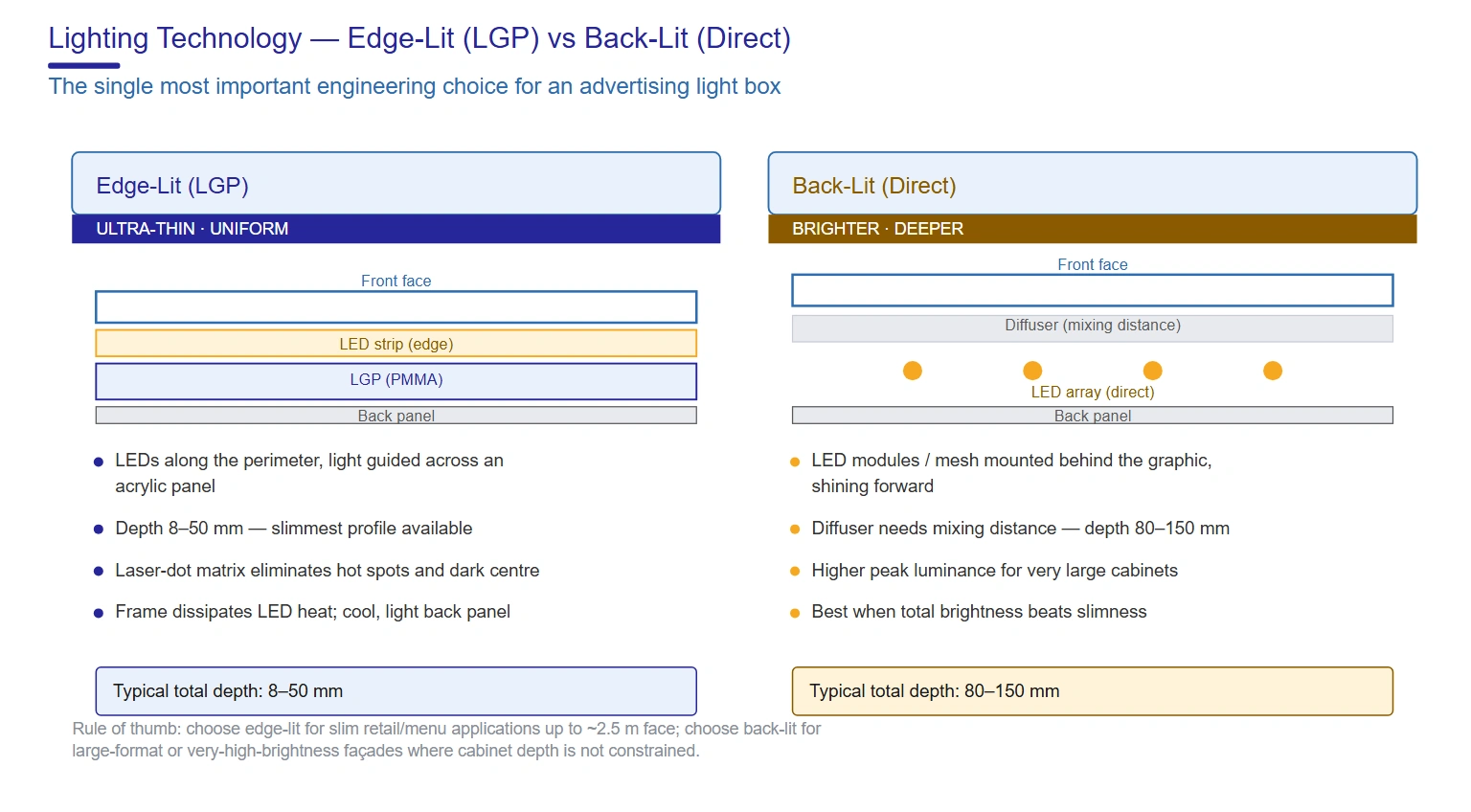
This is the single most important engineering decision for an advertising light box, and it is decided by one variable: cabinet depth vs brightness. Edge-lit boxes mount LEDs along the perimeter and channel the light through a light guide panel (LGP), giving a slim 8–50 mm profile and perfectly even light. Back-lit boxes mount the LED array directly behind the graphic and rely on a diffuser with a mixing distance, giving more raw brightness but a deeper 80–150 mm cabinet.
| Attribute | Edge-Lit (LGP) | Back-Lit (Direct) |
|---|---|---|
| Total depth | 8–50 mm | 80–150 mm |
| Uniformity | Excellent — laser dot matrix | Good — depends on diffuser & pitch |
| Peak brightness | Medium (500–1,500 cd/m²) | High (1,000–3,000+ cd/m²) |
| Best for | Slim retail, menus, interiors, faces ≤2.5 m | Large façades, high-brightness outdoor |
| Heat | Dissipated via frame; cool back | More heat; needs thermal management |
| Cost | Higher (LGP adds cost) | Lower per lumen |
Rule of thumb: choose edge-lit for slim, elegant retail and menu applications up to roughly 2.5 m face; choose back-lit for very large or high-brightness façades where cabinet depth is not constrained. Both are available from this factory, and we will recommend the right build for your site.
Light Guide Panel (LGP) Engineering
In an edge-lit light box, the LGP is the component that makes uniform light possible. Light enters the panel only at the edge, so intensity is naturally highest next to the LED strip and falls off toward the centre. The panel counteracts this with a laser-engraved micro-dot matrix: dot size, depth and spacing are programmed to increase with distance from the LED, scattering progressively more light outward until the whole face reads at a uniform luminance.
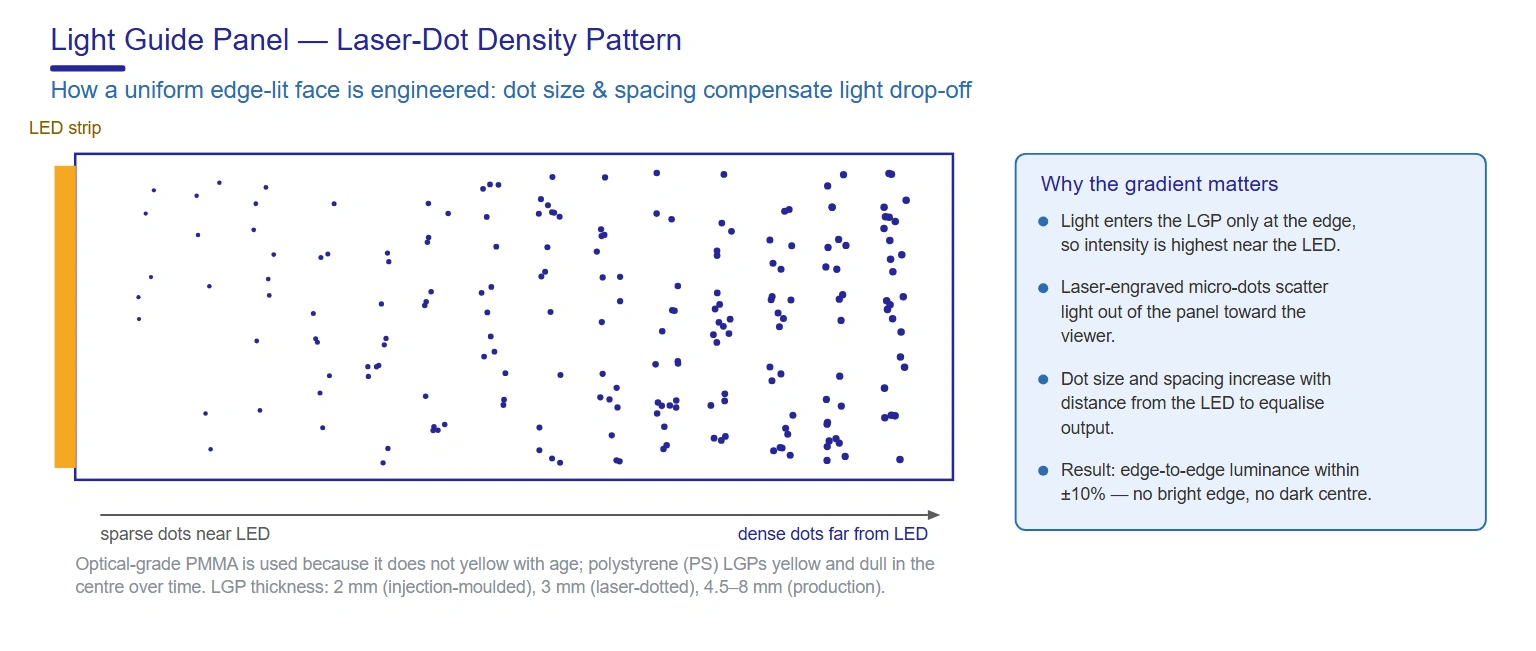
- Optical-grade PMMA is used because it transmits light efficiently and does not yellow with age — polystyrene (PS) LGPs yellow and turn dull in the centre over time
- LGP thickness: 2 mm (injection-moulded), 3 mm (laser-dotted), 4.5–8 mm (production panels for longer light travel)
- Uniformity target: edge-to-edge luminance within ±10% — no bright edge, no dark centre
- Colour options: 2700 K / 4000 K / 5000 K / 6500 K white, tunable CCT, or RGB / RGBW for dynamic brand colour
Face & Graphic Material Options
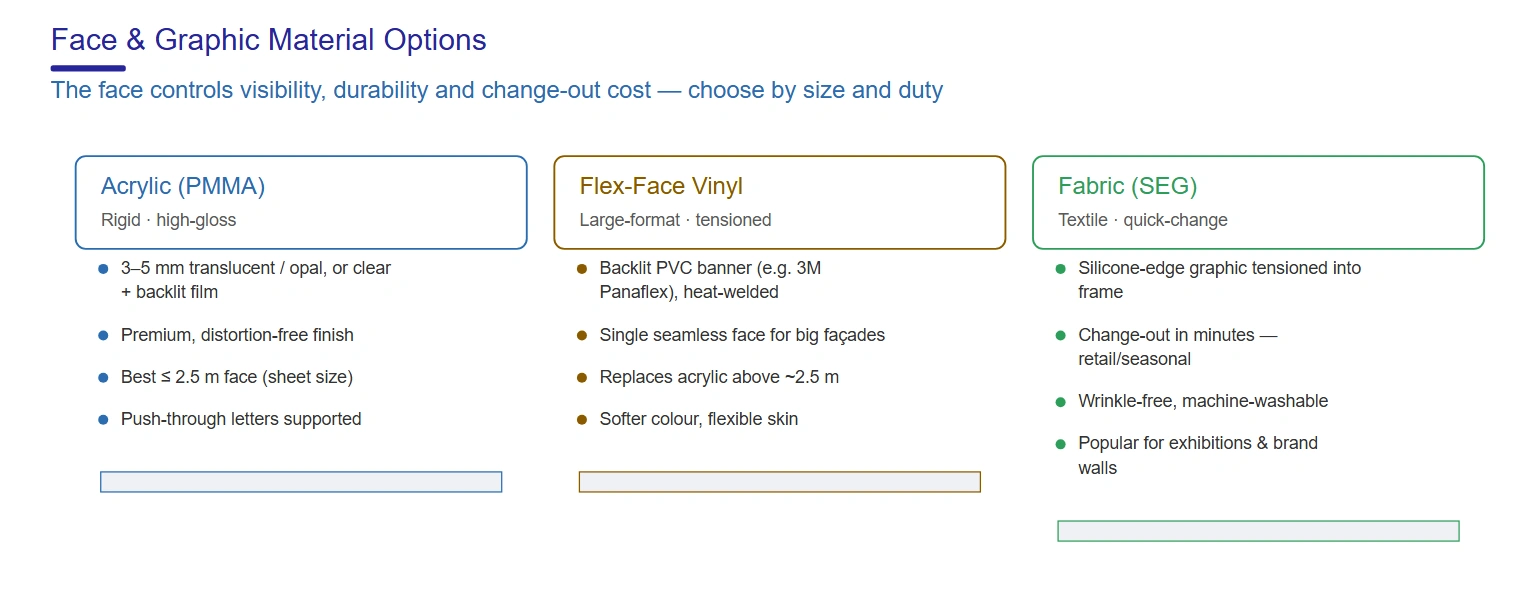
The face controls visibility, durability and the cost of changing your graphic later. Three families cover almost every job — choose by face size and how often the artwork will change.
| Material | Thickness | Best for | Key advantage | Notes |
|---|---|---|---|---|
| Acrylic (PMMA) | 3–5 mm | Faces ≤2.5 m, premium retail | High-gloss, distortion-free, push-through letters | Opal / clear + backlit film or UV print |
| Flex-face vinyl | — (tensioned) | Large façades >2.5 m | Single seamless face, light weight | Heat-welded backlit PVC (e.g. 3M Panaflex) |
| Fabric (SEG) | Silicone-edge textile | Retail, exhibitions, brand walls | Change-out in minutes | Tensioned, wrinkle-free, washable |
| Polycarbonate | 3–4 mm | Impact-prone / public areas | Near-unbreakable | Trade-off: softer surface finish |
Light Box Configurations & Types
Six core builds cover most commercial and public environments. They are combinable — for example, a double-sided outdoor box for a projecting street sign, or an ultra-thin curved box for a pillar. Tell us where it goes and we will specify the right build.
| Type | Description | Mounting | Best for |
|---|---|---|---|
| Single-sided | Lit on one face, flush against a wall | Wall | Storefronts, shops, offices |
| Double-sided | Lit on both faces | Hanging / projecting | Windows, street-facing signs, wayfinding |
| Ultra-thin | Edge-lit, 8–50 mm deep | Wall / flush | Modern retail, menus, reception |
| Outdoor (IP65) | Sealed weatherproof frame | Wall / pole | Façades, petrol stations, transit |
| Curved | Curved acrylic face | Wall / pillar | Pillars, corners, architectural fronts |
| Freestanding / ceiling | Floor-standing or suspended | Floor / ceiling | Exhibitions, events, portable promotion |
LED, Brightness & Color Engineering
Brightness and colour are the two ways a light box either elevates a brand or looks cheap. The engineering targets below are what we specify and verify on every build.
| Parameter | Specification |
|---|---|
| LED type | SMD 2835 / 3030 modules or edge strips, high CRI |
| Colour temperature | 2700 K – 6500 K white; tunable CCT; RGB / RGBW |
| Colour rendering (CRI) | ≥80 standard, ≥90 optional for food & cosmetics |
| Luminance | 500–1,500 cd/m² (edge-lit), 1,000–3,000+ cd/m² (back-lit) |
| Lifespan | 50,000 hr (L70) on branded drivers |
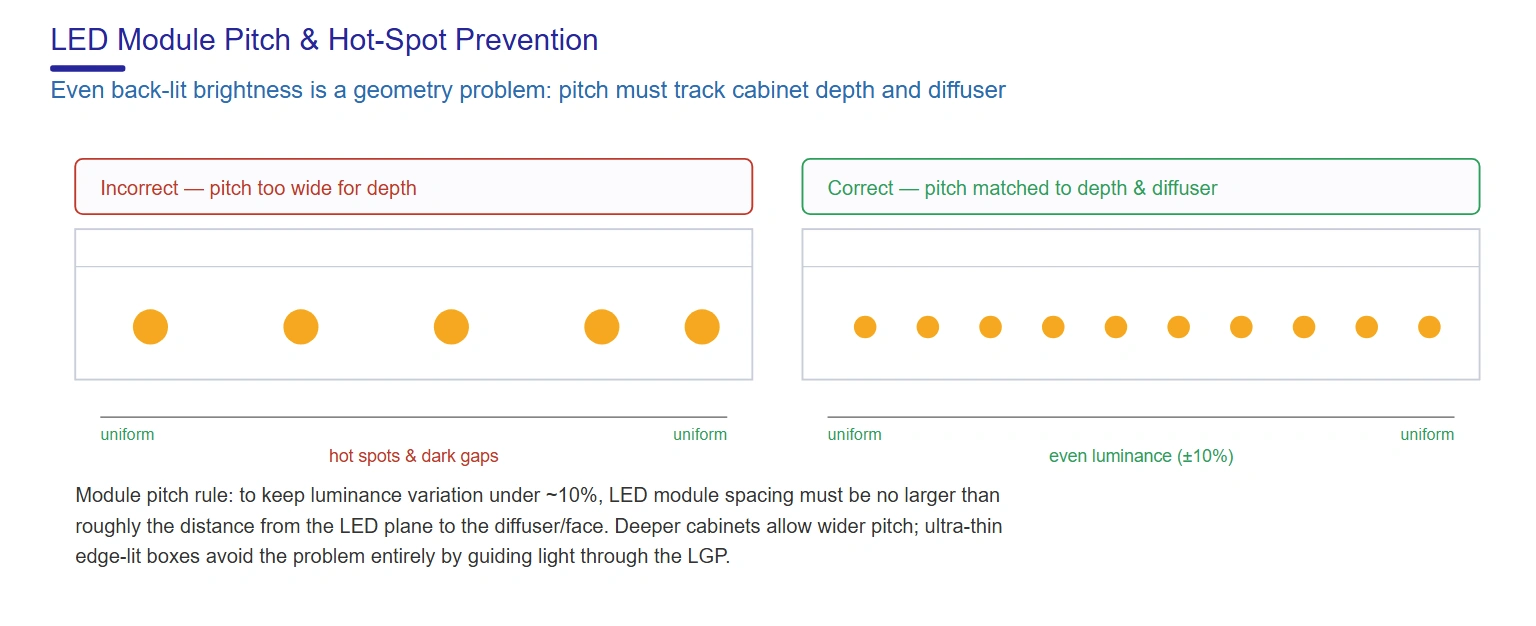
| Module pitch | Set by cabinet depth & diffuser to keep variation ≤10% |
| Power | 12 V / 24 V DC; 100–240 V AC input; ~20–50 W/m² |
| Driver | Class-2 / SELV, UL-listed options; dimming optional |
Product Specifications (Ordering Reference)
The master specification table. Confirm these values in your inquiry so we can quote accurately the first time.
| Parameter | Specification |
|---|---|
| Face material | Acrylic (PMMA) 3–5 mm / flex-face vinyl / SEG fabric / polycarbonate |
| Frame | Aluminum extrusion (powder-coated / brushed / anodized); stainless or galvanized steel for outdoor |
| Lighting | Edge-lit LGP (PMMA) or back-lit LED modules |
| Depth | 8–50 mm (edge-lit) / 80–150 mm (back-lit) |
| Brightness | 500–3,000 cd/m² |
| Color temperature | 2700 K – 6500 K, CCT tunable, RGB / RGBW |
| CRI | ≥80 (optional ≥90) |
| LED lifespan | 50,000 hr (L70) |
| Power | 12 V / 24 V DC, 100–240 V AC; 20–50 W/m² |
| Ingress protection | IP20 (indoor) / IP65–IP67 (outdoor) |
| Mounting | Wall, hanging, freestanding, ceiling, projecting (blade) |
| Size | Custom; large format in transport modules |
| Certifications | CE, RoHS, UL 48 / UL 879 (optional), ETL |
Regulatory & Compliance Matrix
For commercial projects, the relevant standard is usually specified by the landlord, the local authority, or the client’s insurer. We build to the standard you require and supply the documentation.
| Standard | Scope | Relevance to light boxes |
|---|---|---|
| UL 48 | Electric signs (North America) | Full sign listing for US / Canadian installs |
| UL 879 | Electric sign components | Listed components (LED modules, power supplies) inside the sign |
| CE (LVD + EMC) | EU electrical safety & EMC | Required for the European market |
| RoHS | Restriction of hazardous substances | Lead-free solder, compliant materials |
| IP65 / IP67 | Ingress protection (IEC 60529) | Dust-tight + water-jet / immersion for outdoor |
| ISO 9001:2015 | Quality management | Process control from cutting to final inspection |
Thermal Management & Longevity
LED lifespan is quoted as L70 — the hours until the light output falls to 70% of its initial value. Reaching 50,000 hours is mostly a thermal problem: heat shortens LED life and shifts colour temperature. Edge-lit boxes have an inherent advantage because the LED heat dissipates through the aluminum frame, keeping the back panel cool and light. Back-lit boxes need correct spacing, a metal back panel as a heat sink, and driver de-rating for continuous outdoor operation. We specify the LED count, driver load and venting (on outdoor boxes) so the sign holds its brightness and colour for years, not months.
Failure Modes & Prevention
This is the table most suppliers cannot give you — what actually goes wrong in the field, why, and how we prevent it. It is the difference between a sign that is installed and forgotten and one that triggers call-backs.
| Failure mode | Root cause | Detection | Prevention |
|---|---|---|---|
| Hot spots / dark patches | LED pitch too wide for depth, or poor LGP | Visual check at low brightness | Pitch calculated from depth; laser-dot LGP; ±10% uniformity spec |
| Yellowing / dull centre | PS light guide panel, or low-grade acrylic | Colour shift after 1–2 years | Optical PMMA LGP; UV-stable acrylic |
| Water ingress / fogging | Failed gasket or unsealed seam | Condensation inside face | IP65–IP67 seal, weep holes, silicone gasket, drainage |
| LED flicker / early death | Cheap driver, over-driven LEDs, poor soldering | Flicker, dead segments | UL-listed drivers, correct load, in-house aging test |
| Colour mismatch between boxes | Mixed LED bins / batches | Side-by-side colour difference | Single-bin LEDs; BIN uniformity control; batch matching |
| Graphic delamination / fading | Poor print lamination, no UV protection | Peeling, faded print after ~1 year | UV-cured inks, lamination, backlit-grade media |
| Frame corrosion | Untreated mild steel in coastal/salt air | Rust at joints | Aluminum / stainless, powder coat, anodizing |
Quality Control & Test Methodology
Every order passes the checks below before packing. We can share our in-house QC record format on request.
| Test | Standard / method | What it verifies | Acceptance spec |
|---|---|---|---|
| Brightness uniformity | Luminance mapping across the face | No hot spots / dark areas | ±10% variation |
| Ingress protection | IEC 60529 (IP65 / IP67) | Water & dust resistance | Pass rated IP level |
| LED aging / burn-in | 24–48 hr powered soak | Early-failure screening | No dead / flickering LEDs |
| Lumen maintenance | L70 rating of LED source | Long-term brightness | 50,000 hr L70 |
| Electrical safety | Hi-pot / ground continuity | Insulation & grounding | Pass per UL / IEC |
| Colour consistency | Bin matching & CCT check | Batch-to-batch match | Single bin, ≤3-step MacAdam |
| Adhesion | Cross-hatch / tape test | Powder coat & print adhesion | Pass ASTM D3359 |
| Drop / transit | ISTA 1A packing test | Survives shipping | No damage on arrival |
Total Cost of Ownership (TCO)
A light box is bought once and runs for a decade. The purchase price is only part of the story — the table below compares a decade of ownership across lighting technologies.
| Cost factor | LED light box | Fluorescent light box | Digital display |
|---|---|---|---|
| Initial cost (per m²) | Moderate | Low (obsolete) | High |
| Energy use | Low (20–50 W/m²) | Higher | Moderate–high |
| Lamp / module life | 50,000 hr | 8,000–10,000 hr | 5–7 yr panel |
| Maintenance | Minimal | Frequent relamping | Component service |
| Graphic change | Cheap & fast (face swap) | Cheap | Content update only |
| 10-year TCO | Lowest | High (labour + relamping) | Highest |
The practical conclusion for procurement: an LED light box with a changeable graphic face is almost always the lowest total cost of ownership for static brand and menu signage, which is why LED light boxes hold the largest share of the category (42.3% in 2025 — see market data below).
Applications by Industry
Advertising light boxes appear wherever a brand needs a large, evenly-lit graphic that is visible at night. Common deployments include:
- Retail & shopping malls — storefront identification, window promotions, directory signage
- Hospitality & restaurants — menu boards, bar & café branding, QSR drive-thru panels
- Transportation — airports, metro, railway and bus-station advertising and wayfinding
- Corporate & brand walls — reception backdrops, office brand walls, showrooms
- Exhibitions & trade shows — portable, freestanding and SEG fabric backdrops
- Healthcare & public — pharmacy, clinic and municipal information displays
- Petrol stations & drive-thru — outdoor double-sided price and brand panels
Customization Options
- Size & shape — any rectangle, square, circle, or CNC-cut logo silhouette
- Frame finish — powder coat (any RAL), brushed, anodized, silver / black / white
- Face & graphic — acrylic, flex-face, SEG fabric; UV print or translucent vinyl
- Lighting — edge-lit or back-lit; white, tunable CCT, RGB or RGBW
- Colour temperature & CRI — 2700 K–6500 K, CRI 80 or 90
- Mounting — wall, hanging, freestanding, ceiling, projecting blade
- Accessories — dimming, motion sensor, hidden cable management, tamper-proof fixings
MOQ, Pricing Factors & Lead Time
We accept orders from a single sample up to chain-rollout volumes. Pricing is driven by a small number of transparent factors, so you can sanity-check any quote you receive.
| Factor | How it affects price & lead time |
|---|---|
| Size & area | Larger lit area = more LED, LGP and material |
| Lighting type | Edge-lit LGP adds cost vs back-lit; RGBW adds controllers |
| Face material | Flex-face and SEG cost more than standard acrylic |
| IP rating | IP65–IP67 sealing and stainless hardware add cost |
| Quantity | MOQ 1 pc; unit cost drops sharply at 50 / 100 / 500 pcs |
| Certification | UL listing adds documentation and component cost |
| Lead time | Samples 7–10 days; production 10–15 days after approval |
Production Process
- Design confirmation — we convert your artwork into production drawings and confirm every dimension, finish and lighting spec
- Frame fabrication — aluminum extrusion cut, mitered and assembled; welded steel frames for large outdoor boxes
- Light guide / diffuser — PMMA LGP laser-dotted or cut; diffuser cut to size
- LED assembly — modules or edge strips mounted, wired, and load-tested
- Face & graphic — acrylic cut and printed, or SEG fabric printed and silicone-edged
- Assembly & sealing — layers assembled, gasket and seal applied for the rated IP level
- QC & burn-in — 24–48 hr powered soak, uniformity and safety checks
- Packing & shipping — ISTA-tested export packing, FOB or door-to-door
Supplier Evaluation Checklist (16 Points)
Use this checklist when comparing advertising light box suppliers. A factory that cannot answer all sixteen is a risk to your project.
- Does the supplier offer both edge-lit and back-lit, and explain the trade-off?
- Is the LGP optical PMMA (not PS), and is it laser-dotted in-house?
- What LED brand and driver does the supplier use, and what is the rated L70?
- Can the supplier quote a luminance uniformity figure (±10% or better)?
- Is the frame powder-coated / anodized aluminum (not bare mild steel)?
- What IP rating is standard, and how is the seal tested (not just claimed)?
- Are the relevant certifications (CE, RoHS, UL 48 / 879) current and verifiable?
- Does the supplier control LED binning for colour consistency across batches?
- Is there a documented QC checklist and a burn-in / aging step before shipping?
- What is the MOQ, and can you order one sample before a bulk commitment?
- Are samples and lead times realistic (7–10 day samples, 10–15 day production)?
- Is the packing ISTA-tested for export, and who is liable for transit damage?
- Does the supplier provide installation drawings and hidden cable management?
- Can they supply replacement faces / graphics later (a key TCO point)?
- Are the pricing factors transparent (size, lighting type, IP, quantity)?
- Can the supplier provide references or case studies for similar projects?
Market Intelligence & Outlook
The global light box market was valued at USD 3.8 billion in 2025 and is projected to reach USD 6.2 billion by 2034, growing at a 5.8% CAGR, according to Dataintelo. LED light boxes are the largest and fastest-growing segment, holding a 42.3% share (USD 1.61 billion) and growing at 6.2% — driven by LED’s 50,000-hour lifespan versus 8,000–10,000 hours for fluorescent, and its lower energy consumption. Wall-mounted units dominate installation at 47.3%, and indoor advertising is the leading application at 44.7%.
This sits inside a larger signage market that Future Market Insights values at USD 39.43 billion in 2026, growing at 4.3% CAGR to USD 60.06 billion by 2036, with LED technology holding a 60% share and advertising & promotion a 60% share. For a B2B supplier, three structural drivers stand out:
- Retail modernisation — chain brands and malls are replacing static and fluorescent signage with LED boxes
- Energy & regulatory pressure — EU Green Deal and energy codes favour low-wattage LED over fluorescent
- LED cost decline — falling module prices shorten payback and widen the market to mid-size businesses
Frequently Asked Questions
What is the difference between an edge-lit and a back-lit advertising light box?
Edge-lit boxes mount LEDs along the perimeter and channel light through a light guide panel (LGP), giving a slim 8–50 mm cabinet with perfectly even light. Back-lit boxes place the LED array directly behind the graphic with a diffuser, giving more peak brightness but a deeper 80–150 mm cabinet. Choose edge-lit for slim retail and menu applications; back-lit for large or high-brightness façades.
How long do the LEDs last?
The LED sources we use are rated 50,000 hours to L70 — the point where light output falls to 70% of initial value. At 12 hours of daily operation that is over 11 years. Reaching that figure depends on correct thermal design, which is why we specify the LED count, driver load and heat sinking rather than relying on the LED’s datasheet alone.
Can I order a single custom light box, or is there a minimum?
Our MOQ is 1 piece for custom builds. That means you can order one sample, evaluate the build quality and uniformity in person, and only then commit to a chain rollout. Unit cost drops at 50, 100 and 500 pieces, so we will quote the volume tier that fits your project.
Are your light boxes suitable for outdoor use?
Yes. Outdoor models are built to IP65–IP67 with sealed frames, stainless hardware, weep-hole drainage and UV-stable materials. We specify the exact ingress-protection level for your climate — IP65 for general façades, IP67 for exposed or wash-down locations.
How do you ensure the graphic lights evenly, without hot spots?
For edge-lit boxes, a laser-engraved PMMA light guide panel with a programmed dot matrix equalises luminance to within ±10%. For back-lit boxes, we calculate LED module pitch from the cabinet depth and diffuser so no bright spots or dark gaps appear. Both are verified by luminance mapping in QC before shipping.
What certifications do you provide?
We supply CE (LVD + EMC), RoHS, and optional UL 48 / UL 879 listings with documentation for North American installs. Our factory runs an ISO 9001:2015 quality system, and we can provide test reports for ingress protection, electrical safety and colour consistency on request.
How are the graphics printed, and can I change them later?
Graphics are UV-printed on backlit-grade media or printed acrylic, or produced as SEG fabric with a silicone edge. Because the face is changeable, you can update a promotion or rebrand without replacing the box — a major total-cost-of-ownership advantage over channel letters or digital screens.
Key Takeaways
- An advertising light box lights a whole graphic panel uniformly — the lowest-total-cost way to keep a brand visible 24/7.
- The critical choice is edge-lit (slim, uniform, 8–50 mm) vs back-lit (brighter, 80–150 mm) — we specify the right one for your site.
- A laser-dotted optical PMMA light guide panel is what delivers hot-spot-free, ±10% uniform light — the detail cheap suppliers skip.
- 50,000-hour LEDs, IP65–IP67 outdoor sealing and CE/RoHS/UL compliance are standard on request, backed by documented QC.
- MOQ is 1 piece; samples in 7–10 days, production in 10–15 days; changeable faces keep 10-year ownership cost the lowest.