
Jelly Letters & Signs
— Custom Jelly LED Acrylic Lettering
Vacuum-thermoformed acrylic (PMMA) letters with an even, jelly-like glow. A factory-level engineering reference for sign resellers, architects, procurement teams and distributors — with the thermoforming process, optical, MOQ and QC specifications you can place an order against.
Thermoformed PMMA · even edge-to-edge glow · face-lit / halo · CE / RoHS · MOQ 1 pc
A brand name in jelly (thermoformed acrylic) letters on a storefront or lobby wall; even, saturated edge-to-edge glow, shot straight-on.
Recommended size: 1600 × 1067 px
Jelly letters — also sold as jelly LED letters or thermoformed acrylic letters — are dimensional LED sign letters with a raised, rounded, candy-like glow. The acrylic face is vacuum-thermoformed: a sheet is heated and drawn over a precision mould, then assembled with an aluminium shell and internal LED lighting. This is a factory-level engineering reference for sign resellers, architects, procurement teams, distributors and chain brands — with the thermoforming process, material, optical, MOQ and QC specifications you can place an order against.
What you can expect from our factory
- ISO 9001:2015 quality system; CE / RoHS / UL-certified LED modules and power supplies
- In-house vacuum thermoforming — acrylic faces formed over precision moulds for a clean, seamless glow
- MOQ 1 piece; 3–7 working-day production after artwork approval
- Free dimensioned engineering drawing + written quote within 24 hours
What Is a Jelly Letter?
A jelly letter is a dimensional (3D) LED sign letter built around a thermoformed acrylic face. An acrylic sheet is heated until soft and vacuum-formed over a precision mould into a raised, rounded letterform, then combined with an aluminium or metal shell and internal LED lighting. The result is a thick, even, saturated glow — the signature candy-like “jelly” look popular in dessert shops, beauty salons, kids’ retail and experiential fit-outs.
Jelly letters sit in the dimensional-letter family alongside channel letters, acrylic letters and metal letters, but they occupy a distinct niche: maximum colour saturation with a cool-running, low-voltage, child-safe light source — produced by a forming process (not casting) that keeps them lightweight and cost-effective.
Close-up of a single jelly letter showing the raised thermoformed face and even internal glow, no visible LED dots.
Recommended size: 1600 × 1067 px px
Thermoforming Process — How the Acrylic Face Is Made
The core process behind a jelly letter is vacuum thermoforming. It is what gives the letter its raised, seamless, rounded form — without the visible glue seams of flat-cut or stacked lettering. In simple terms: heat → vacuum-form → cool.
| Step | What happens | Engineering note |
|---|---|---|
| 1 · Material | Acrylic sheet is selected — 3 mm standard; 5 mm for letters over ~2.5 m | Extruded sheet is preferred in signage: it softens fast and forms cleanly |
| 2 · Mould | A precision mould is machined to the exact letterform | Mould accuracy directly sets the finished letter's quality — every curve and serif comes from it |
| 3 · Heat + vacuum | The sheet is heated until pliable, then a vacuum pump draws it tight onto the mould | Vacuum control determines how crisply the raised 3D letterform forms |
| 4 · Cool + trim | The face cools to set; the excess is trimmed and edges polished, then assembled with the metal shell + LED | Trimming and edge polish define the clean final silhouette |
Material and mould are the two variables that decide whether a jelly letter reads as crisp or lumpy. We control both: extruded sheet is matched to letter size, and moulds are machined to the client’s vector artwork so the formed face reproduces the brand geometry exactly.
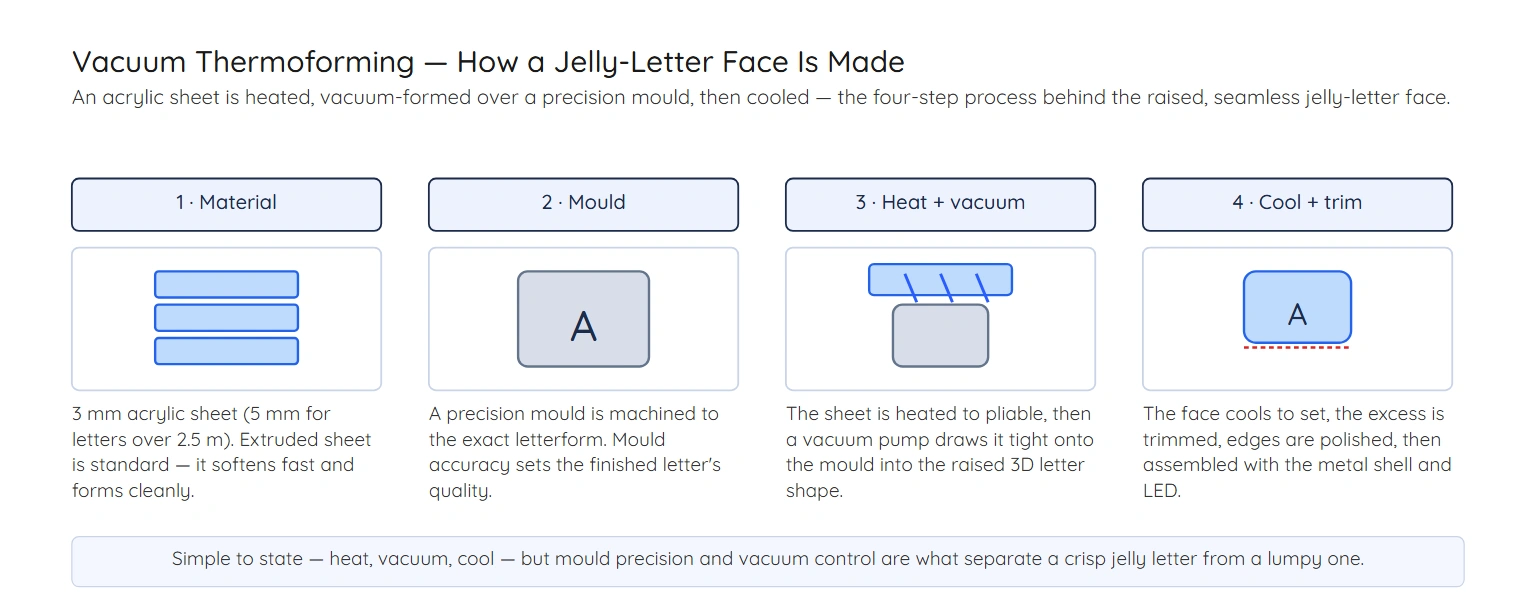
The four-step thermoforming flow: material → mould → heat + vacuum → cool + trim — the process behind the raised, seamless jelly-letter face.
Why the Glow Is Even — Optical & Lighting Engineering
A jelly letter glows evenly because light is injected into the hollow formed face and then reflected and scattered until it exits uniformly. PMMA acrylic has a refractive index of about 1.49, so light is internally reflected before leaving the surface — which is what produces the dense, saturated colour rather than a point-light look.
Two engineering choices make the difference between a “jelly” look and a blotchy one: LED pitch and diffusion. We space LEDs to the letter’s depth and add a frosted or white-opal diffusion layer where needed, so you never see bright dots through the face.
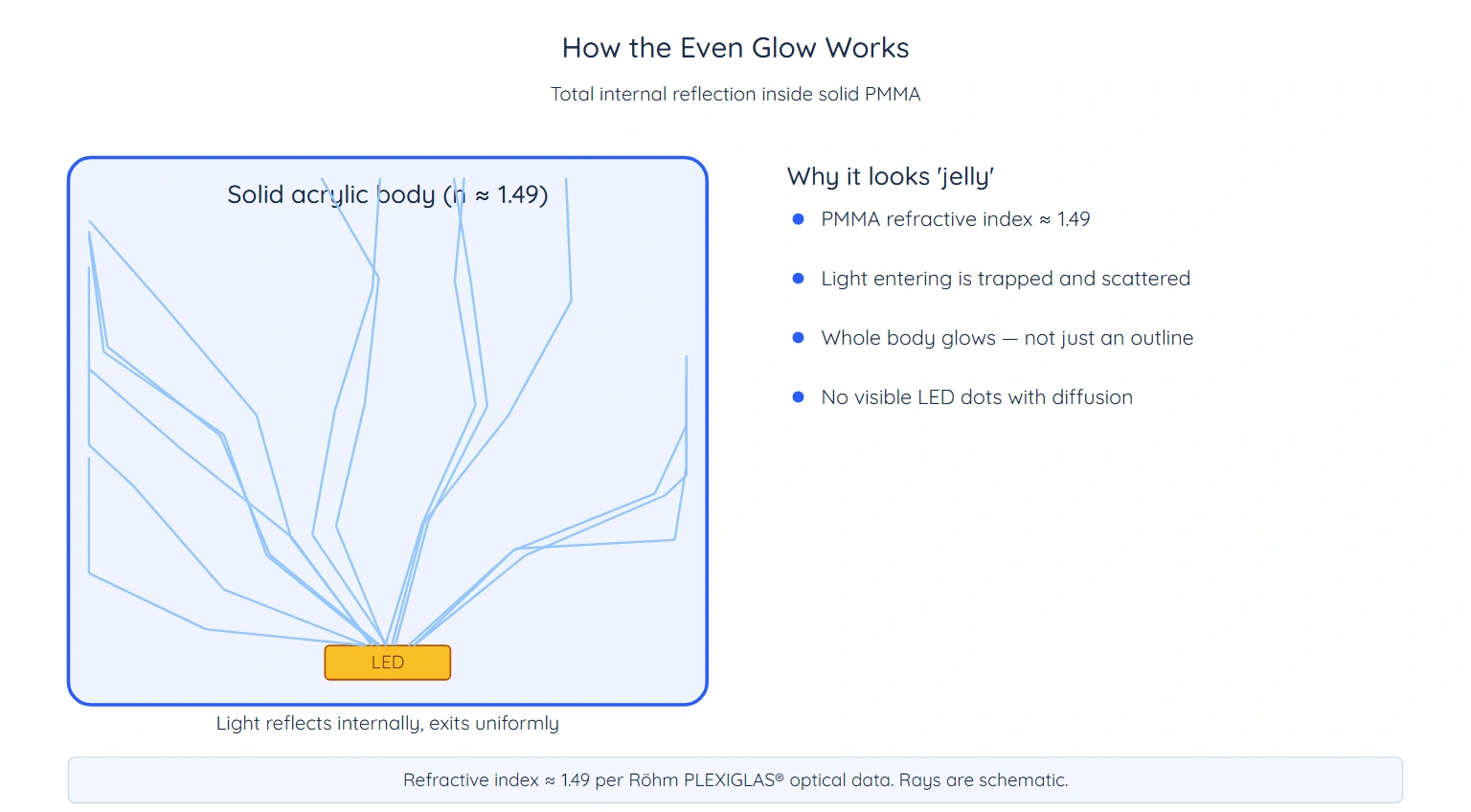
Light is injected into the formed acrylic face and internally reflected and scattered until it exits uniformly — the reason a jelly letter reads as a solid colour, not a point source.
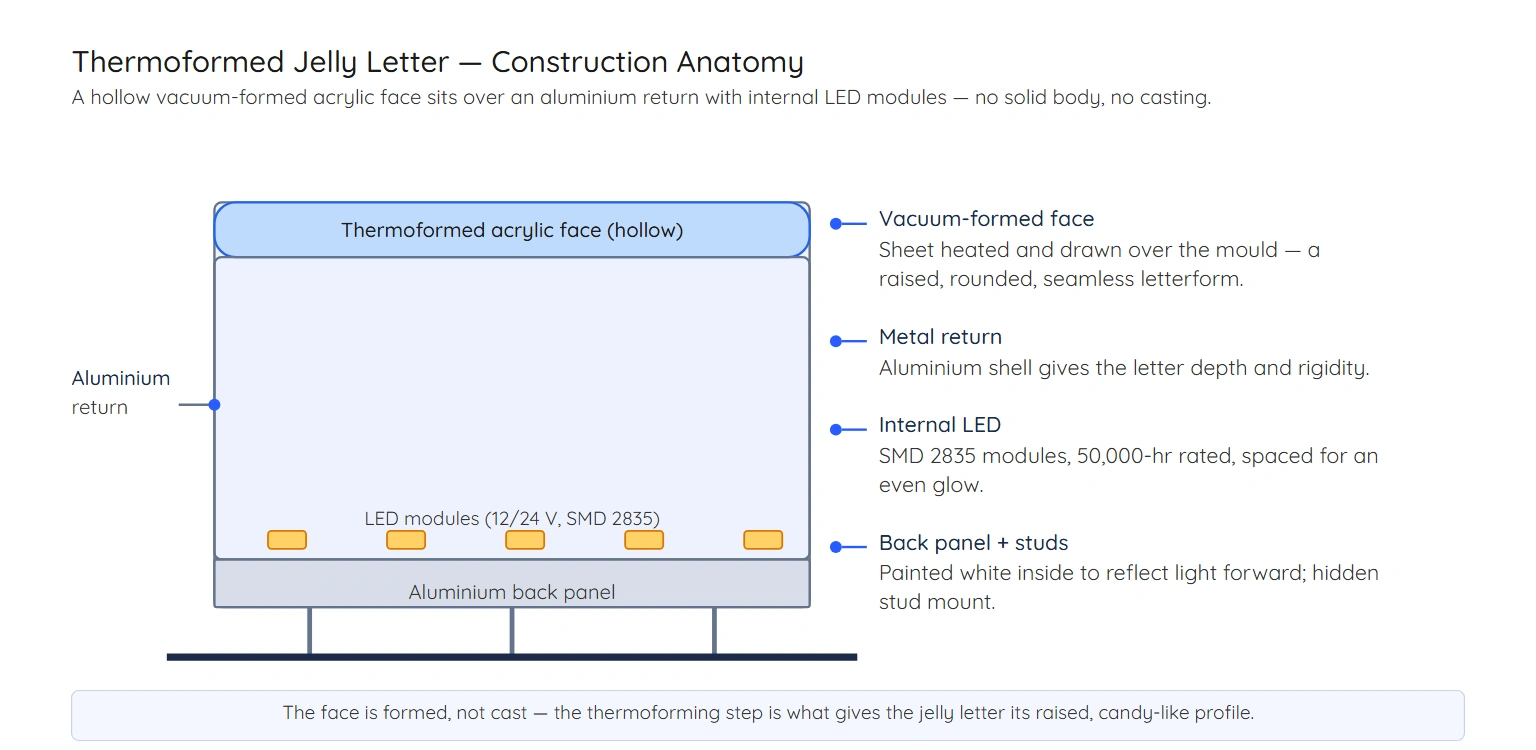
Cross-section: a hollow vacuum-formed acrylic face over an aluminium return with internal LED modules — the face is formed, not cast.
Two Construction Methods — Thermoformed vs CNC-Carved
Jelly letters are built two ways. The everyday method is thermoforming; the premium crystal-clear look is CNC-carved from solid acrylic.
| Construction | How it is built | Depth | Illumination | Best for |
|---|---|---|---|---|
| Thermoformed face | Acrylic sheet vacuum-formed over a mould; hollow face over an aluminium return + internal LED | 30–80 mm | Face-lit / halo | Standard jelly letters — cost-effective, lightweight, the everyday choice |
| CNC-carved solid | Solid acrylic blank CNC-machined to the letterform, then polished; colour on the back | 20–60 mm | Face-lit (volume glow) | Premium crystal-clear letters — the seamless, glue-mark-free “jelly” look |
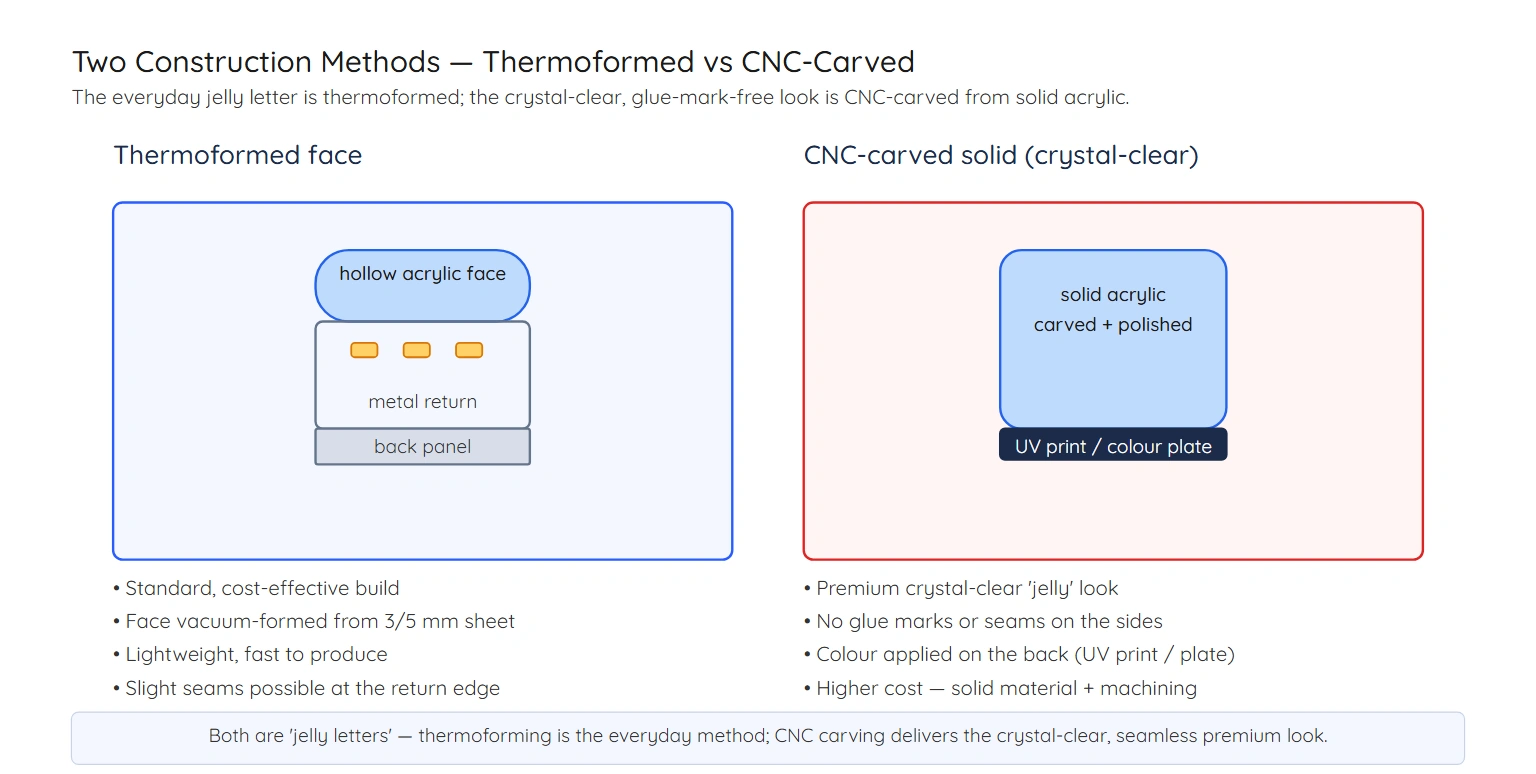
Two construction methods: thermoforming is the everyday build; CNC carving from solid acrylic delivers the crystal-clear, seamless premium look.
Crystal-Clear Jelly Letters (CNC Carving)
When a client needs the truly crystal-clear, “jelly-like” effect — translucent like jelly, with no visible glue marks on the letter sides — thermoforming is the wrong process. That look is produced by CNC-carving a solid acrylic blank to the exact letterform, polishing the edges to glass clarity, and applying the colour on the back — either a UV digital print or a coloured backing plate. Light then passes through a solid, seamless body with no seams or glue lines on the edges.
The two methods are often mixed in one sign: thermoformed letters for the main brand name and CNC-carved letters for the hero or logo element that needs the crystal-clear effect. We will advise which method suits each part of your artwork at quote stage.
Illumination Types
Fully-lit (volume glow) — LEDs inside the body light the entire letter evenly, the classic “jelly” look. Face-lit — an opaque or frosted face with internal LEDs; light exits the front surface only. Backlit / halo — an opaque face with light aimed back at the wall for a soft halo. Edge-lit — LEDs at the letter rim for a slim glow line.
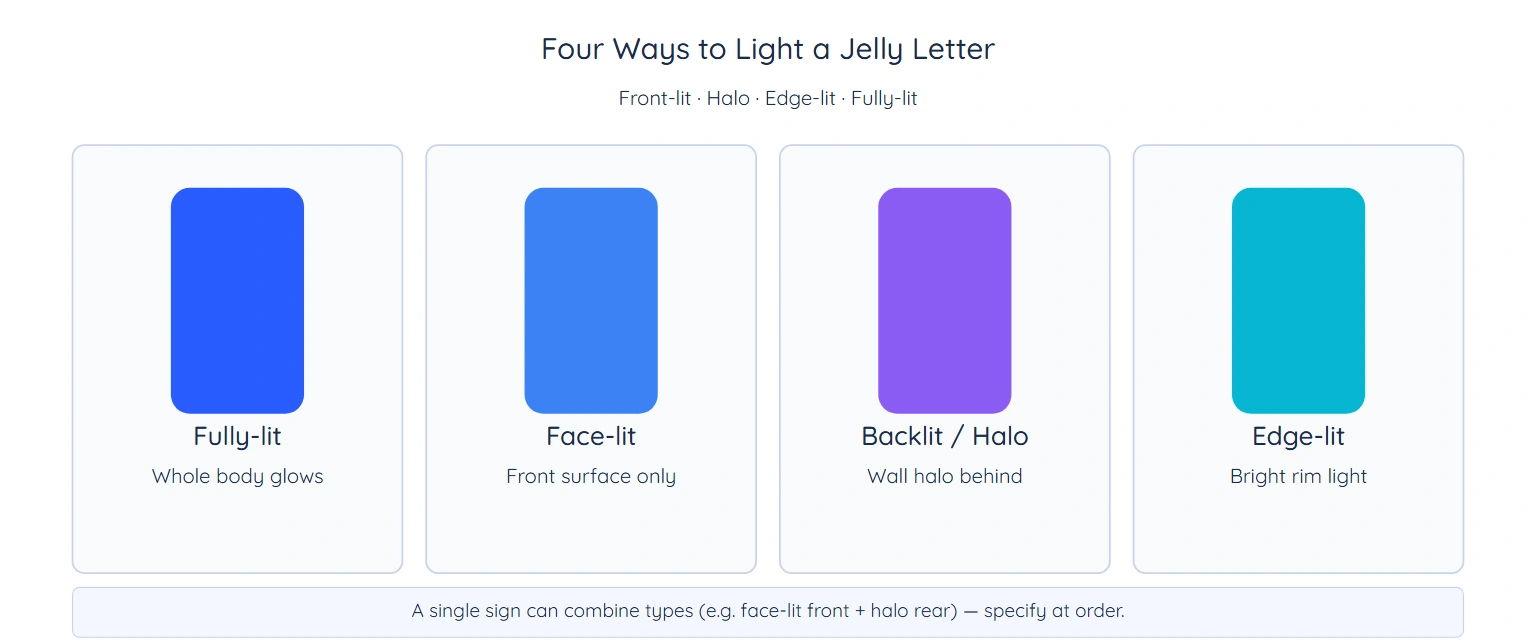
Four ways to light a jelly letter — fully-lit, face-lit, halo and edge-lit.
Same jelly letter sign shown off (mirror/crystal acrylic) and on (saturated glow) — demonstrates the mirror-finish option.
Recommended size: 1600 × 1067 px px
Surface Finishes — Crystal, Matte, Frosted & Mirror
Crystal — polished, glass-clear edges and face; maximises sparkle and colour depth. Matte — satin, non-glare surface; soft glow, resists fingerprints in high-touch areas. Frosted — a fine diffusion layer to even out LED hot spots. Mirror — reflective surface that reads as a solid object when off and glows when lit.
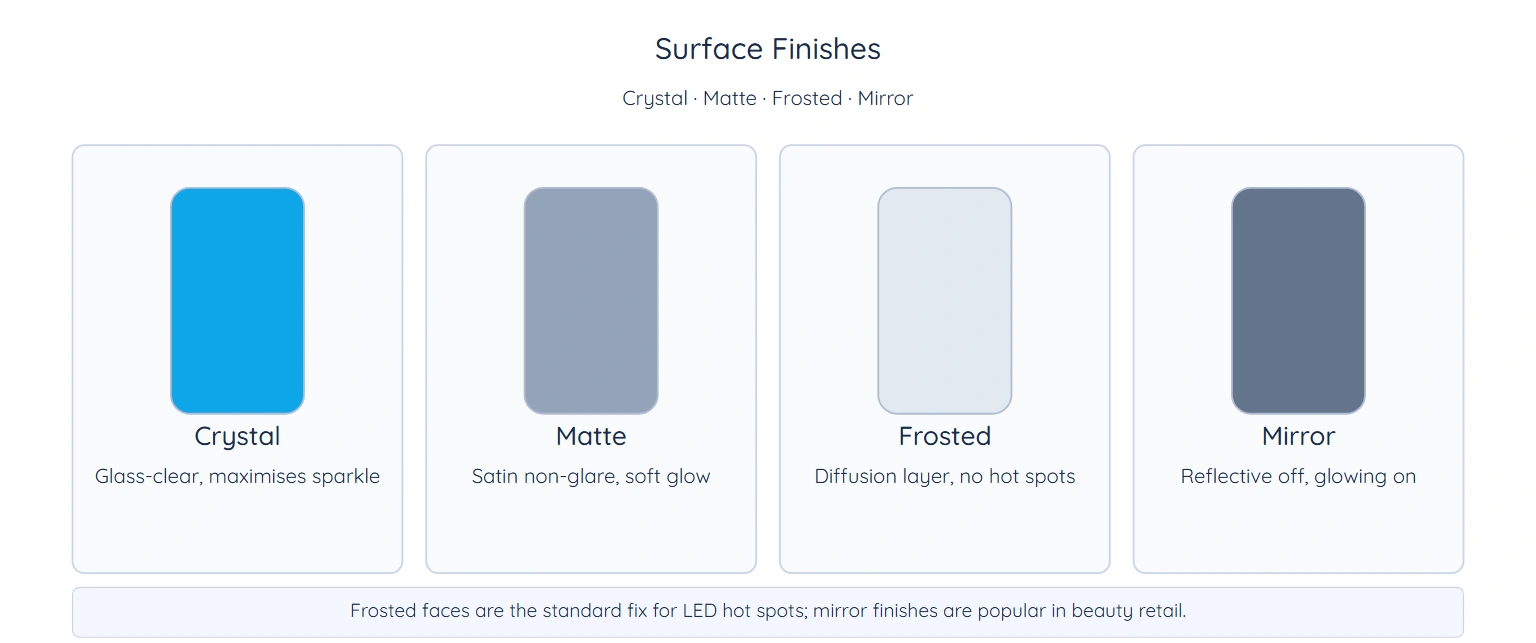
Four surface finishes — crystal, matte, frosted and mirror — each changes how the letter reads by day and by night.
Technical Specifications & Product Parameters
| Parameter | Specification | Notes |
|---|---|---|
| Face process | Vacuum thermoformed extruded acrylic | 3 mm (5 mm for letters over ~2.5 m) |
| Premium option | CNC-carved solid acrylic (crystal-clear) | Polished edges + back UV print / colour plate |
| Return | Aluminium (or metal) shell | Anodised or painted, any RAL / Pantone |
| Letter height | 50 mm – 1,500 mm (2″ – 59″) | Custom sizes outside range on request |
| Letter depth | 30 – 80 mm | Thermoformed face + metal return |
| Light source | 12V/24V DC LED modules | 2835 SMD, 50,000-hr rated |
| Working voltage | DC12V/24V or AC110V/220V | Mean Well / CE-certified driver |
| Surface finish | Crystal / matte / frosted / mirror | Custom colour & Pantone / RAL match |
| Certifications | CE, RoHS, UL (on request) | ISO 9001 factory; SGS reports |
| Ingress protection | IP20 (interior) / IP65–67 (outdoor) | Silicon-sealed for outdoor use |
| LED lifespan | 50,000 hours | ≈ 5 years at 24/7 operation |
| Warranty | 3 years (LEDs + drivers) | Lifetime on acrylic body |
Applications by Industry
| Industry | Typical use | Why jelly letters fit |
|---|---|---|
| Beauty, spa & salon | Interior brand walls, reception signage | Saturated pastel glow matches soft branding |
| Dessert, beverage & F&B | Counter-top signs, feature walls | Candy-like colour cues appeal to appetite |
| Kids' retail & play space | Wall letters, mascot signage | Cool-running, child-safe, low-voltage build |
| Experiential & pop-up | Photo-backdrop signage | Volumetric glow photographs well |
| Retail storefronts (covered) | Façade letters, window displays | IP65 build extends the look to semi-outdoor use |
Playful multi-colour jelly letters in a children’s store or play area, rounded low-voltage build, bright cheerful palette.
Recommended size: 1600 × 1067 px px
Jelly letters above a beauty salon reception or mirror, pastel pink/white glow, warm interior lighting.
Recommended size: 1600 × 1067 px px
Customization Options
- Fonts and logos — any vector file (.ai, .eps, .cdr, .svg); we reproduce your exact brand typeface
- Colour — Pantone / RAL matched acrylic, painted edges, multi-colour builds and RGB within one sign
- Depth and size — from slim edge-lit letters to deep fully-lit body letters
- Finish — crystal, matte, frosted or mirror
- Illumination — fully-lit, face-lit, halo or edge-lit
- Mounting — flush, stand-off, suspended or window-mount, with a full-size paper template
Total Cost of Ownership: Jelly Letters vs. Alternatives
Jelly letters cost more up front than flat acrylic or vinyl, but they replace a recurring failure point: the sign is the décor. Compare over a 10-year horizon.
| Option | Up-front cost | Lifespan | Maintenance | 10-yr TCO verdict |
|---|---|---|---|---|
| Jelly letters (this product) | Medium-high | 10–20+ years (acrylic body) | Minimal (wipe; LEDs serviceable) | Low — no recurring replacement |
| Neon (gas discharge) | High | 8–15 years (tube + transformer) | Tube/transformer replacement | High — fragile, high-voltage servicing |
| Flat-cut acrylic letters | Low | 5–10 years (non-lit) | Re-gluing, cleaning | Medium — replaced 1–2× |
| Vinyl / printed graphics | Very low | 2–5 years (fade/peel) | Full reprint | High — replaced 3–5× in 10 years |
Quality Control & Test Methodology
| Test | Standard / method | What it verifies |
|---|---|---|
| Form quality | Visual vs. mould reference | The thermoformed face is crisp, with no thinning or webbing |
| Light uniformity | Visual + luminance spot-check | No LED hot spots or dark corners across the face |
| LED burn-in | 24-hour continuous run | Early-failure screening; colour-temperature stability |
| Colour match | Pantone/RAL vs. colour meter | Face and edge match the approved swatch |
| Dimensional accuracy | Vernier / template vs. drawing | Letter height, stroke width and set-out match the artwork |
| Edge polish | Visual, 3× magnification | Crystal edges are clean with no burrs or haze |
| Ingress protection (outdoor) | IP65/67 seal check | Silicone seal integrity for exterior use |
| Packaging | Drop / transit simulation | Foam-lined, no face-to-face contact |
Failure Modes & Prevention
| Failure mode | Root cause | Detection | Prevention (specify at order) |
|---|---|---|---|
| Yellowing / haze | Non-UV-stabilised acrylic outdoors | Colour shift over 2–3 years | Specify UV-stabilised acrylic |
| Uneven glow / hot spots | LED pitch too wide or missing diffusion | Visible bright dots through the face | Specify frosted diffusion + correct LED pitch |
| Face webbing / distortion | Poor vacuum control or mould wear | Wrinkled or thinned face | Specify in-house thermoforming + mould maintenance |
| Edge haze | Incomplete edge polish | Cloudy edges under light | Specify crystal edge polish |
| LED premature failure | Non-branded modules or poor driver | Dead sections | Specify 50,000-hr modules + named driver brand |
| Letter detachment | Wrong mount for weight/surface | Loose or fallen letter | Stud/stand-off mount + template |
MOQ, Pricing Factors & Lead Time
| Item | Detail |
|---|---|
| MOQ | 1 piece (samples and single letters) · 10+ pieces (bulk, tiered pricing) |
| Production | 3–7 working days after artwork approval (mould-making: confirm at quote) |
| Free proof | Dimensioned engineering drawing + written quote within 24 hours |
| Pricing factors | Letter height, depth, face finish, colour, illumination, construction method, quantity |
| Shipping | Express 5–7 days · air ~10 days · sea 40–65 days · DDP available |
| Payment | T/T, L/C, PayPal — 50% deposit / 50% before shipment |
Production Process
- Artwork & mould — vector file review, letter height/depth confirmed, precision mould machined to the letterform
- Material — extruded acrylic sheet selected (3 mm standard, 5 mm for large letters)
- Heating — sheet heated to its softening point
- Vacuum forming — the softened sheet is drawn tight onto the mould into the raised letter shape
- Cooling & trimming — face cooled to set, excess trimmed, edges polished
- Assembly — thermoformed face + aluminium return + LED modules + driver
- QC — form inspection, 24-hr burn-in, light-uniformity check, colour match
- Packing & ship — foam-lined export crate; express / air / sea / DDP
Supplier Evaluation Checklist (Procurement)
- Does the supplier thermoform in-house, or just buy finished letters and resell them?
- Can they document the mould-making process and mould precision?
- Do they specify extruded vs cast sheet — and UV stabilisation for outdoor builds?
- Can they offer the CNC-carved crystal-clear option (with polished edges + back colour) where needed?
- What is the LED module spec (SMD type, LEDs/m, IP rating, driver brand)?
- Do certifications (CE / RoHS / UL / ISO 9001) cover the LED and power supply, not just the acrylic?
- What is the real MOQ, lead time and free-proof policy — and is the quote written?
Market Intelligence: Jelly Letters in Experiential Retail
Jelly letters ride the same tailwind as experiential retail and “Instagram-first” fit-outs: brands are spending on interiors that photograph well because the space itself is marketing. The global illuminated signs market is projected to reach about USD 52.9 billion by 2032 (5.82% CAGR), with LED signs holding roughly 65% of the market (P-Market Research, illuminated signs market). For B2B buyers the practical takeaway is margin: a thermoformed jelly letter is lightweight and cost-effective to produce, yet it commands a premium in the experiential and F&B segments that value its candy-like colour saturation.
Frequently Asked Questions
What are jelly letters, and how are they different from neon signs?
Jelly letters are dimensional LED letters with a thermoformed acrylic face that glows as a thick, saturated volume. A neon sign emits light along a thin gas-discharge tube, so it reads as an outline. Jelly letters run on low-voltage DC LEDs, are child-safe, and reproduce brand colours in solid blocks rather than thin lines.
What is the minimum order quantity and lead time?
The minimum order is 1 piece — you can order a single letter, logo or a full set. Production takes 3–7 working days after artwork approval (mould-making may add time on a first order). We provide a free dimensioned engineering drawing and written quote within 24 hours.
Are jelly letters safe for kids' retail and low-voltage use?
Yes. Jelly letters run on 12V or 24V DC LEDs — low-voltage, cool-running and child-safe. There is no fragile glass tube, no high-voltage transformer and no exposed wiring, which makes them the default choice for kids’ retail and play spaces.
Can jelly letters be used outdoors?
Yes, with the right build. We silicon-seal the letters to IP65/IP67 and specify UV-stabilised acrylic so the colour stays saturated without yellowing. For full exterior exposure we recommend halo or face-lit construction, and we will advise you at quote stage.
Can you match my brand font, logo and exact colours?
Yes. We reproduce any vector logo or typeface (.ai, .eps, .cdr, .svg) and match Pantone or RAL colours on the face and edges. Multi-colour builds and RGB within a single sign are available, and we run a colour-meter check against your swatch before packing.
What certifications and QC do your jelly letters carry?
Products carry CE and RoHS as standard, with UL certification on request. The factory holds ISO 9001:2015 and provides SGS test reports. Every order passes a form inspection, 24-hour LED burn-in, luminance uniformity check and dimensional check.
How are jelly letters mounted?
Four ways: flush (direct to wall), floating (stand-off studs/spacers), suspended (ceiling cables), or window-mount. We supply the mounting hardware and a full-size paper template so the letters go up level the first time.
Key Takeaways
- Jelly letters = dimensional LED letters with a vacuum-thermoformed acrylic face over an aluminium shell — formed, not cast
- Core process: material → mould → heat + vacuum → cool + trim
- The crystal-clear, glue-mark-free look is CNC-carved solid acrylic + polished edges + back UV print / colour plate — a premium option
- Cool-running, low-voltage, child-safe LEDs; CE / RoHS / UL / ISO 9001
- MOQ 1 piece; 3–7 day production; free dimensioned drawing + written quote within 24 hours; express / air / sea / DDP shipping
Get a Free Engineering Drawing & Quote
Send your logo or text, and our engineering team will return a dimensioned drawing, MOQ, lead time and written quote within 24 hours.