
Liquid Acrylic Letters & Signs
— Custom Liquid Acrylic Sign Lettering
Single-component liquid acrylic letters, poured into a metal or 3D-printed shell and UV-cured into a deep, glass-clear body. A factory-level engineering reference for sign resellers, architects, procurement teams and distributors — with UV cure, letter shell, bubble-free pouring, MOQ and QC specifications you can place an order against.
Single-component liquid acrylic · 30–80 mm deep body · fully-lit / face-lit / halo · CE / RoHS / UL · MOQ 1 pc

Liquid acrylic letters — also called super letters or liquid acrylic LED letters — are dimensional 3D sign letters formed by pouring a single-component, UV-curable liquid acrylic into a precision letter shell and curing it under UV light into a solid, optically-clear letter. Because the letter is grown from liquid rather than cut from a flat sheet, it can be poured deep (30–80 mm), in any contour, with a glass-like, bubble-free body that edge-lights and back-lights evenly. We produce them factory-direct with an ISO 9001 process, CE/RoHS/UL components, a minimum order of 1 piece, and 3–7 day production.
What you can expect from our factory
- ISO 9001:2015 quality system; CE / RoHS / UL-certified LED modules and power supplies
- True single-component liquid acrylic bodies — poured and UV-cured in a metal or 3D-printed shell, not CNC-cut sheet
- MOQ 1 piece; 3–7 day production after artwork approval
- Free dimensioned engineering drawing + written quote within 24 hours
What Is a Liquid Acrylic Letter?
A liquid acrylic letter is a dimensional sign character made by pouring a single-component, UV-curable liquid acrylic into a letter shell (3D-printed or bent metal) and curing it under UV light into a solid, crystal-clear body. The term “liquid acrylic” refers to the manufacturing method, not a different plastic: instead of routing letters out of a stock sheet (where thickness is capped by the sheet, usually 25 mm), the liquid acrylic is poured to any depth and cures into a single, seamless, stress-free block. The result is a deep, glossy, glass-like letter that carries LED light through its full volume with no lamination seams and no machining haze.
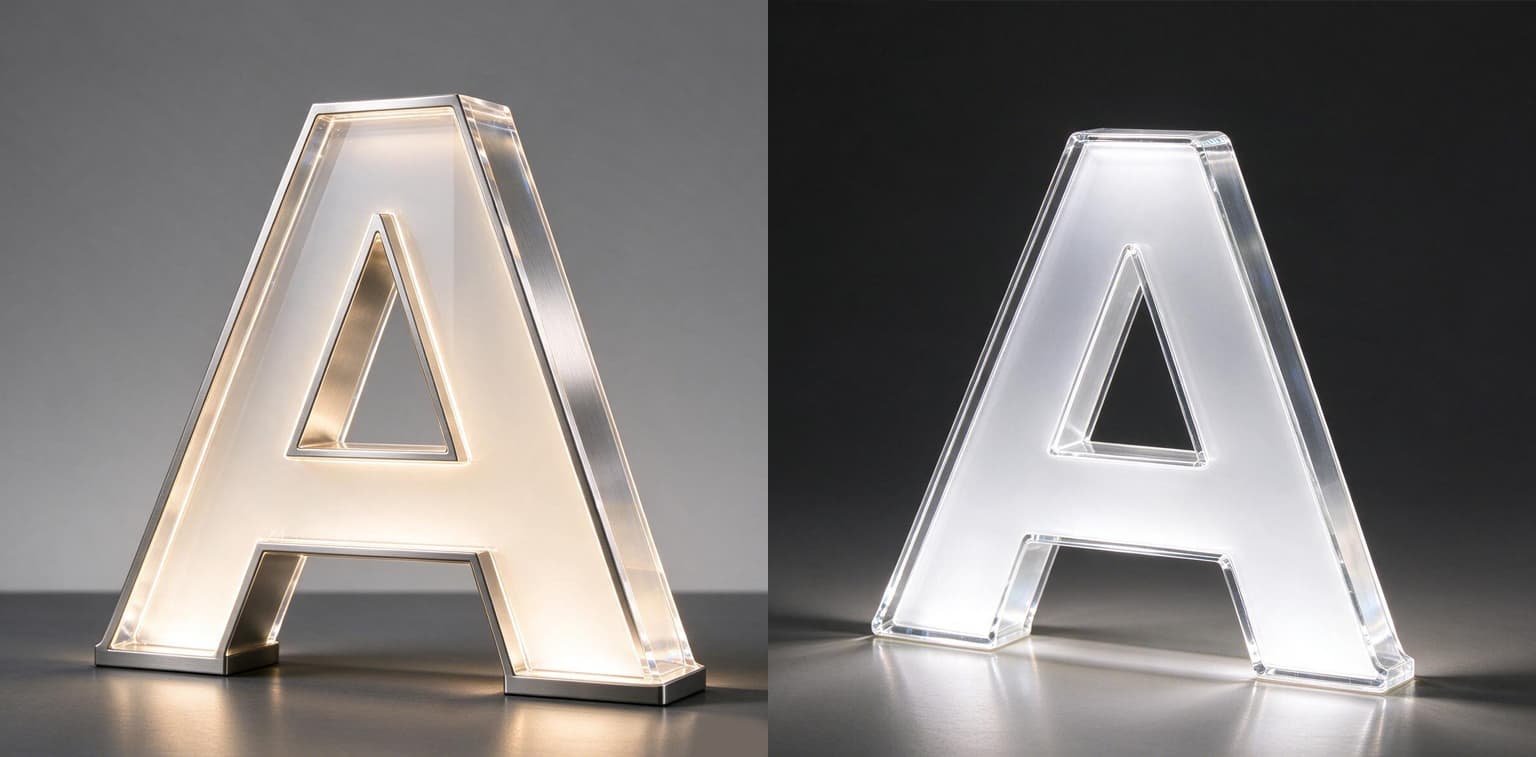
Liquid acrylic letters sit beside channel letters, flat-cut acrylic letters and metal letters in the dimensional-letter family, but they win on three axes no sheet process can match: depth (30–80 mm), optical clarity (≈92% light transmission), and a glass-like finish with the ability to tint or gradient the acrylic body itself. They are the default choice for premium interior brand walls, reception signage and semi-outdoor storefronts where the sign is part of the architecture.
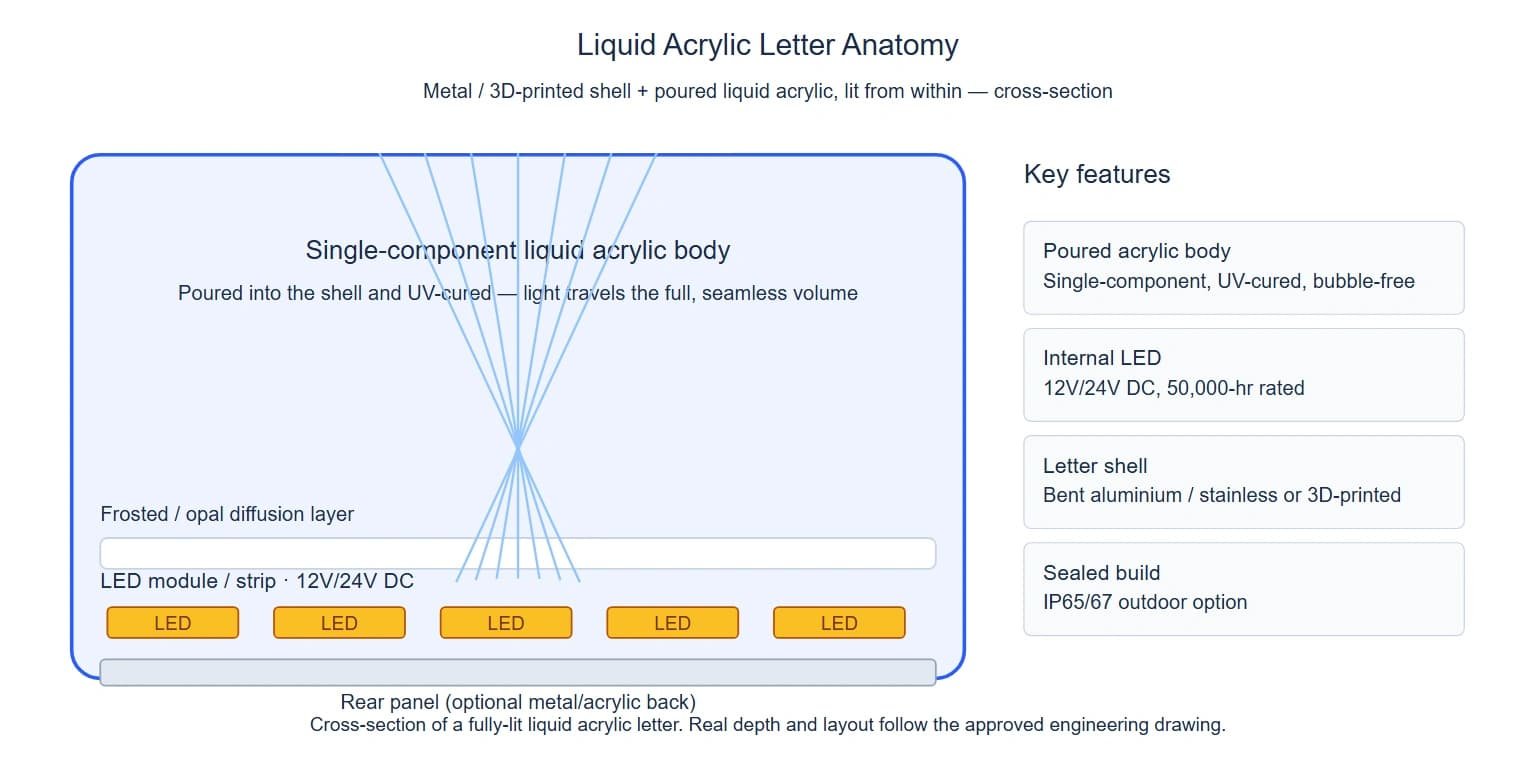
Cross-section of a fully-lit liquid acrylic letter: a metal or 3D-printed shell with a poured single-component acrylic body, internal LED strip, frosted diffusion layer and rear panel.
Production Process
Every acrylic letter is either cut from a solid sheet or poured from single-component liquid acrylic. The two routes produce visibly different products, and the difference compounds once the letter is lit. We pour our liquid acrylic letters by default.
| Factor | Liquid acrylic (poured) letter | CNC-cut sheet letter | Why it matters |
|---|---|---|---|
| Max body depth | 30–80 mm (shell + pour) | Capped by sheet gauge (≤ 25 mm) | Deep letters glow like glass, not flat panels |
| Body structure | Single seamless pour | Stacked / laminated sheets | No glue seams to catch light or delaminate |
| Edge quality | Shell-formed, glass-clear | Machined, needs polish (can haze) | Poured edges transmit light without fog |
| Internal stress | UV-cured, stress-relieved | Residual from routing | UV-cured bodies resist crazing and cracking |
| Colour / gradient | Tinted or gradient body | Not possible | Unique branding capability |
| Optical clarity | Liquid acrylic, τ D65 ≈ 92% | Extruded/stock varies | Saturated, even glow |
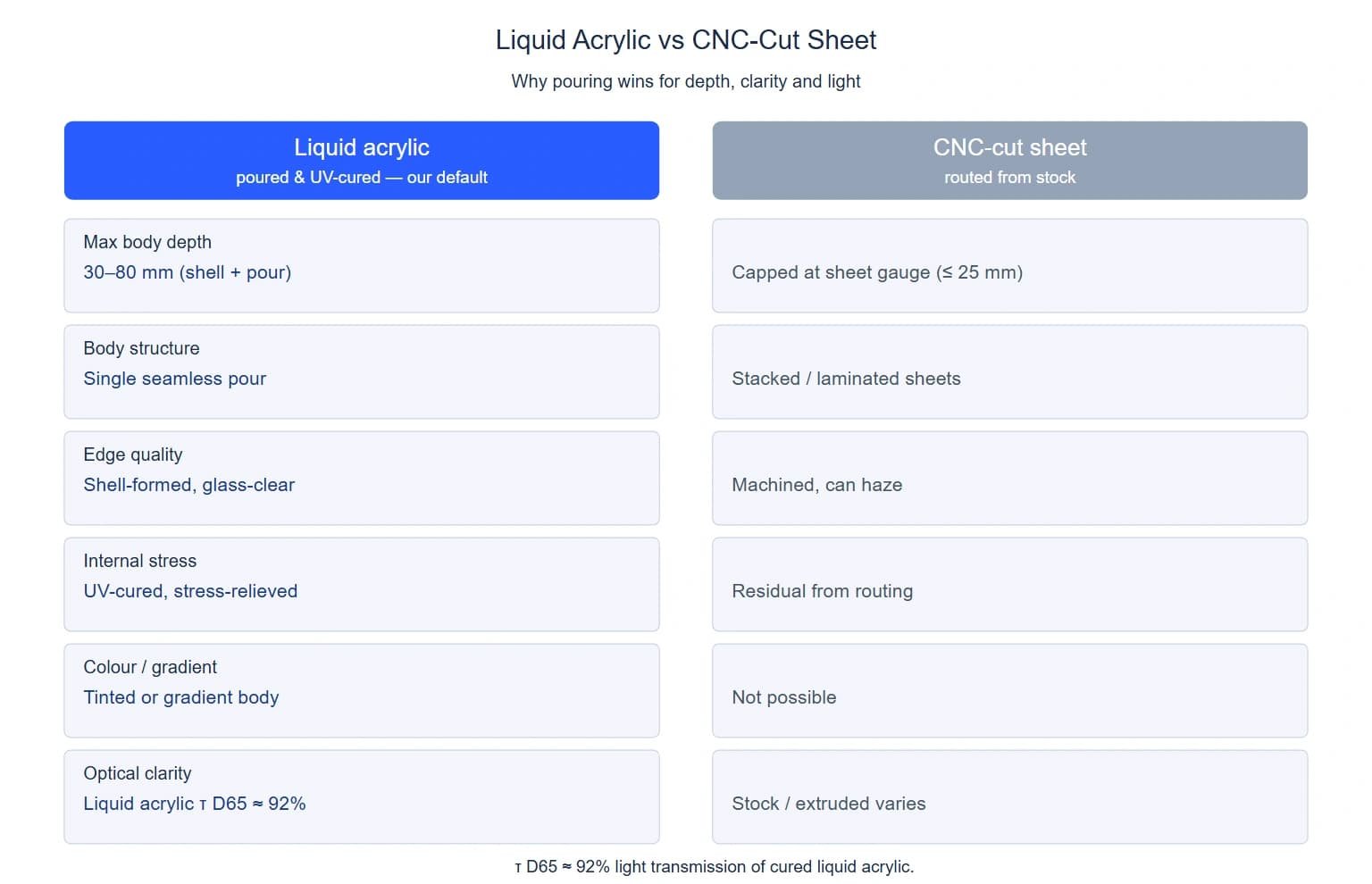
Liquid pouring vs CNC-cut sheet: depth, edge quality, internal stress and colour capability all favour the pour method.

The seven-stage pouring flow from artwork to a lit, glass-clear letter — letter shell, single-component pour, UV cure, polish, light.
Liquid Acrylic Material & UV Cure — Single Component, No Mixing
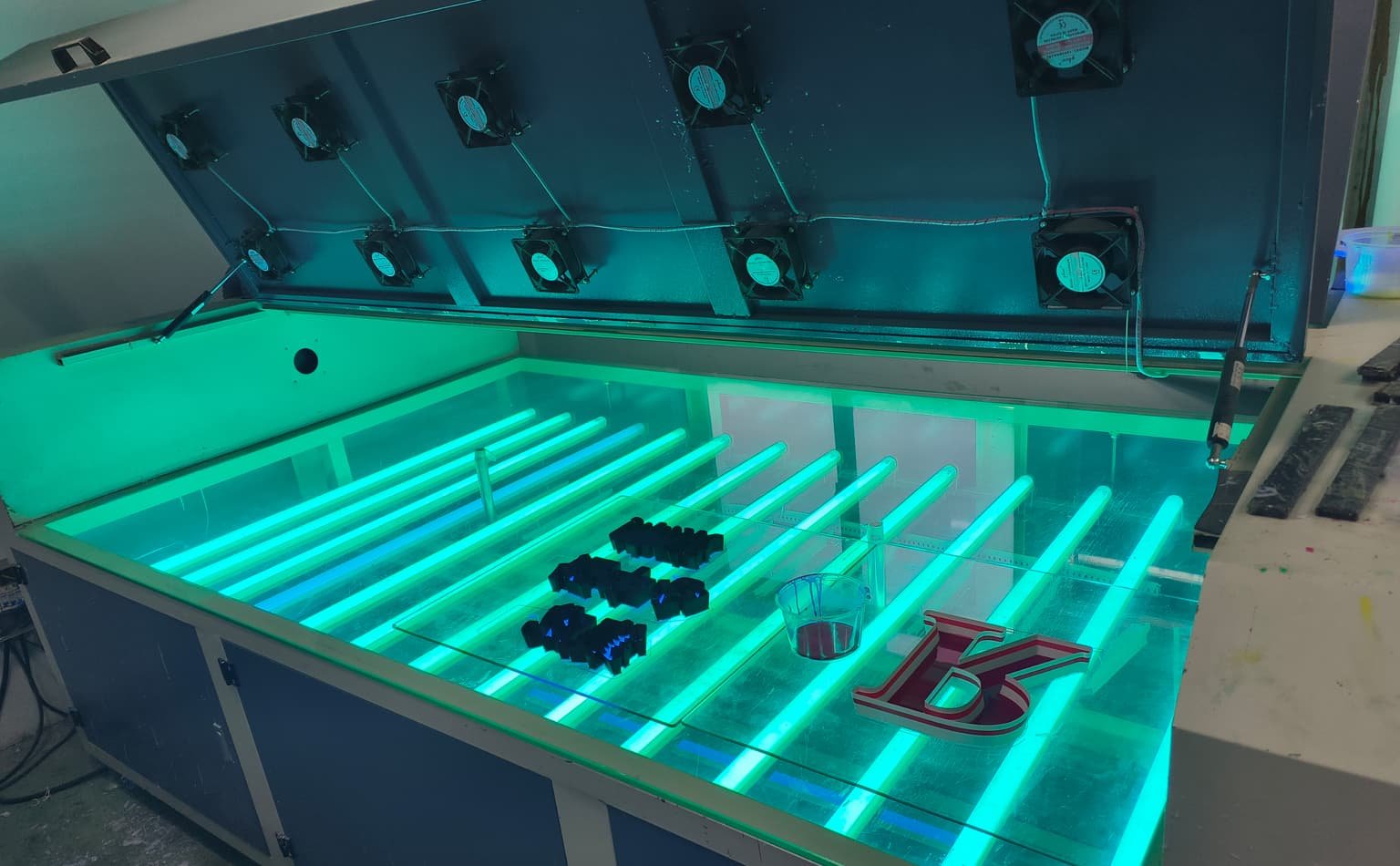
The “liquid” in liquid acrylic is a single-component, UV-curable acrylic — factory pre-mixed, so there is no A/B mixing, no pot life to race and no exotherm to manage. Ultraviolet light triggers the polymerisation that turns the liquid into a solid, crystal-clear body. The cure is what gives the finished letter its clarity and stability; keeping the pour clean and even is where quality is won or lost.
| Property | Liquid acrylic (single-component) | Engineering control |
|---|---|---|
| Material system | Single-component, UV-curable liquid acrylic | Factory pre-mixed — no A/B mixing to get wrong |
| Cure trigger | UV light | UV tunnel / lamp triggers polymerisation |
| Cure time | ≈2 hours | Fast, room-temperature UV cure |
| Mixing | None required | One-part — nothing to weigh or stir |
| Outdoor stability | UV-stabilised acrylic | No yellowing or crazing in sunlight |
| Optical clarity | ≈92% light transmission | Bright, even glow — no hot spots |
| Finish | Glass-clear, bubble-free | Clean, dry pour environment |
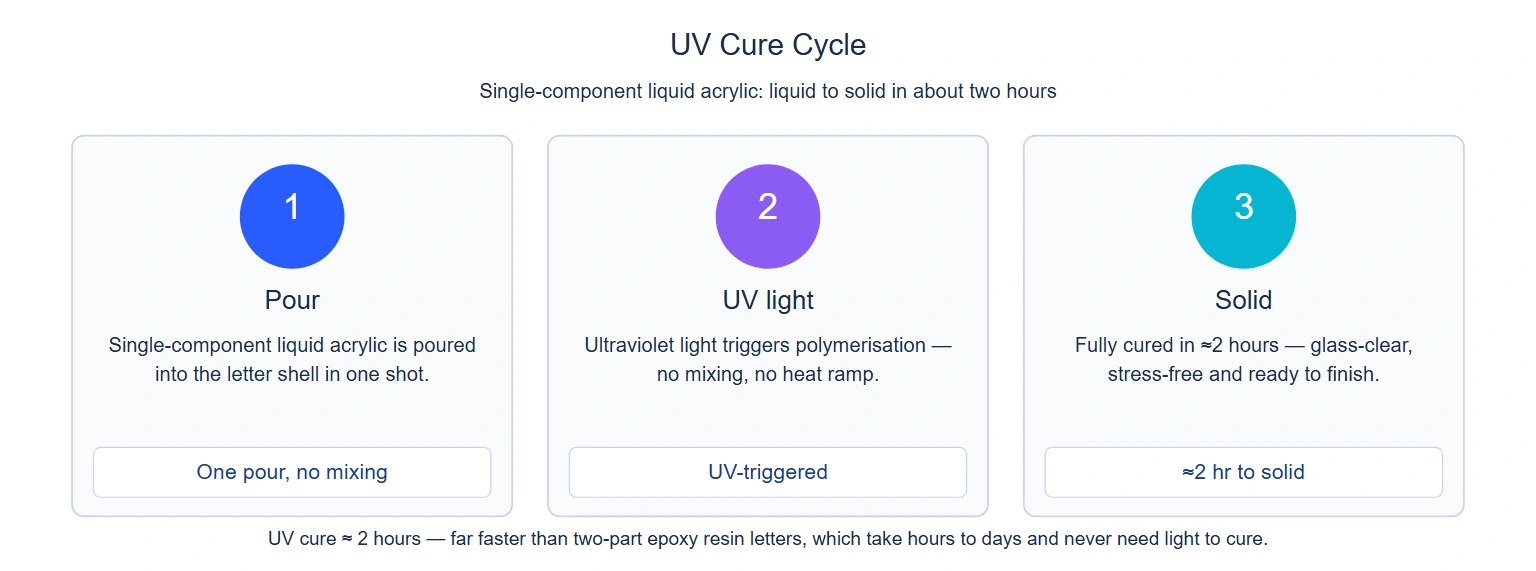
The UV cure cycle: single-component liquid acrylic cures to solid in about two hours under UV light.
Liquid Acrylic vs Epoxy Resin Letters — Not the Same Product
Liquid acrylic letters and epoxy resin letters are often mixed up, but they are different materials with different processes and different lifespans. Liquid acrylic is a single-component, UV-cured acrylic — the modern upgrade. Epoxy resin is a two-part system that cures by chemical reaction and yellows outdoors.
| Dimension | Liquid acrylic (super letters) | Epoxy resin letters |
|---|---|---|
| Material system | Single-component liquid acrylic | Two-part epoxy (A + B) |
| Mixing | None — factory pre-mixed | A:B weighed 3:1 and stirred |
| Cure trigger | UV light | Chemical reaction (room temp) |
| Cure time | ≈2 hours | Hours to days |
| Outdoor life | UV-stable — no yellowing | Yellows in sunlight |
| Best use | Indoor + outdoor | Indoor |
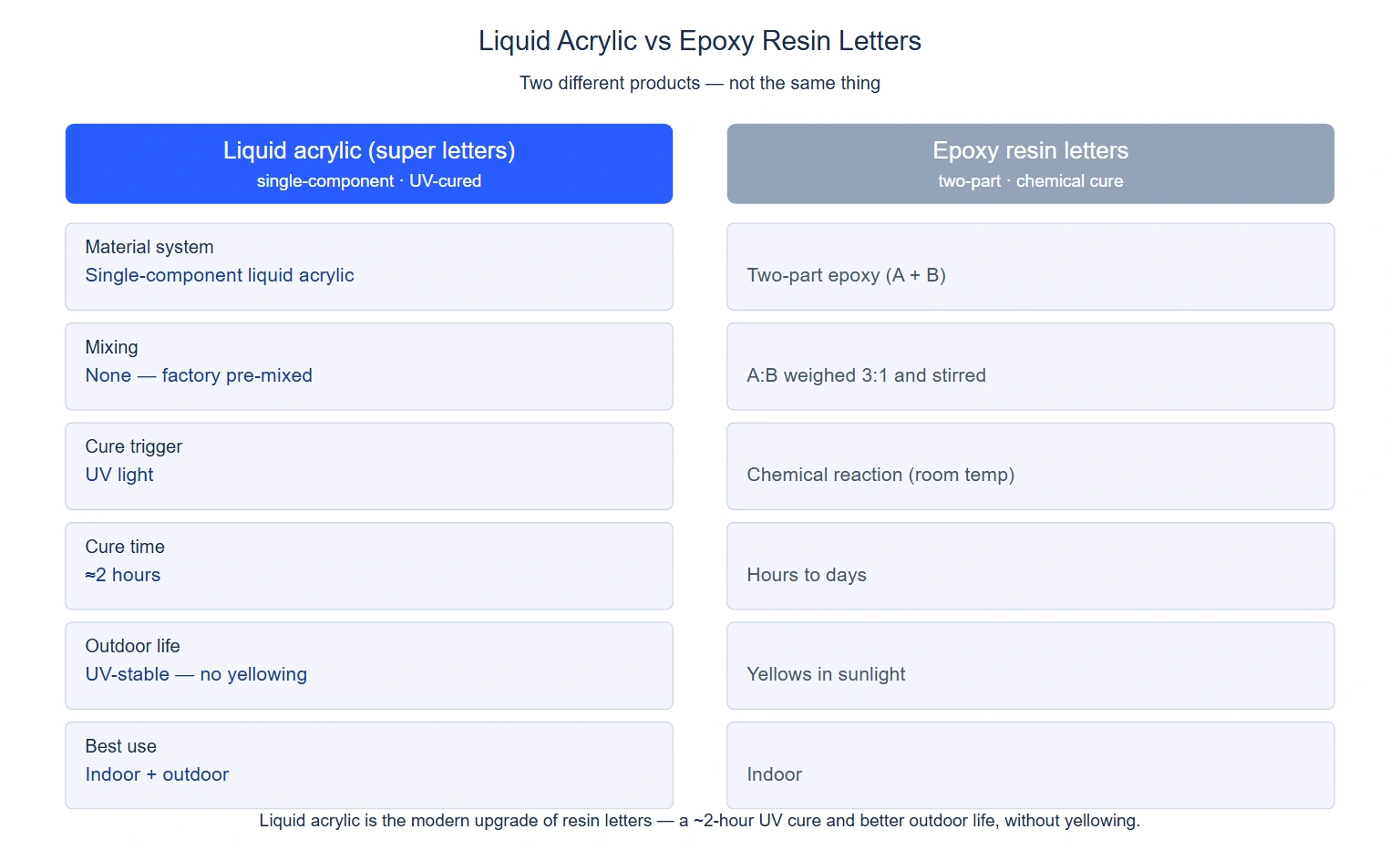
Liquid acrylic (super letters) vs epoxy resin letters — two different products, compared across material, mixing, cure and outdoor life.
Bubble-Free Pouring Engineering
A single trapped bubble is visible through a back-lit acrylic face — so de-aeration is the make-or-break step. Because the acrylic is single-component, no air is whipped in during mixing — fewer bubbles from the start. We finish the job two ways: a thin, high stream that lets any remaining bubbles pop on the way down, and a clean, temperature- and humidity-controlled pour room.
Temperature and humidity are controlled through the whole pour: the acrylic and letter shells are brought to room temperature so the liquid flows level, and the pouring room is kept dry to prevent moisture clouding. The result is a body with no visible bubbles, no cloudiness and no porosity at the surface.

Single-component liquid acrylic pours bubble-free — a thin-stream pour in a clean, dry room delivers a crystal-clear body.
Letter Shell Technology & Precision
The letter shell is the letter’s skeleton — the aluminium or stainless edge that holds the liquid acrylic and becomes part of the finished letter. It is formed per order from your vector artwork, so every serif, radius and logo detail reproduces exactly. Because the shell is the letter itself rather than a separate letter shell, there is no letter shell cost and no tooling lead time — which is why single letters and small batches stay economical.
| Shell type | Material | Best for | Detail |
|---|---|---|---|
| Bent aluminium shell | Aluminium edge strip | Standard letters, most sizes | Bent on a letter-bending machine — crisp, consistent edges |
| Bent stainless shell | 304 stainless edge strip | Premium / outdoor letters | Rust-resistant, polished finish |
| 3D-printed frame | Photopolymer / ABS frame | Complex shapes, small runs | Fine detail where bending is impractical |
| Shell precision | — | All letters | Machine-formed one-piece shells beat hand-welded joints for consistency |
How Liquid Acrylic Glows — vs Thermoformed Letters
Liquid acrylic letters and thermoformed (vacuum-formed) acrylic letters light differently because their panels form differently. A liquid acrylic panel is poured in place inside the letter shell and cures around the LED source; a thermoformed panel is a solid sheet heated and drawn over a mould. That single difference drives uniformity, colour saturation and lifespan.
| Dimension | Liquid acrylic (poured) | Thermoformed (vacuum-formed) |
|---|---|---|
| Panel forming | Liquid polymer poured into the letter shell, flows level, cures | Solid sheet heated + vacuum-drawn over a mould |
| Refractive index | ≈ 1.6 — LED light fully diffuses inside the material | ≈ 1.49 — light passes through the solid sheet |
| Uniformity | “Translucent, not transparent” — no dark spots, no LED-dot grain | Depends on sheet thickness + LED pitch; hot spots if spacing is off |
| Colour saturation | High — light homogenized through the whole panel | ≈ 92% sheet transmittance |
| LED protection | LED can be poured directly inside — fully encapsulated, ≈ 30% longer life | LED sits behind the sheet |
Tooling is the other split. Liquid acrylic needs no mould — the shell is the letter, so a single letter or a small batch is economical and complex shapes are no problem. Thermoformed letters require a mould, and a different size means a different mould, so the mould cost only makes sense at volume. As a rule: choose liquid acrylic for custom, low-volume or intricate work; choose thermoforming when you need standard shapes at scale.
Deep Solid Pouring & Colour Gradients
Because the letter is poured, depth is a design choice, not a stock limitation. We pour solid bodies from 30 mm up to 80 mm deep, and can pour thicker on request — a genuinely deep, jewellery-like letter rather than a flat panel with a spacer behind it.
Liquid pouring also enables effects no sheet process can produce: we can tint the acrylic to any Pantone/RAL colour, and we can pour pigment layers or gradients directly into the body for an ombre or marbled finish. These are the details that turn a sign into a branded object — and they are exclusive to the liquid-pour method.

Deep pouring, tinted acrylic and pigment gradients are capabilities only liquid pouring enables.
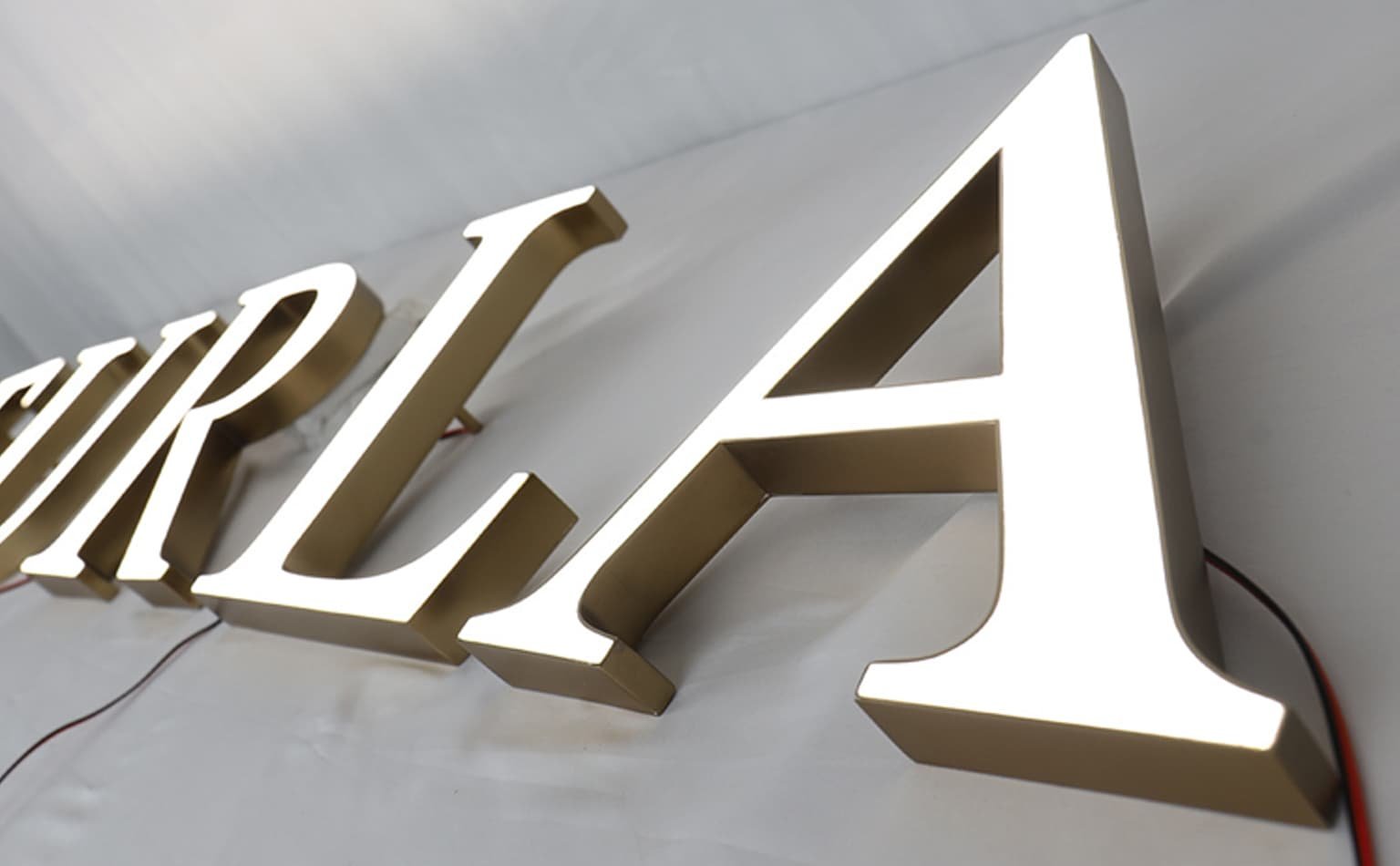
Illumination Types
- Fully-lit (volume glow): LEDs inside the solid body light the whole letter evenly — the classic deep acrylic look.
- Face-lit: Opaque or frosted front with internal LEDs; light exits the front surface only.
- Backlit / halo: Opaque face with rear LEDs; light washes the wall behind as a halo.
- Edge-lit: Clear body with LEDs at the rear edge; light travels the face and reads as a bright rim.

Four ways to light a liquid acrylic letter — fully-lit, face-lit, halo (backlit) and edge-lit.
Surface Finishes — Crystal, Matte, Frosted & Mirror
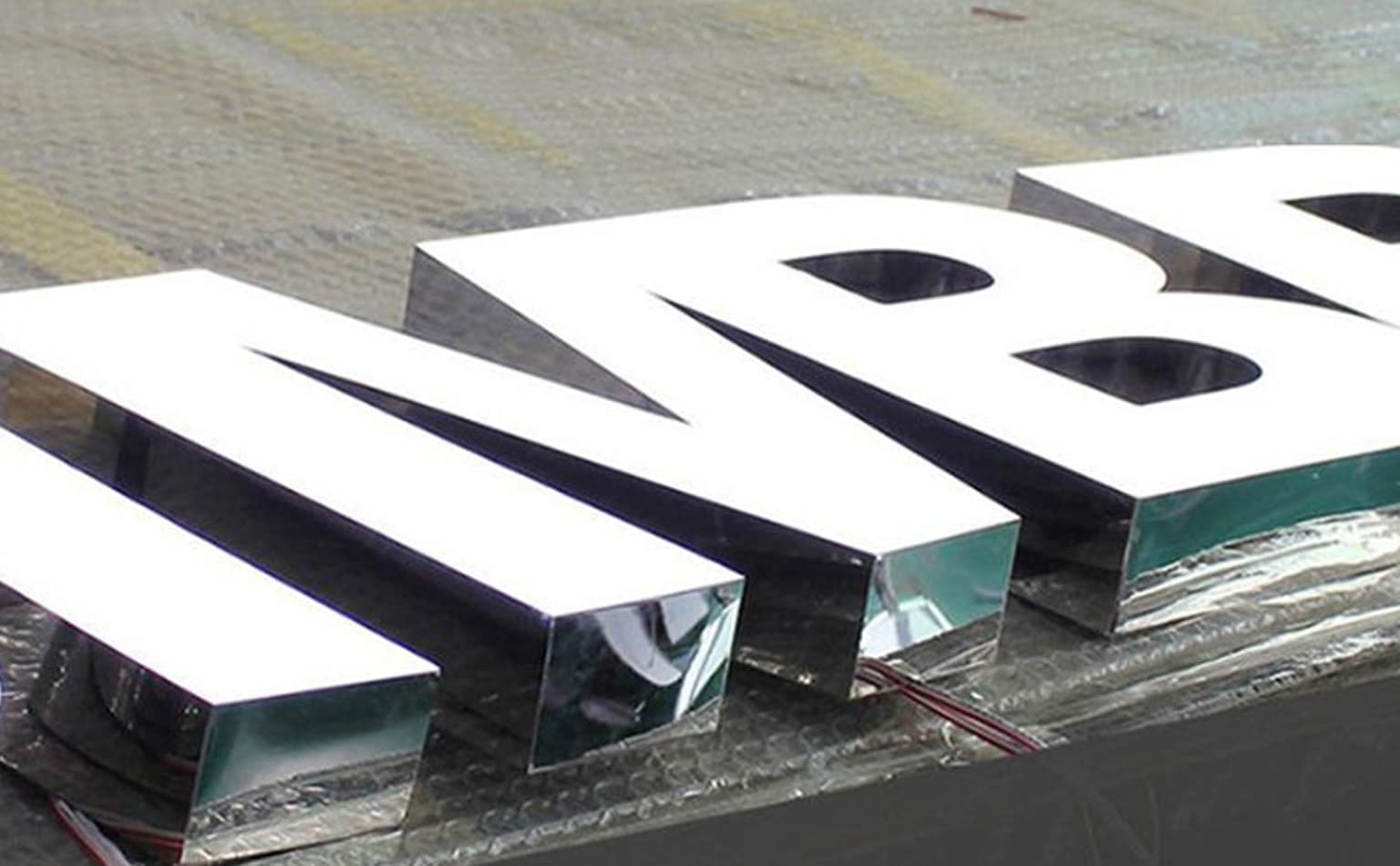
- Crystal: Polished, glass-clear edges and face; maximises sparkle and colour depth.
- Matte: Satin, non-glare surface; soft glow, resists fingerprints in high-touch areas.
- Frosted: Fine diffusion layer; used to even out LED light and eliminate hot spots.
- Mirror: Reflective face; off = mirror, on = glowing colour — popular in beauty retail.
Technical Specifications & Product Parameters
| Parameter | Specification | Notes |
|---|---|---|
| Material | Single-component liquid acrylic (UV-cured) | UV-cured, 92% light transmission |
| Letter height | 50 mm – 1,500 mm (2″ – 59″) | Custom sizes outside this range on request |
| Body depth | 30 – 80 mm deep (shell + poured body) | Thicker / hollow / gradient on request |
| Light source | 12V/24V DC LED modules or strips | 2835 SMD, 50,000-hr rated, IP65/67 outdoor |
| Working voltage | DC12V/24V or AC110V/220V | Mean Well / CE-certified drivers |
| Surface finish | Crystal / matte / frosted / mirror | Custom colour & Pantone/RAL match |
| Certifications | CE, RoHS, UL (on request) | ISO 9001 factory; SGS reports available |
| Ingress protection | IP20 (interior) / IP65–67 (exterior) | Silicon-sealed for outdoor use |
| LED lifespan | 50,000 hours | ≈ 5 years at 24/7 operation |
| Warranty | 3 years (LEDs + drivers) | Lifetime on acrylic letter bodies |
Applications by Industry
| Industry | Typical use | Why liquid acrylic letters fit |
|---|---|---|
| Beauty, spa & salon | Interior brand walls, reception signage | Deep crystal-clear body reads premium and photographs well |
| Corporate & professional | Lobby logos, boardroom walls | Glass-like depth conveys permanence and quality |
| Hospitality & F&B | Feature walls, wayfinding | Saturated glow complements ambient interior lighting |
| Retail storefronts (covered) | Façade letters, window displays | IP65 build extends the look to semi-outdoor use |
| Events & exhibitions | Photo-backdrop signage | Volumetric glow is the set piece — highly shareable |
Customization Options
- Fonts and logos: any vector file (.ai, .eps, .cdr, .svg); we reproduce your exact brand typeface
- Colour: Pantone / RAL matched acrylic, painted edges, multi-colour builds, ombre and marbled bodies
- Gradient: layered pigment pours for an ombre or marbled body
- Depth and size: 30–80 mm deep bodies, custom heights, hollow or gradient builds
- Lighting: fully-lit, face-lit, halo (backlit) or edge-lit; single colour, RGB or tunable white
- Mounting: flush, floating (stand-off), suspended, or window-mount — hardware and template included
Total Cost of Ownership: Liquid Acrylic vs. Alternatives
Liquid acrylic letters cost more up front than flat-cut acrylic or vinyl, but they are a recurring-failure killer: a poured, UV-cured body lasts decades without yellowing, crazing or replacement. Compare over a 10-year horizon.
| Option | Up-front cost | Lifespan | Maintenance | 10-yr TCO verdict |
|---|---|---|---|---|
| Liquid acrylic letters (this product) | Medium-high | 10–20+ years (liquid acrylic) | Minimal (wipe; LEDs serviceable) | Low — no recurring replacement |
| Neon (gas discharge) | High | 8–15 years (tube + transformer) | Tube/transformer replacement | High — fragile, high-voltage servicing |
| Flat-cut acrylic letters | Low | 5–10 years (non-lit) | Re-gluing, cleaning | Medium — replaced 1–2× |
| Vinyl / printed graphics | Very low | 2–5 years (fade/peel) | Full reprint | High — replaced 3–5× in 10 yrs |
Quality Control & Test Methodology
| Test | Standard / method | What it verifies |
|---|---|---|
| Bubble / clarity inspection | Visual, back-lit inspection | No trapped air, cloudiness or porosity |
| Light uniformity | Visual + luminance spot-check | No LED hot spots or dark corners across the face |
| LED burn-in | 24-hour continuous run | Early-failure screening; colour temperature stability |
| Colour match | Pantone/RAL vs. colour meter | Face and edge match the approved swatch |
| Dimensional accuracy | Vernier / template vs. drawing | Letter height, stroke width, spacing tolerance |
| Edge & surface polish | Visual, 3× magnification | Crystal edges are clean, stress-free, no crazing |
| Ingress protection (outdoor) | IP65/67 seal check | Silicone seal integrity for moisture |
| Packaging | Drop / transit simulation | Foam-lined, no face-to-face contact in transit |
Failure Modes & Prevention
| Failure mode | Root cause | Detection | Prevention (specify at order) |
|---|---|---|---|
| Cloudiness / micro-bubbles | Moisture or air trapped at pour | Hazy face under back-lighting | Single-component pour + UV cure + dry room |
| Yellowing / haze | Non-UV-stabilised acrylic outdoors | Colour shift over 2–3 years | Specify UV-stabilised liquid acrylic |
| Uneven glow / hot spots | LED pitch too wide or missing diffusion | Visible bright dots through face | Specify frosted diffusion + correct LED pitch |
| Edge crazing / cracks | Residual stress from poor cure | Fine cracks at edges | UV cure + single-component liquid acrylic |
| LED premature failure | Non-branded modules or poor heat path | Dead sections | Specify 50,000-hr modules + Mean Well driver |
| Letter detachment | Wrong mount for weight/substrate | Loose or fallen letter | Stud/stand-off mount + template; review substrate |
MOQ, Pricing Factors & Lead Time
| Item | Detail |
|---|---|
| MOQ | 1 piece · 5+ sets (tiered pricing) |
| Production | 3–7 working days after artwork approval |
| Free proof | Engineering drawing + written quote within 24 hours |
| Shipping | Express 5–7 days · air ~10 days · sea 40–65 days · DDP available |
| Payment | T/T, L/C, PayPal — 50% deposit / 50% before shipment |
Production Process
- 1 · Artwork & shell design Vector file review, letter height/depth confirmation, lighting layout, shell design, engineering drawing for approval.
- 2 · Shell forming Aluminium or 304 stainless edge bent on a letter-bending machine to form the letter shell — or a 3D-printed frame for complex shapes.
- 3 · Liquid acrylic preparation Single-component liquid acrylic conditioned to room temperature — no mixing, no degassing.
- 4 · Pouring & curing Thin-stream pour into the letter shell, then UV-cured in about two hours.
- 5 · Finishing Flash removal, flame/diamond polish to crystal or matte, frosted/mirror treatment where specified.
- 6 · LED assembly & test LED modules/strips mounted at engineered pitch (or poured inside the shell), wiring and strain relief, diffusion layer, 24-hour burn-in.
- 7 · Packing & shipping Foam-lined individual packing, branded crate for bulk, export documentation included.


Supplier Evaluation Checklist (Procurement)
- Pouring vs cutting — does the supplier actually pour single-component liquid acrylic, or just cut stock sheet?
- Material — single-component UV-curable liquid acrylic, not economy two-part resin?
- Bubble control — single-component pour in a clean, dry room, with no mixing air?
- LED source — modules/drivers CE/UL-certified, 50,000-hr rated, with a named driver brand?
- Certifications — ISO 9001 factory, CE/RoHS, UL on request, SGS test reports available?
- Proof process — free dimensioned engineering drawing + written quote before you commit?
- MOQ & lead time — 1-piece MOQ and a 3–7 day production window, with no hidden tooling fees?
- Colour control — Pantone/RAL matching with a colour-meter check, not a ‘close enough’ pour?
- Packaging — foam-lined, no face-to-face contact, transit-tested for international shipping?
- Warranty — 3 years on LEDs/drivers and a defined claims process?
Market Intelligence: Liquid Acrylic in Premium Signage
Liquid acrylic letters sit in the premium segment of a signage market that Future Market Insights values at USD 37.8 billion in 2025, rising at 4.3% CAGR to USD 60.06 billion by 2036 — with illuminated dimensional lettering as the high-margin slice where a single statement sign justifies its cost through branding and social sharing.
On the material side, liquid acrylic is the structural backbone of this product: MarketsandMarkets projects the polymethyl methacrylate (PMMA) market to grow from USD 5.48 billion in 2026 to USD 6.48 billion by 2031 (3.4% CAGR), and ranks cast acrylic sheets as the second-largest form by share — valued for exactly the properties liquid acrylic letters exploit: superior optical clarity, surface quality and availability in greater thicknesses.
For B2B buyers the practical takeaway is margin: liquid acrylic letters are a high-perceived-value, low-voltage, lightweight product that ships economically by air (unlike heavy metal letters or fragile gas neon), making them an attractive premium SKU for distributors, resellers and Amazon sellers adding depth to a sign catalogue without the liability of high-voltage neon.
Frequently Asked Questions
What are liquid acrylic letters, and how are they different from regular acrylic letters?
Regular acrylic letters are cut from a flat sheet, so their depth is capped by the sheet (usually 25 mm) and they may need lamination for thickness. Liquid acrylic letters are formed by pouring a single-component liquid acrylic into a letter shell and UV-curing it into a single solid body, so they can be 30–80 mm deep with no seams, glass-clear edges, and the ability to tint or gradient the acrylic body. The term “liquid” describes the material and method.
What is the minimum order quantity and lead time?
The minimum order is 1 piece — you can order a single letter, logo or a full set. Production takes 3–7 working days after artwork approval. We provide a free dimensioned engineering drawing and written quote within 24 hours before you commit.
Can liquid acrylic letters be used outdoors?
Yes, with the right build. We silicon-seal the letters to IP65/IP67 and specify UV-stabilised liquid acrylic so the colour stays saturated without yellowing. For full exterior exposure we recommend halo or face-lit construction with a sealed power supply; for covered or semi-outdoor storefronts, fully-lit is fine.
How are the letters kept bubble-free and crystal clear?
Because the acrylic is single-component, no air is whipped in during mixing. We pour in a thin high stream so any bubbles pop on the way down, then UV-cure the filled shell in a clean, dry room — about two hours to a crystal-clear solid. The pouring room is temperature- and humidity-controlled to prevent moisture clouding.
Can you match my brand font, logo and exact colours
Yes. We reproduce any vector logo or typeface (.ai, .eps, .cdr, .svg), match Pantone or RAL colours, and can pour pigment layers or gradients for an ombre or marbled body, and tint the acrylic to your exact colour.
Are liquid acrylic letters safe and low-voltage?
Yes. They run on 12V or 24V DC LEDs — low-voltage, cool-running and safe, with no fragile glass tube and no high-voltage transformer. This makes them suitable for reception areas, retail and any environment where low surface temperature and safety matter.
What certifications and QC do your letters carry?
Products carry CE and RoHS as standard, with UL certification on request. The factory holds ISO 9001:2015 and provides SGS test reports. Every order passes a bubble/clarity inspection, a 24-hour LED burn-in, a luminance uniformity check and a dimensional inspection against the approved drawing.
How are liquid acrylic letters mounted?
Four ways: flush (direct to wall), floating (stand-off studs/spacers), suspended (ceiling cables), or window-mount. We supply the mounting hardware and a full-size paper template so the letters go up level the first time.
Key Takeaways
- Liquid acrylic letters = dimensional letters poured from single-component, UV-curable liquid acrylic, cured into a deep (30–80 mm), seamless, glass-clear body
- Poured from single-component liquid acrylic, not cut from sheet — so depth, clarity and colour are design choices, not stock limits
- Bubble-free by single-component pouring; UV cure is fast (~2 hours) and prevents yellowing
- MOQ 1 piece · 3–7 day production · free engineering drawing + quote in 24h
- CE / RoHS / UL components · ISO 9001 factory · IP65/67 outdoor option · 3-year warranty
- Low-voltage, cool-running and lightweight — the premium illuminated SKU for distributors and resellers
Get a Free Engineering Drawing & Quote
Send your logo or text, and our engineering team will return a dimensioned drawing, MOQ, lead time and written quote within 24 hours.
Liquid acrylic letters — also called super letters or liquid acrylic LED letters — are dimensional 3D sign letters formed by pouring a single-component, UV-curable liquid acrylic into a precision letter shell and curing it under UV light into a solid, optically-clear letter. Because the letter is grown from liquid rather than cut from a flat sheet, it can be poured deep (30–80 mm), in any contour, with a glass-like, bubble-free body that edge-lights and back-lights evenly. We produce them factory-direct with an ISO 9001 process, CE/RoHS/UL components, a minimum order of 1 piece, and 3–7 day production.
Ready to Improve Your Advertising Sign Supply Chain?
Whether you are looking for a new sign supplier, a backup manufacturer, or a trusted sourcing partner, We are ready to support your business.