
Acrylic Letters & Signs
— Custom-Cut Dimensional Lettering
Custom-cut 3D acrylic letters with polished edges and four illumination options — solid, edge-lit, backlit and face-lit. A factory-level engineering reference for sign resellers, architects, procurement teams, distributors and chain brands — with acrylic grades, finish, thickness, MOQ and QC specifications you can place an order against.
Cast PMMA · 3–25 mm · solid / edge-lit / backlit / face-lit · CE / RoHS · MOQ 1 pc
What Is an Acrylic Letter?
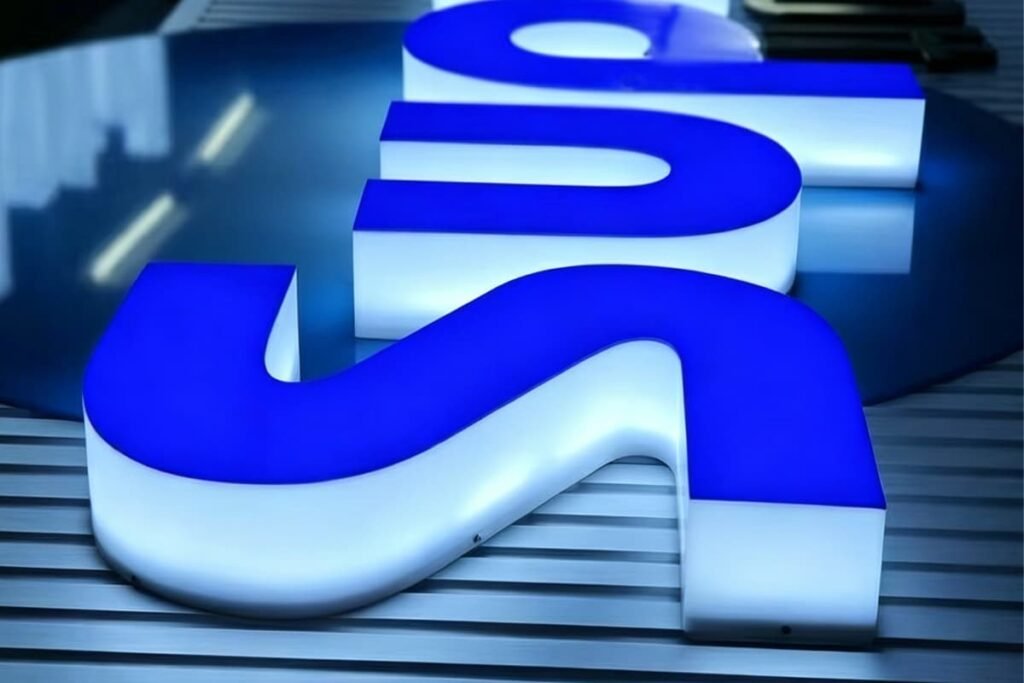
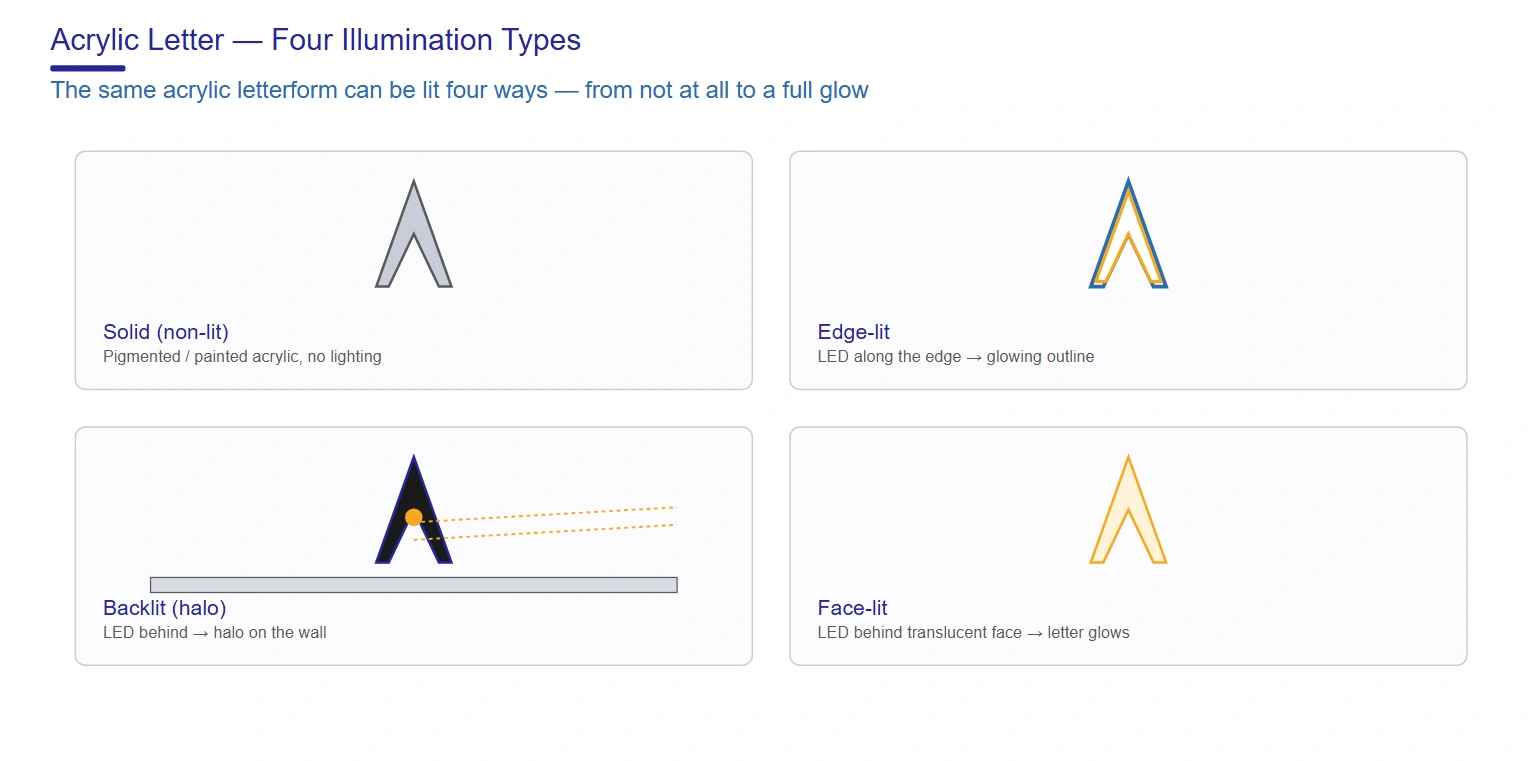
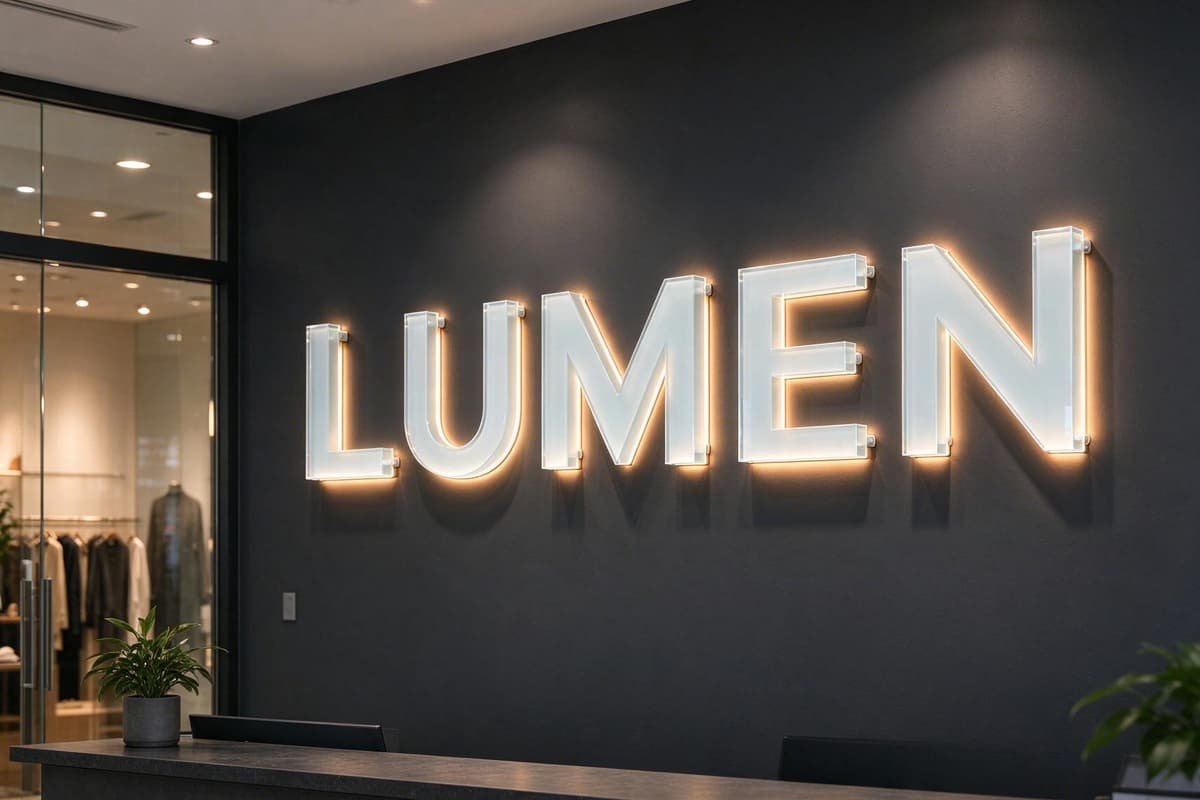
An acrylic letter is a dimensional letterform cut from solid acrylic (PMMA) — a flat, glossy letter with a polished edge, applied to a wall or panel to spell a brand name or logo. It is the clean, cost-effective alternative to fabricated metal or channel letters: the same dimensional presence at a lower weight and price, with a glass-like finish. Acrylic letters can be left unlit (solid), or illuminated three ways — edge-lit (a glowing outline), backlit (a halo on the wall) or face-lit (the whole letter glows).
This page is a factory-level engineering reference written for sign resellers, architects and project specifiers, procurement teams, distributors and chain-brand managers. It covers acrylic grades, the four illumination types, edge-lit engineering, finish and thickness options, mounting, IP and regulatory compliance, failure modes, QC methodology, total cost of ownership and market data — the specifications you need to place an order against, not a retail sales pitch.
What you can expect from our factory
- Cast acrylic (PMMA) letters in clear, frosted, pigmented, mirror and painted finishes
- Solid, edge-lit, backlit and face-lit illumination options
- Polished edges (flame- or diamond-polished) and Pantone / RAL colour matching
- MOQ from 1 piece; thickness 3–25 mm; heights 50 mm – 1,200 mm+
- ISO 9001:2015 quality system; CE / RoHS on illuminated builds
Construction & Anatomy
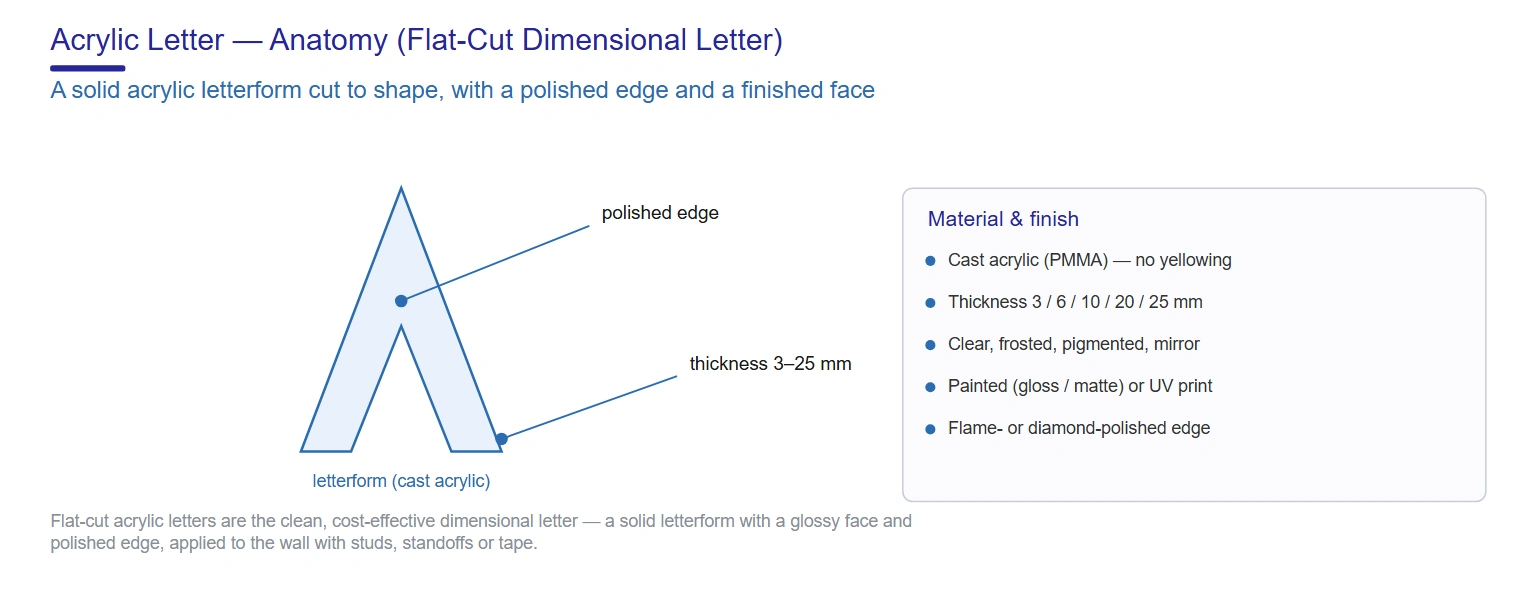
An acrylic letter is a single solid letterform cut to shape. Quality lives in three places: the material grade (cast vs extruded), the edge finish (polished, not rough-cut), and the face finish (painted or pigmented, matched to your brand). Cheap letters show their origin in a cloudy face and a chalky edge.
Acrylic Material Grades — Cast vs Extruded
| Property | Cast acrylic (PMMA) | Extruded acrylic |
|---|---|---|
| Optical clarity | Excellent, low internal stress | Good |
| Yellowing resistance | High (outdoor UV stable) | Lower over time |
| Machining & polishing | Excellent — clean polished edges | Tends to melt / gum on cutting |
| Thickness tolerance | Tighter | Looser |
| Cost | Higher | Lower |
| Use for letters | Recommended (premium letters) | Budget / short-life interior |
We cut letters from cast acrylic as standard — it machines to a clean edge and resists the yellowing that cheapens extruded acrylic outdoors. Extruded is available for budget interior jobs where the difference will never be seen.
Illumination Types — Four Ways to Light a Letter
| Type | How it lights | Best for | Notes |
|---|---|---|---|
| Solid (non-lit) | No lighting | Interior walls, clean branding | Pigmented / painted face |
| Edge-lit | LED along the edge → glowing outline | Premium logos, reception walls | Clear / frosted acrylic |
| Backlit (halo) | LED behind → halo on the wall | Lobbies, façades | Opaque letter + standoff |
| Face-lit | LED behind translucent face → letter glows | Storefronts, retail | Opal / white acrylic |
Edge-Lit Engineering — How the Glow Works
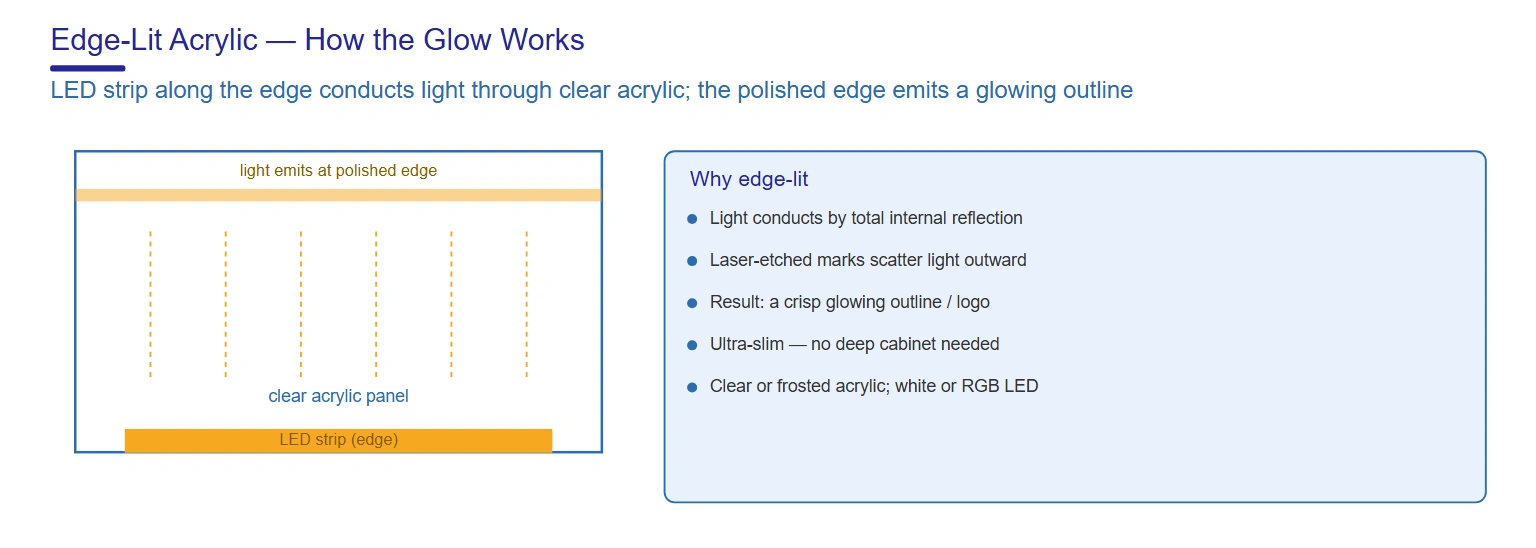
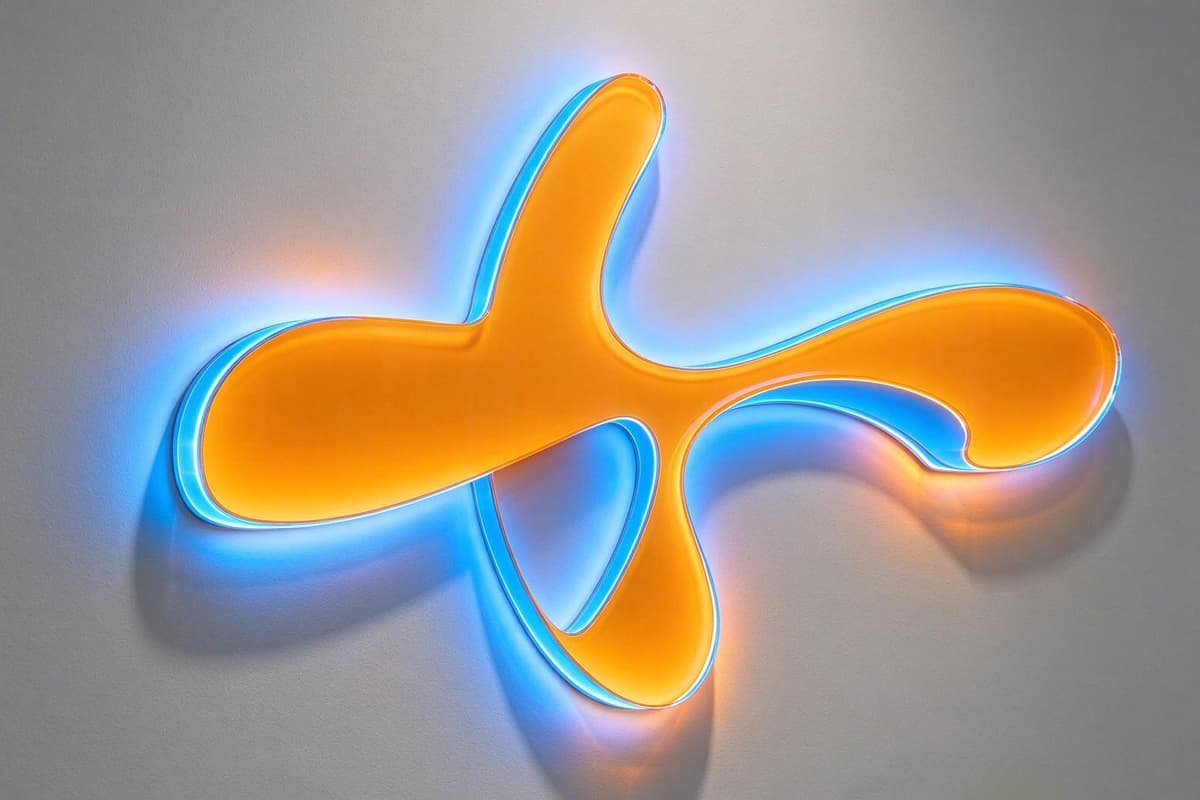
In an edge-lit acrylic letter, an LED strip sits along the edge of a clear acrylic form. The light conducts through the material by total internal reflection and is scattered outward at laser-etched marks and the polished edges, producing a crisp, glowing outline. The result is a premium, ultra-slim lit letter with no deep cabinet and no hot spots.
Finish & Colour Options
| Finish | Look | Best for |
|---|---|---|
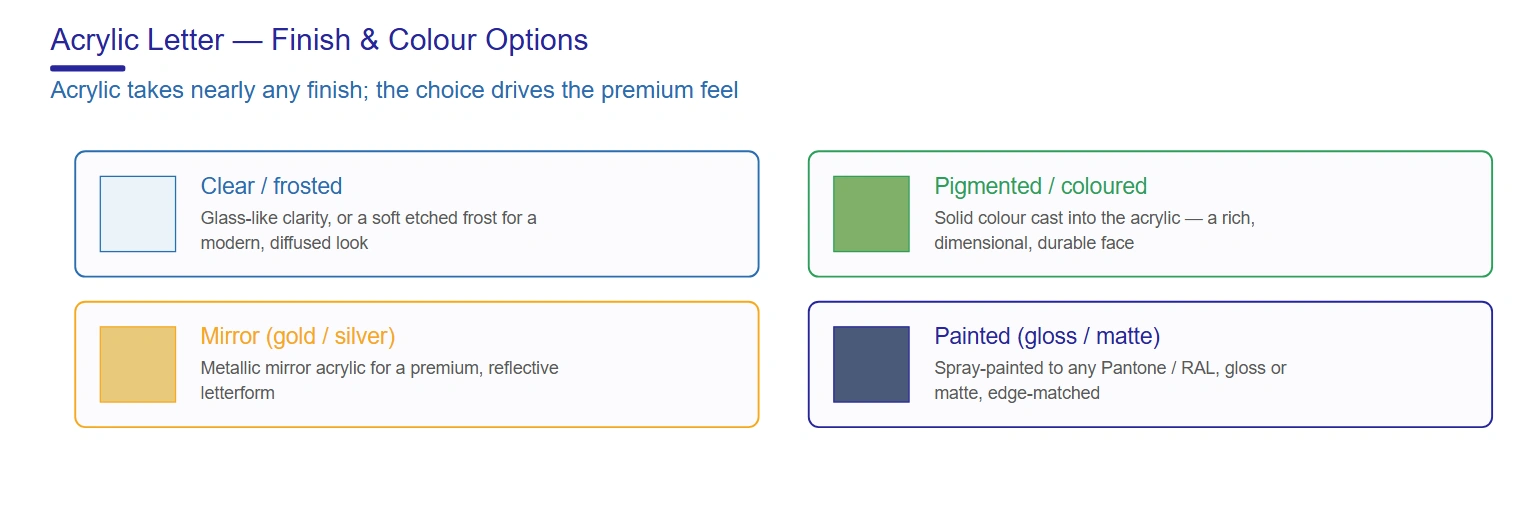
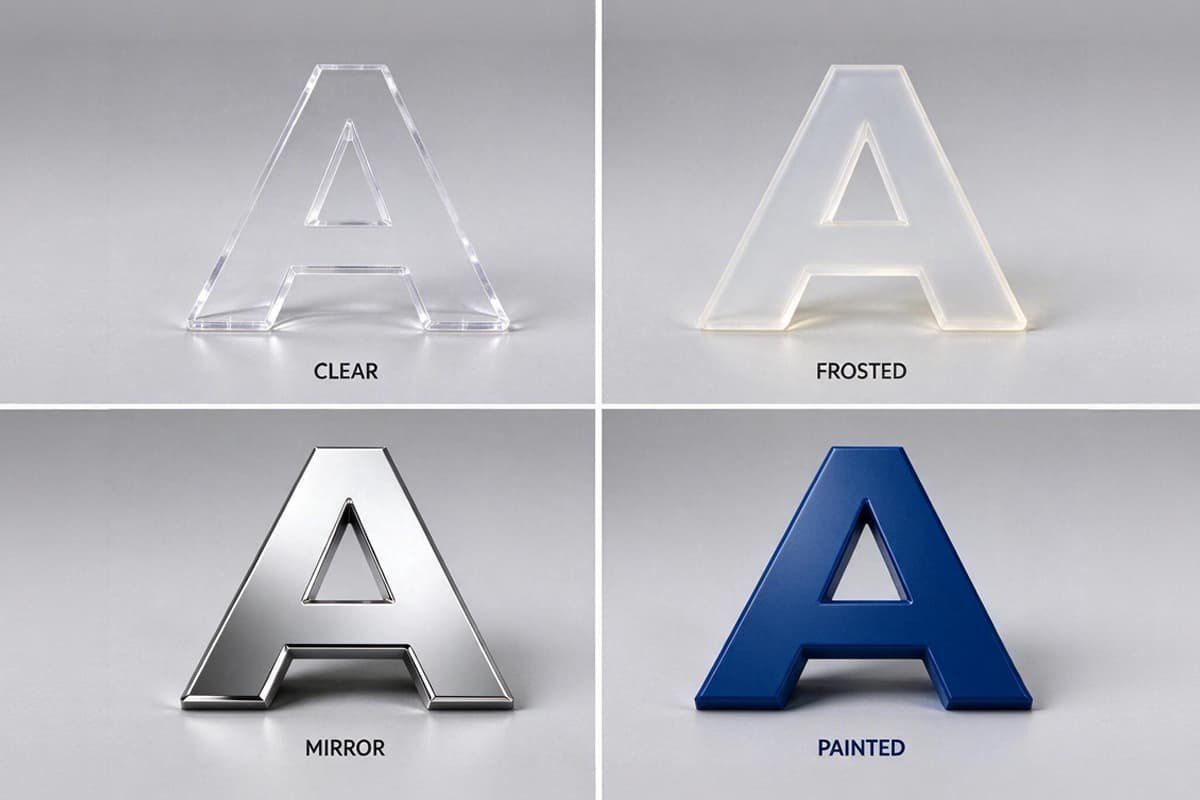
| Clear | Glass-like clarity | Edge-lit letters, layered logos |
| Frosted | Soft, diffused etch | Modern, non-reflective interiors |
| Pigmented / coloured | Solid colour cast into the acrylic | Bold, durable brand colours |
| Mirror (gold / silver) | Metallic reflective face | Premium, luxury branding |
| Painted (gloss / matte) | Spray-painted to any Pantone / RAL | Exact brand colour matching |
| UV printed | Full-colour, gradients | Logos and photographic effects |
Thickness & Height Guide
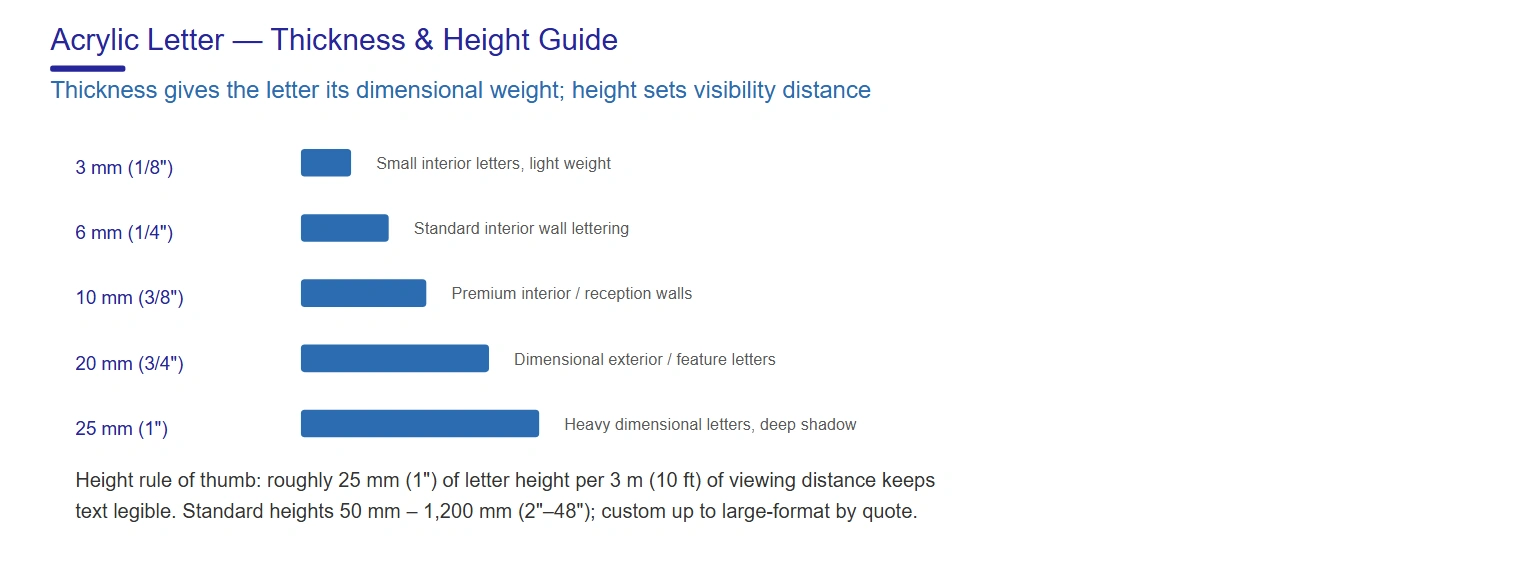
| Thickness | Letter weight | Typical use |
|---|---|---|
| 3 mm (1/8″) | Light | Small interior lettering |
| 6 mm (1/4″) | Standard | Interior wall lettering |
| 10 mm (3/8″) | Premium | Reception walls, signage |
| 20 mm (3/4″) | Dimensional | Exterior / feature letters |
| 25 mm (1″) | Heavy | Deep-shadow dimensional letters |
Product Specifications (Ordering Reference)
| Parameter | Specification |
|---|---|
| Material | Cast acrylic (PMMA); extruded on request |
| Thickness | 3 / 6 / 10 / 20 / 25 mm (1/8″–1″) |
| Height | 50 mm – 1,200 mm (2″–48″); larger by quote |
| Finish | Clear, frosted, pigmented, mirror, painted (Pantone/RAL), UV print |
| Edge | Flame- or diamond-polished |
| Cutting | Laser-cut or CNC-routed to your vector file |
| Illumination | Solid / edge-lit / backlit (halo) / face-lit; 50,000 hr LED |
| Mounting | Stud + standoff / double-sided tape / backer panel |
| Ingress protection | IP20 (interior) / IP65 (outdoor illuminated) |
| Certifications | CE, RoHS (illuminated builds), ISO 9001 |
Regulatory & Compliance
| Standard | Scope | Relevance |
|---|---|---|
| CE (LVD + EMC) | EU electrical safety | Illuminated (edge/back/face-lit) letters |
| RoHS | Hazardous substances | Lead-free LED and wiring |
| ISO 9001:2015 | Quality management | Cutting, finishing and QC process control |
| IP65 | Ingress protection | Outdoor illuminated letters |
Failure Modes & Prevention
| Failure mode | Root cause | Detection | Prevention |
|---|---|---|---|
| Cloudy / yellowed face | Extruded acrylic, or poor UV grade | Colour shift after 1–2 years | Cast acrylic; UV-stable pigment |
| Chalky / rough edge | Poor cutting or no polishing | Visible edge roughness | Laser cut + flame/diamond polish |
| Colour mismatch | Wrong paint mix or batch | Side-by-side colour difference | Pantone/RAL matching; single batch |
| Edge-lit dark spots | Uneven LED placement | Dim sections of outline | Even LED pitch; single-bin LEDs |
| Letter detach | Inadequate adhesive / stud | Letter falling | Correct stud/tape per weight & surface |
| Halo uneven | Inconsistent standoff gap | Uneven wall glow | Machined standoffs; template mount |
Quality Control & Test Methodology
| Test | Method | What it verifies | Acceptance |
|---|---|---|---|
| Edge polish | Visual / gloss check | Clean, glossy edge | No roughness |
| Colour match | Pantone / RAL verification | Exact brand colour | Delta E ≤ 1.5 |
| Dimensional | Template + caliper | Letter height & thickness | ±0.5 mm |
| LED burn-in | 24–48 hr soak | Edge/back-lit reliability | No dead LEDs |
| Adhesion | Pull test | Mounting strength | Pass per surface |
| Lumen uniformity | Luminance check (lit builds) | Even glow | ±10% |
Total Cost of Ownership (TCO)
| Cost factor | Acrylic letters | Metal letters | Channel letters |
|---|---|---|---|
| Initial cost | Lowest | High | Moderate |
| Weight | Light (easy install) | Heavy | Moderate |
| Illumination | Optional (edge/back/face) | Optional (backlit) | Built-in |
| Durability | Good (UV cast acrylic) | Excellent | Good |
| Maintenance | Minimal | Minimal | LED service |
| Best for | Budget + premium interior | Architectural exterior | Storefront lit signage |
Applications by Industry
- Corporate & reception — painted or edge-lit logo walls
- Retail & storefronts — face-lit and backlit acrylic signage
- Healthcare & education — wayfinding, room and directory letters
- Hospitality — frosted and mirror acrylic interior branding
- Exhibitions & events — lightweight portable lettering and logos
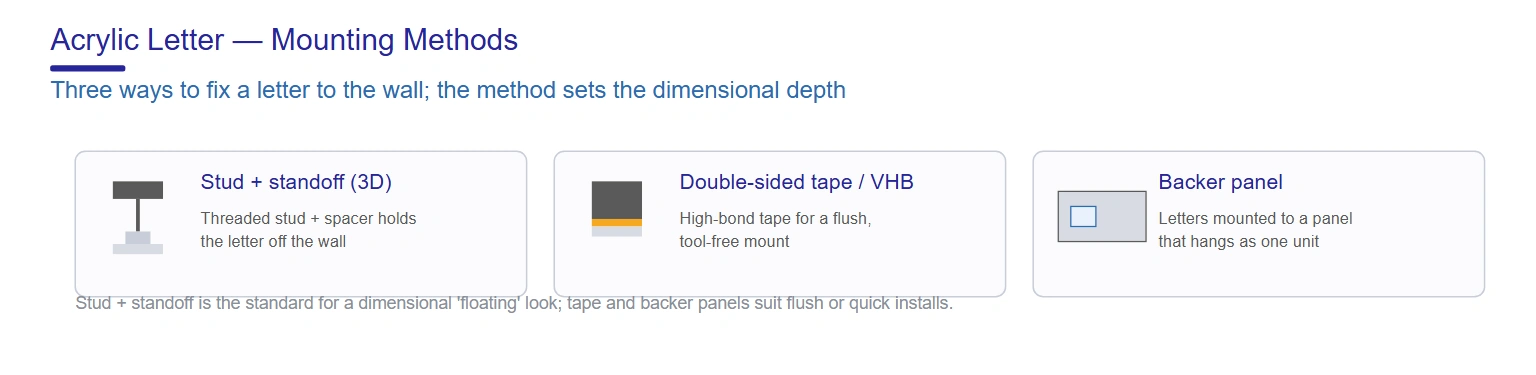
Mounting Methods
Three ways to fix an acrylic letter to the wall; the method sets the dimensional depth. Stud + standoff gives a floating 3D look, high-bond tape gives a flush, tool-free mount, and a backer panel hangs the whole set as one unit.
Customization Options
- Font & shape — any vector logo, custom shape or CNC-cut silhouette
- Thickness & height — 3–25 mm thick, 50 mm – 1,200 mm+ tall
- Finish & colour — clear, frosted, pigmented, mirror, painted, UV print
- Illumination — solid, edge-lit, backlit (halo) or face-lit
- Mounting — stud + standoff, tape, or backer panel
- Edge detail — polished, frosted, or painted edge
MOQ, Pricing Factors & Lead Time
| Factor | How it affects price & lead time |
|---|---|
| Size & height | Larger letters use more material and machining |
| Thickness | Thicker acrylic costs more per letter |
| Finish | Painted and mirror cost more than clear / pigmented |
| Illumination | Edge/back/face-lit adds LED and driver cost |
| Quantity | MOQ 1 pc; unit cost drops at 25 / 100 / 500 letters |
| Lead time | Samples 7–10 days; production 10–15 days after approval |
Production Process
- Design confirmation — vector artwork to cut file, thickness and finish confirmed
- Cutting — laser-cut or CNC-routed from cast acrylic sheet
- Edge finishing — flame- or diamond-polished to a glossy edge
- Face finishing — painted (Pantone/RAL), pigmented, frosted, or UV printed
- Illumination (lit builds) — LED strip/modules fitted and wired
- Mounting hardware — studs, standoffs or tape applied; template supplied
- QC — dimensional, colour and (lit) burn-in checks
- Packing & shipping — protective export packing
Supplier Evaluation Checklist (16 Points)
- Does the supplier cut from cast or extruded acrylic — and do they explain the difference?
- Can they polish edges to a glossy finish (flame / diamond)?
- Can they match your exact brand colour (Pantone / RAL)?
- Do they offer all four illumination types (solid, edge, back, face-lit)?
- What LED brand and driver do they use on lit builds, and what is the L70?
- Is edge-lit illumination even, with no dark spots?
- What thickness and height range can they produce?
- Are they ISO 9001 certified, with CE / RoHS on illuminated builds?
- Do they control colour and batch consistency?
- Is there a documented QC checklist before shipping?
- What is the MOQ, and can you order one sample first?
- Are lead times realistic (7–10 day samples, 10–15 day production)?
- Do they supply a mounting template with stud / standoff spacing?
- Is the packing protective for transit (letters are rigid but scratchable)?
- Are pricing factors transparent (size, thickness, finish, lighting, quantity)?
- Can they provide references for similar acrylic letter projects?
Market Intelligence & Outlook
Acrylic letters sit on top of a polymethyl methacrylate (PMMA) materials market that MarketsandMarkets values at USD 5.48 billion in 2026, growing at 3.4% CAGR to USD 6.48 billion by 2031, with cast acrylic sheets the second-largest form — the grade used for premium letters because of its optical clarity and weather resistance. Demand is driven by signage, retail displays and architectural interiors.
This sits inside a broader signage market that Future Market Insights values at USD 39.43 billion in 2026, growing at 4.3% CAGR to USD 60.06 billion by 2036. For a B2B supplier, three drivers stand out:
- Brand-standard interior signage — chains want consistent acrylic lettering across locations
- Premium-but-cost-effective — acrylic gives a dimensional look at a fraction of metal cost
- Edge-lit growth — LED cost decline makes illuminated acrylic affordable for mid-size brands
Frequently Asked Questions
What is the difference between acrylic letters and channel letters?
Acrylic letters are flat, solid letterforms cut from a single sheet of acrylic. Channel letters are hollow cans with an acrylic face, metal returns and internal LED — deeper and more expensive. Acrylic letters are lighter and cheaper; channel letters give a brighter, more dimensional lit look.
Can acrylic letters be illuminated?
Yes, three ways: edge-lit (LED along the edge for a glowing outline), backlit (LED behind for a wall halo) and face-lit (LED behind a translucent face so the letter glows). Solid non-lit is also available.
How thick should my letters be?
6 mm (1/4″) is the standard interior thickness; 10 mm (3/8″) for premium reception walls; 20–25 mm for exterior and heavy dimensional letters. We recommend the thickness based on letter height and viewing distance.
Can you match my exact brand colour and font?
Yes. We cut to your vector logo and match colour to Pantone or RAL. Painted faces are matched to Delta E ≤ 1.5 so your letters match your brand across locations.
Are acrylic letters suitable for outdoor use?
Yes, using cast acrylic which resists UV yellowing, and weatherproof LED on illuminated builds. We specify IP65 on outdoor edge/back/face-lit letters.
How are the letters mounted?
Three methods: stud + standoff (a dimensional floating look), high-bond double-sided tape (flush, tool-free) or a backer panel (letters pre-mounted to a panel that hangs as one unit). We supply a drilling template.
What is the minimum order quantity?
1 piece. Order a single sample letter to check the finish and colour, then commit to a full set. Unit cost drops at 25, 100 and 500 letters.
Key Takeaways
- Acrylic letters are flat-cut dimensional letterforms from solid PMMA — the clean, cost-effective alternative to metal and channel letters.
- Choose cast acrylic for a clear face and a polished edge that resists yellowing outdoors.
- Four ways to light a letter: solid, edge-lit (outline glow), backlit (wall halo) and face-lit (letter glows).
- Polished edges, Pantone/RAL colour matching and MOQ 1 pc make acrylic letters the flexible choice for chains and resellers.
- Edge-lit and backlit builds use 50,000-hour LEDs with even, hot-spot-free glow — backed by documented QC.
Ready to Improve Your Advertising Sign Supply Chain?
Whether you are looking for a new sign supplier, a backup manufacturer, or a trusted sourcing partner, We are ready to support your business.