Backlit Signs & Signage
— LED Illuminated & Halo-Lit
Backlit signs illuminated from behind — backlit panels with an even glow, and halo (reverse) letters with a soft wall halo. A factory-level engineering reference for sign resellers, architects, procurement teams, distributors and chain brands — with construction, backlighting, IP, MOQ and QC specifications you can place an order against.
Backlit panel · halo letter · IP65–IP67 outdoor · CE / RoHS / UL · MOQ 1 pc
What Is a Backlit Sign?
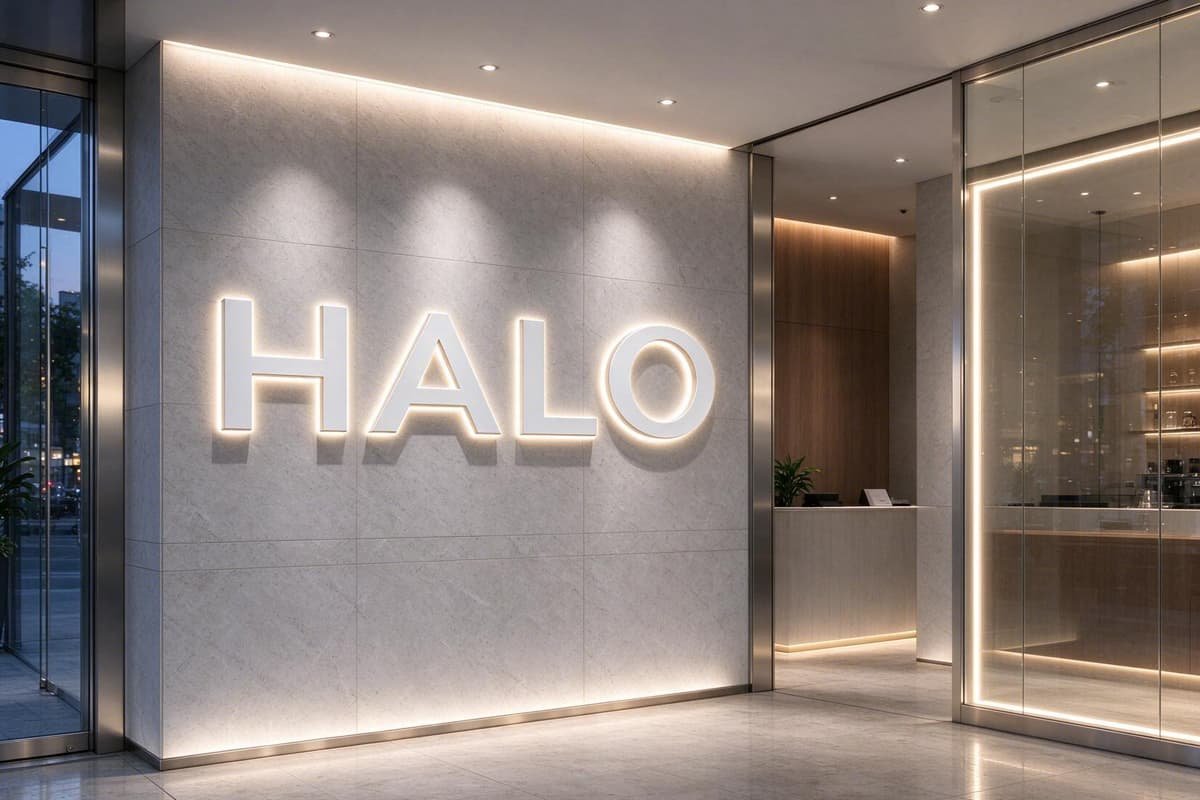
A backlit sign is a sign illuminated from behind — the light source sits behind the face, graphic or letterform, so the sign glows against its surroundings. There are two fundamental forms: a backlit panel, where light shines forward through a translucent or printed face to make the whole graphic glow; and a halo (reverse) letter, where light is aimed back at the wall behind an opaque letter to create a soft ring of light around it. Both read cleanly by day and glow with intent by night, which is why backlit signage is the fastest-growing product segment in the printed-signage market.
This page is a factory-level engineering reference written for sign resellers, architects and project specifiers, procurement teams, distributors and chain-brand managers. It covers the backlighting technique, panel and halo construction, LED and power engineering, IP and regulatory compliance, failure modes, QC methodology, total cost of ownership and market data — the specifications you need to place an order against, not a retail sales pitch.
What you can expect from this factory
- Backlit panels and halo (reverse) letters, engineered for even, hot-spot-free illumination
- ISO 9001:2015 quality system; CE / RoHS / UL 48 / UL 879 options; IP65–IP67 outdoor builds
- 50,000-hour LED sources (L70) with correct pitch and diffuser for uniform glow
- MOQ from 1 piece, custom sizes, faces, finishes and mounting
- 7–15 day sample and production lead times with export packaging
Construction & Anatomy — Panel vs Halo
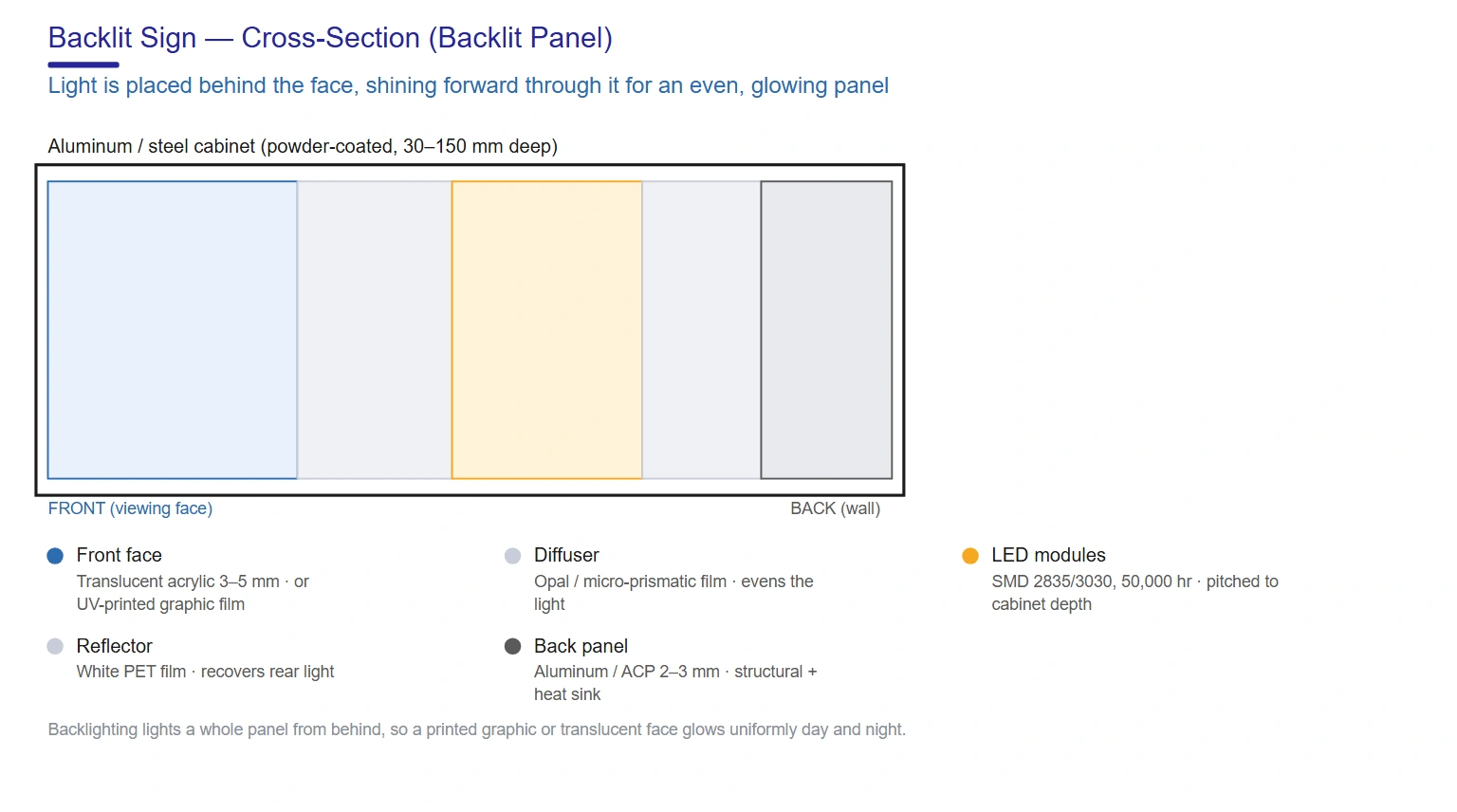
Every backlit sign is a stack of layers built around one question: where the light goes. A panel shines light forward through the face; a halo letter aims light back at the wall. Understanding the stack is how a buyer separates a sign that glows evenly for a decade from one that shows hot spots and dark patches.
| Layer | Backlit panel | Halo (reverse) letter |
|---|---|---|
| Face / graphic | Translucent acrylic 3–5 mm or UV-printed film | Opaque acrylic / metal face (no light through) |
| LED source | SMD 2835/3030 modules behind the face | SMD 2835 modules facing back at the wall |
| Light path | Forward through a diffuser → whole face glows | Backward onto the wall → halo of light |
| Depth | 30–150 mm cabinet | 20–80 mm letter return (stud-mounted) |
| Mounting | Flush to the wall | Off-wall studs / standoffs set the halo spread |
| Back / frame | Aluminum / steel cabinet | Reflective back for even halo |
The Backlighting Technique — Panel vs Halo
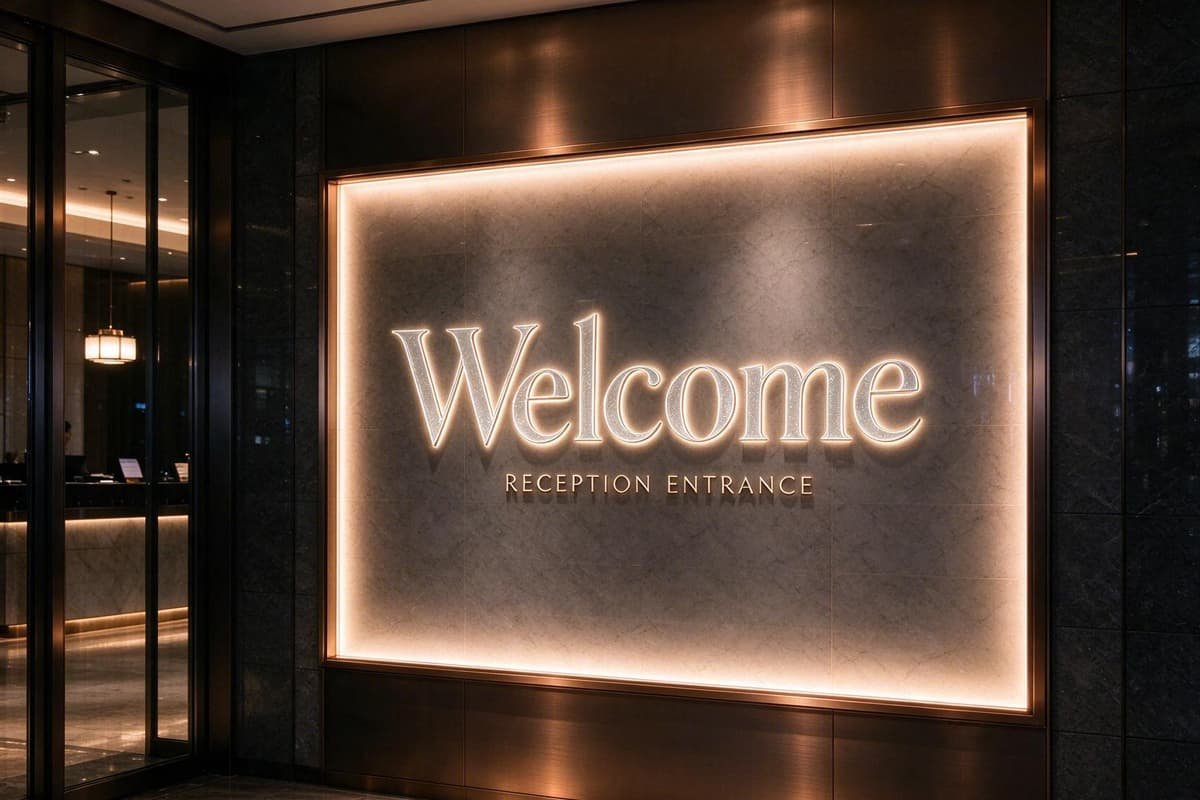
The two backlit forms are built around different optical goals. A backlit panel places the LED array behind a diffuser, so the whole graphic face emits even light — the standard for logo panels, menu boards and storefront faces. A halo letter hides the LED behind an opaque letter and aims it at the wall, so the letter itself reads as a solid architectural form while a soft glow spills around it.
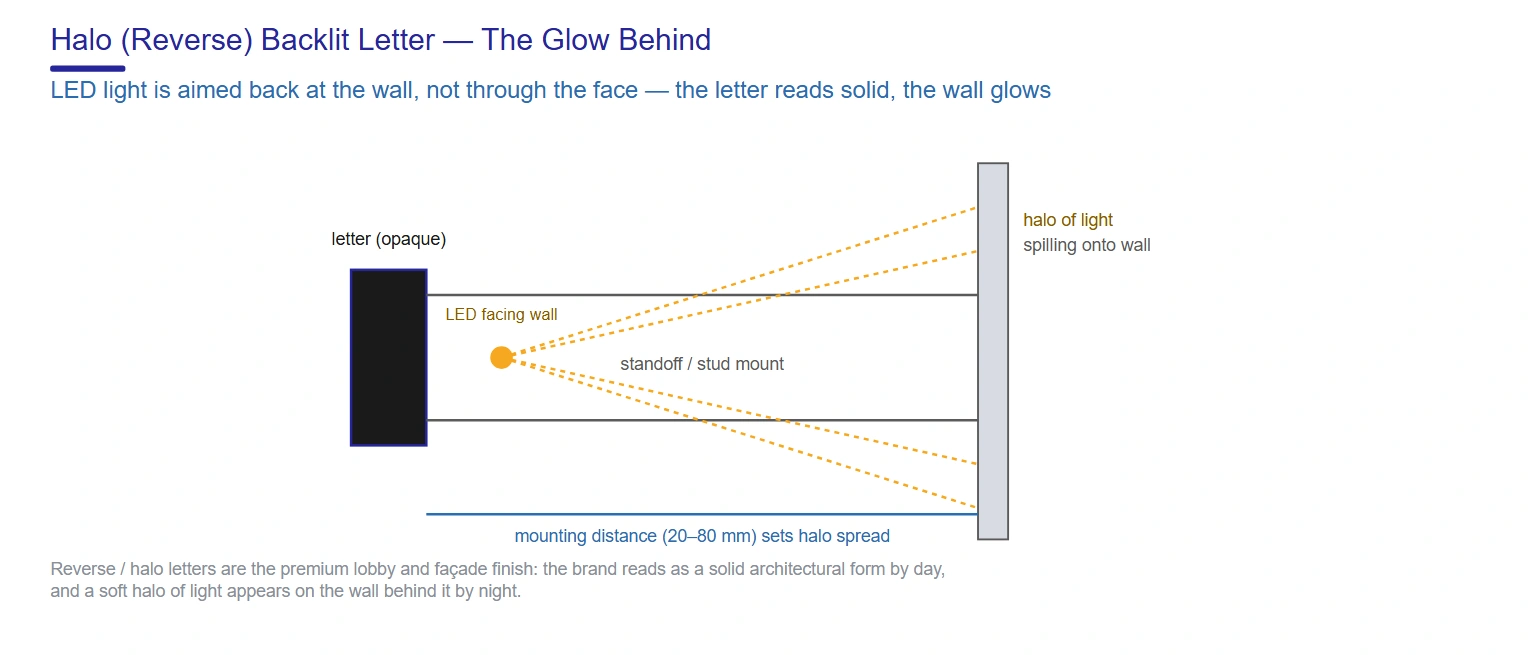
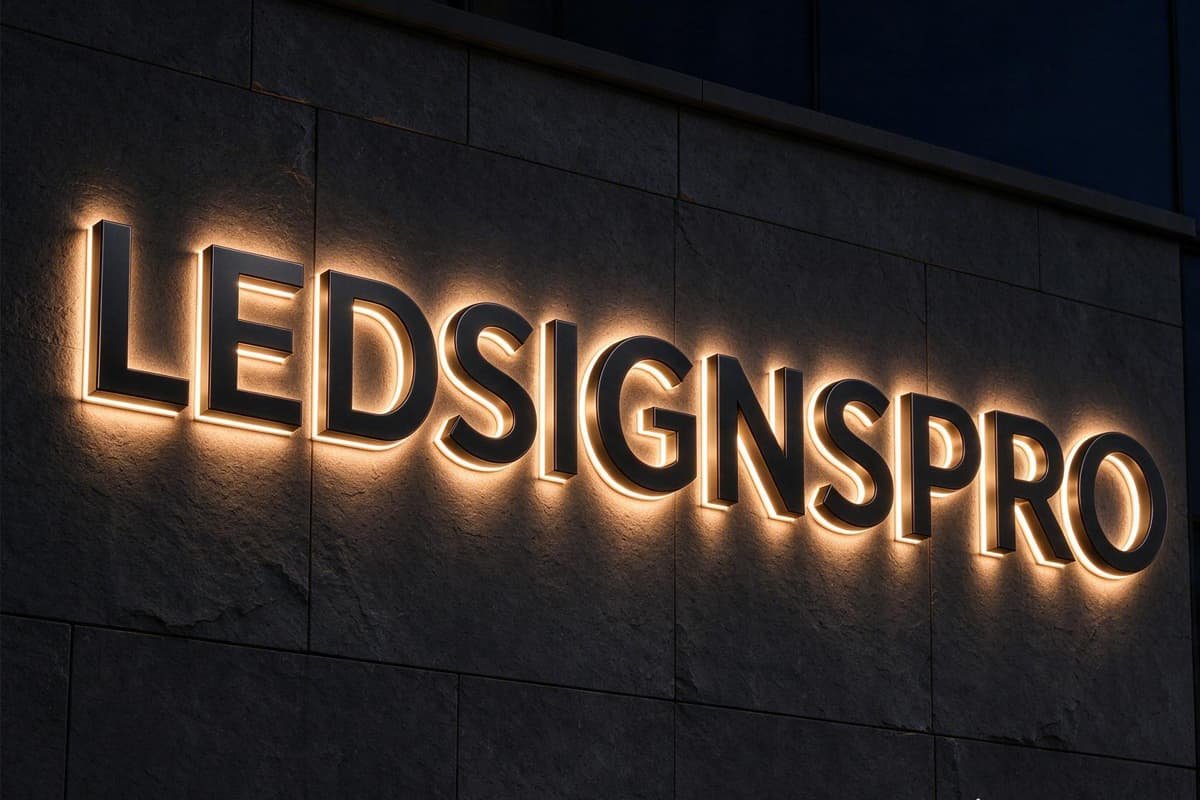
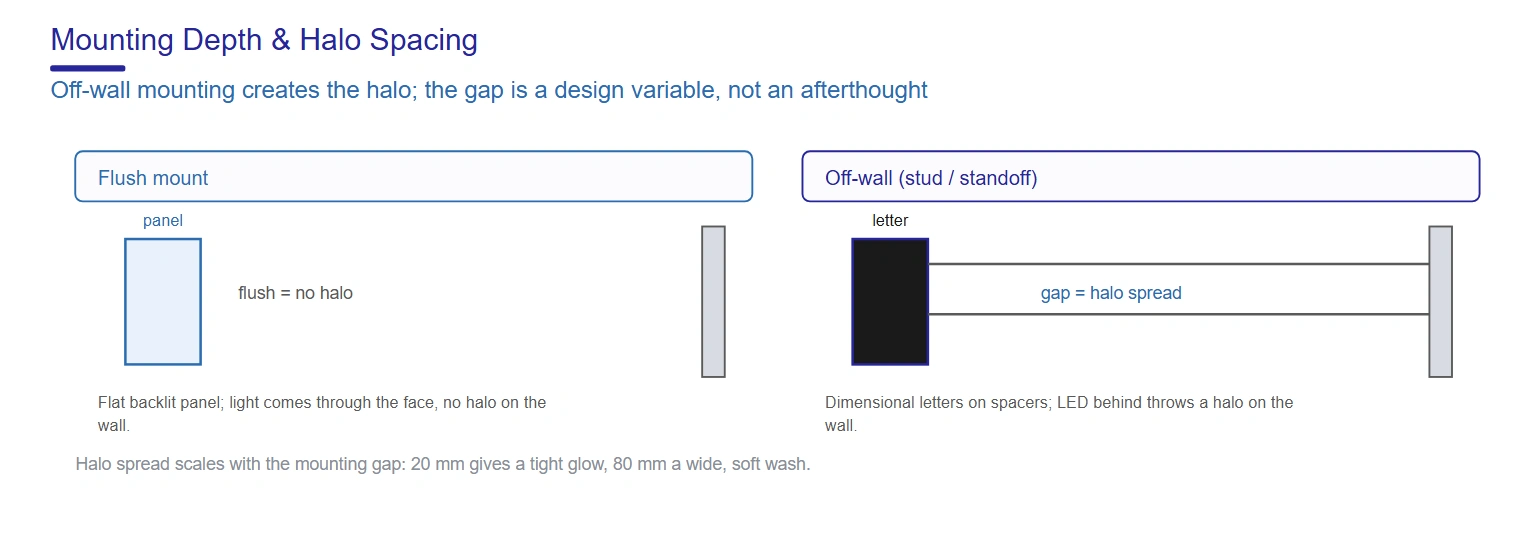
The halo effect is a design variable, not an accident: the mounting gap between the letter and the wall controls the size and softness of the glow. A 20 mm gap gives a tight, defined ring; an 80 mm gap gives a wide, soft wash. We spec this gap to your brand and wall condition.
Backlit Sign — Four Core Builds
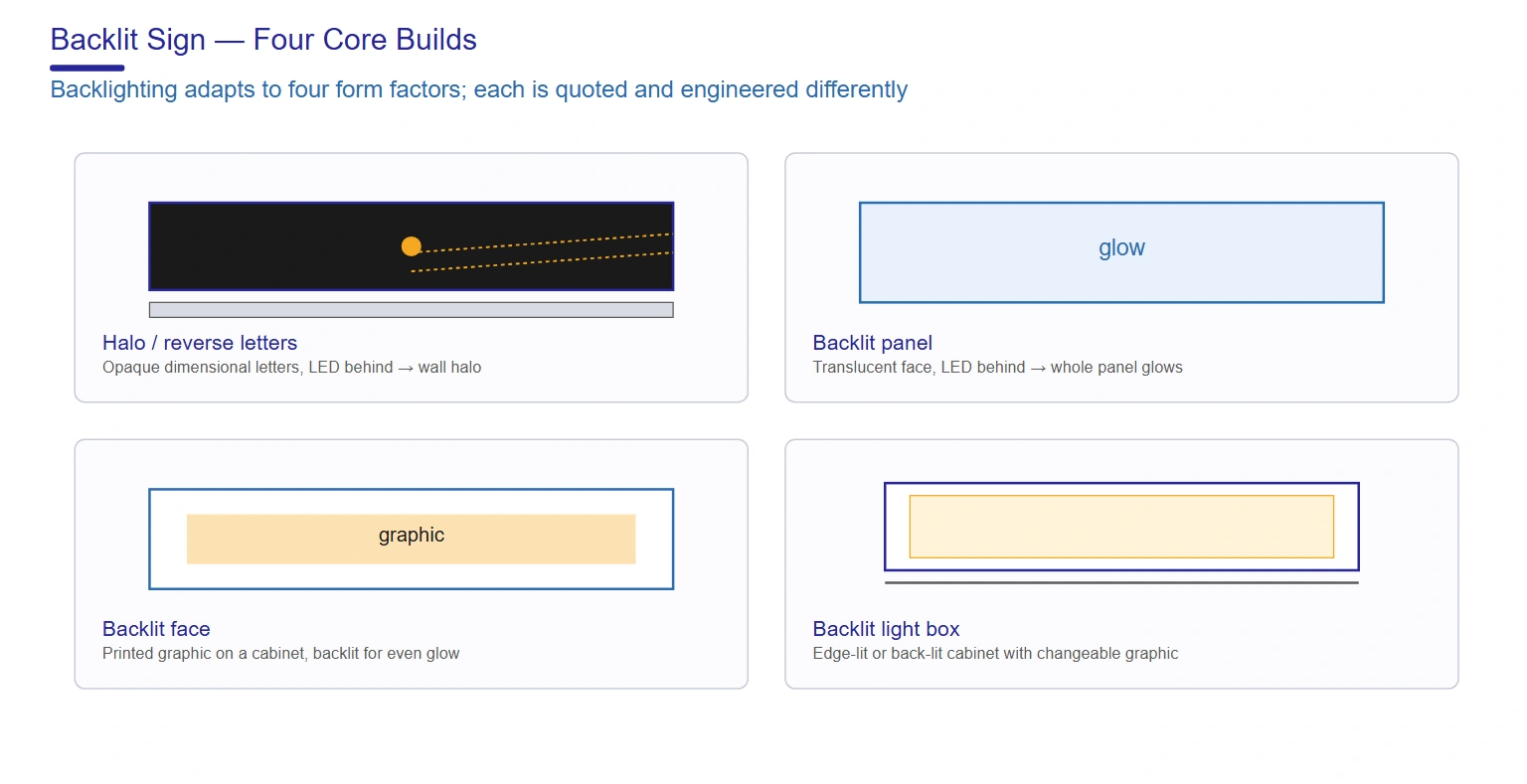
| Build | How it glows | Best for |
|---|---|---|
| Halo / reverse letters | Opaque letters, LED behind → wall halo | Lobbies, façades, premium corporate |
| Backlit panel | Translucent face, LED behind → panel glows | Logo panels, reception walls, menus |
| Backlit face | Printed graphic on a cabinet, backlit | Full-colour brand graphics, day & night |
| Backlit light box | Edge-lit or back-lit cabinet, changeable graphic | Promotions, menus, retail windows |
Face & Graphic Material Options
| Face | Glow style | Best for | Notes |
|---|---|---|---|
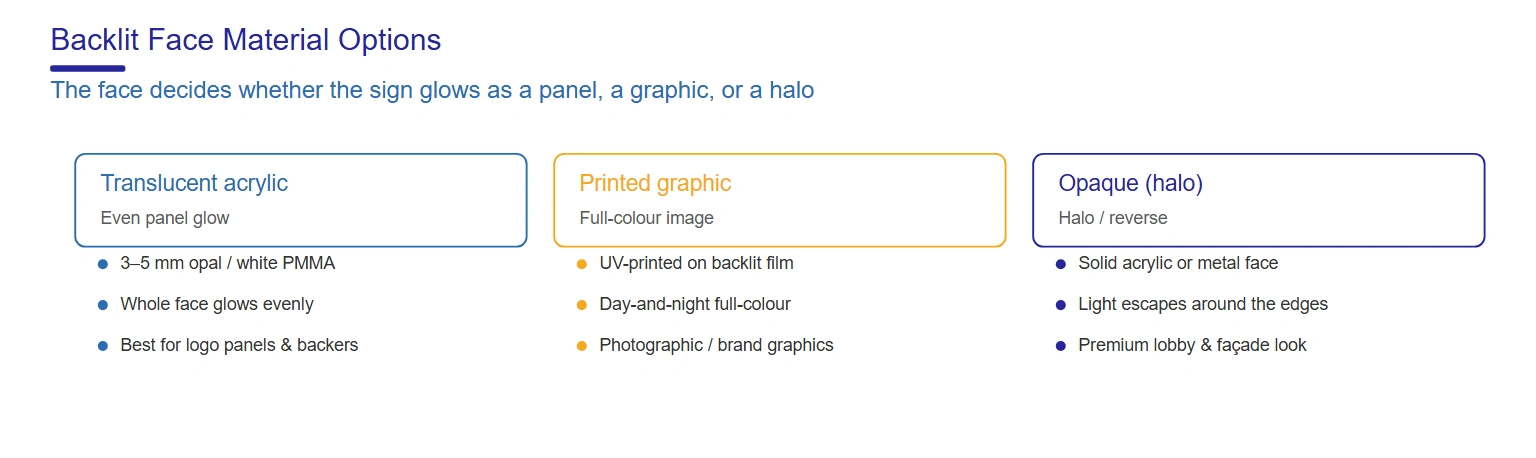
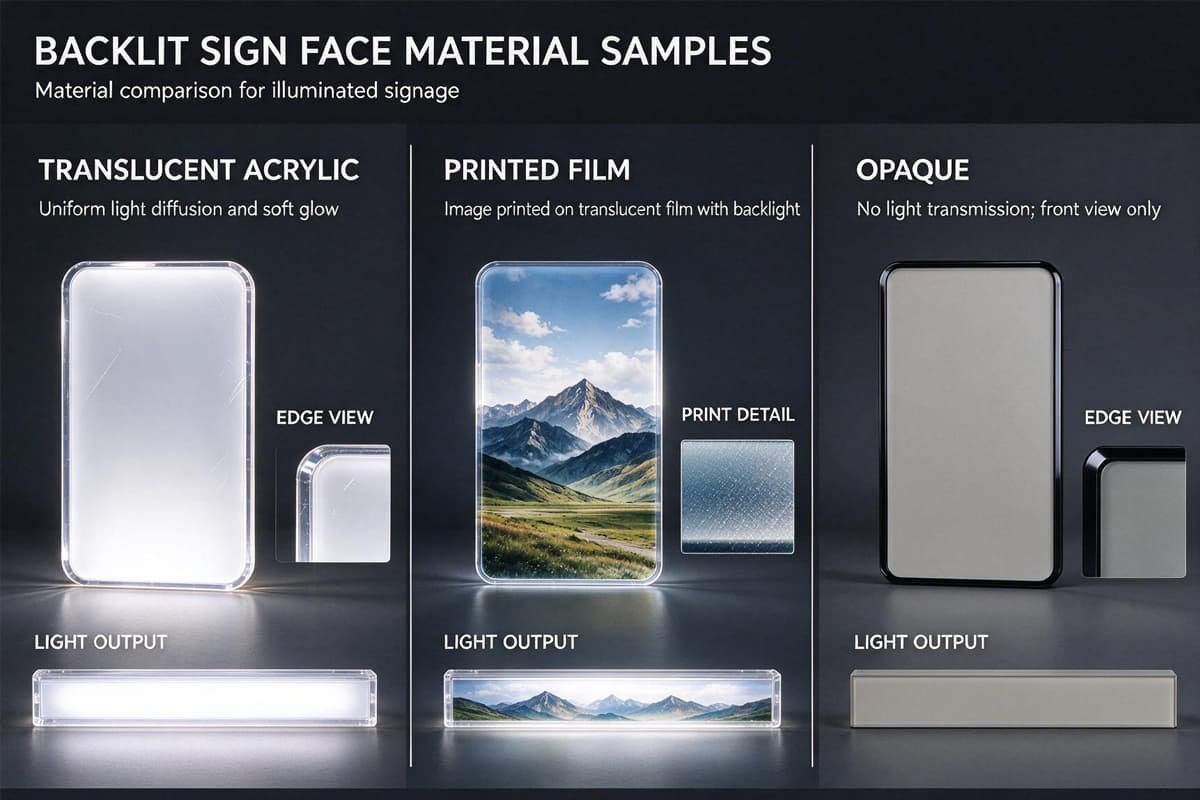
| Translucent acrylic (PMMA) | Even panel glow | Logo panels & backers | 3–5 mm opal / white |
| Printed graphic (backlit film) | Full-colour image | Photographic / brand graphics | UV-printed, day-and-night |
| Opaque (halo) | Edge-only glow | Premium lobby / façade letters | Solid acrylic or metal face |
LED, Brightness & Even Backlighting
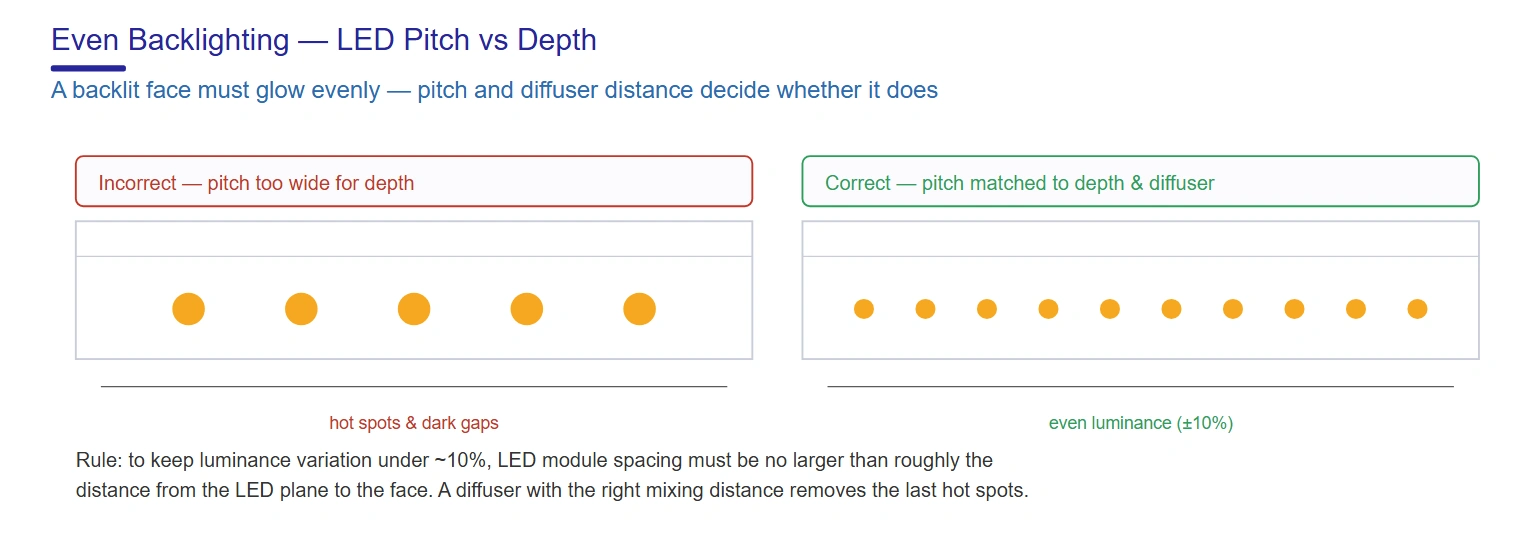
An even backlit glow is a geometry problem: LED module pitch must track the cabinet depth and the diffuser, or the face shows bright spots and dark gaps. We calculate the pitch and specify the diffuser so luminance stays within ±10% across the face.
| Parameter | Specification |
|---|---|
| LED type | SMD 2835 / 3030 modules or edge strips, high CRI |
| Colour temperature | 2700 K – 6500 K white; tunable CCT; RGB / RGBW |
| Colour rendering (CRI) | ≥80 standard, ≥90 optional |
| Luminance uniformity | ±10% across the face |
| Lifespan | 50,000 hr (L70) |
| Power | 12 V / 24 V DC; 100–240 V AC; Class-2 / SELV drivers |
| Ingress protection | IP20 indoor / IP65–IP67 outdoor |
Product Specifications (Ordering Reference)
| Parameter | Specification |
|---|---|
| Sign type | Backlit panel / backlit face / halo (reverse) letter / backlit light box |
| Face | Translucent acrylic 3–5 mm / printed backlit film / opaque acrylic or metal |
| Frame & cabinet | Aluminum extrusion or steel, powder-coated / brushed / anodized |
| Depth | 30–150 mm (panel) / 20–80 mm return (halo letter) |
| LED | SMD 2835/3030, 50,000 hr L70 |
| Brightness | 500–3,000 cd/m² |
| Colour temperature | 2700–6500 K, CCT tunable, RGB / RGBW |
| Power | 12 V / 24 V DC, 100–240 V AC; Class-2 |
| Ingress protection | IP20 (indoor) / IP65–IP67 (outdoor) |
| Mounting | Flush / stud + standoff / hanging / raceway |
| Certifications | CE, RoHS, UL 48 / UL 879 (optional), ETL |
Regulatory & Compliance Matrix
| Standard | Scope | Relevance to backlit signs |
|---|---|---|
| UL 48 | Electric signs (North America) | Full sign listing for US / Canadian installs |
| UL 879 | Electric sign components | Listed LED modules & power supplies |
| CE (LVD + EMC) | EU electrical safety & EMC | Required for the European market |
| RoHS | Restriction of hazardous substances | Lead-free solder, compliant materials |
| IP65 / IP67 | Ingress protection (IEC 60529) | Dust-tight + water-jet / immersion for outdoor |
| ISO 9001:2015 | Quality management | Process control from cutting to final inspection |
Failure Modes & Prevention
| Failure mode | Root cause | Detection | Prevention |
|---|---|---|---|
| Hot spots / dark gaps | LED pitch too wide for depth | Visual check at low brightness | Pitch calculated from depth; ±10% uniformity spec |
| Uneven halo | Inconsistent mounting gap or reflector | Visual check of wall glow | Machined standoffs; reflective back panel |
| Water ingress / fogging | Failed seal | Condensation inside face | IP65–IP67 seal, weep holes, gasket |
| LED flicker / early death | Cheap driver, over-driven LEDs | Flicker, dead segments | UL-listed drivers, correct load, aging test |
| Colour mismatch | Mixed LED bins | Side-by-side colour difference | Single-bin LEDs; BIN uniformity control |
| Graphic fading | No UV protection | Faded print after ~1 year | UV-cured inks, lamination, backlit-grade media |
Quality Control & Test Methodology
| Test | Standard / method | What it verifies | Acceptance |
|---|---|---|---|
| Brightness uniformity | Luminance mapping | No hot spots / dark areas | ±10% variation |
| Ingress protection | IEC 60529 (IP65/67) | Water & dust resistance | Pass rated IP |
| LED aging / burn-in | 24–48 hr soak | Early-failure screening | No dead / flickering LEDs |
| Lumen maintenance | L70 rating | Long-term brightness | 50,000 hr L70 |
| Electrical safety | Hi-pot / ground continuity | Insulation & grounding | Pass UL / IEC |
| Adhesion | Cross-hatch (ASTM D3359) | Paint & print adhesion | Pass |
Total Cost of Ownership (TCO)
| Cost factor | LED backlit sign | Fluorescent backlit | Digital display |
|---|---|---|---|
| Initial cost (per m²) | Moderate | Low (obsolete) | High |
| Energy use | Low (20–50 W/m²) | Higher | Moderate–high |
| Lamp / module life | 50,000 hr | 8,000–10,000 hr | 5–7 yr panel |
| Maintenance | Minimal | Frequent relamping | Component service |
| Graphic change | Face swap (cheap) | Cheap | Content update only |
| 10-year TCO | Lowest | High | Highest |
Applications by Industry
- Corporate & lobbies — halo letter reception walls, logo panels
- Retail & storefronts — backlit faces, window graphics, light boxes
- Hospitality & restaurants — menu boards, bar & café branding
- Healthcare & public — wayfinding, directory and information panels
- Transportation — backlit advertising in airports, metro and stations
- Exhibitions & trade shows — portable backlit displays and SEG frames
Mounting & Halo Spacing
How a backlit sign is mounted determines whether you get a flush panel or a dimensional halo. Off-wall studs and standoffs create the halo; the mounting gap is the design variable that controls its spread — a 20 mm gap gives a tight ring, an 80 mm gap a wide, soft wash.
Customization Options
- Size & shape — any panel, logo silhouette, or CNC-cut letterform
- Face & graphic — translucent acrylic, printed film, opaque (halo), SEG fabric
- Frame finish — powder coat (any RAL), brushed, anodized, mirror
- Lighting — white, tunable CCT, RGB or RGBW; dimming & sensors
- Mounting — flush, stud + standoff (halo), hanging, raceway
- Halo gap — 20–80 mm, set to your desired glow spread
MOQ, Pricing Factors & Lead Time
| Factor | How it affects price & lead time |
|---|---|
| Size & area | Larger lit area = more LED, material and cabinet |
| Sign type | Halo letters cost more per unit than flat backlit panels |
| Face material | Printed graphic and SEG cost more than plain acrylic |
| IP rating | IP65–IP67 sealing and stainless hardware add cost |
| Quantity | MOQ 1 pc; unit cost drops at 50 / 100 / 500 pcs |
| Lead time | Samples 7–10 days; production 10–15 days after approval |
Production Process
- Design confirmation — artwork to production drawings, dimensions and lighting confirmed
- Cabinet / letter fabrication — aluminum extrusion or steel, cut, bent, welded, painted
- Face & graphic — acrylic cut and printed, or backlit film / SEG produced
- LED assembly — modules mounted, wired, and load-tested at the specified pitch
- Assembly & sealing — layers assembled, gasket and seal applied to the rated IP
- QC & burn-in — 24–48 hr soak, uniformity and safety checks
- Packing & shipping — ISTA-tested export packing, FOB or door-to-door
Supplier Evaluation Checklist (16 Points)
- Does the supplier offer both backlit panels and halo (reverse) letters?
- Can they explain the panel-vs-halo light path and recommend the right one?
- What LED brand and driver do they use, and what is the rated L70?
- Can they quote a luminance uniformity figure (±10% or better)?
- How do they prevent hot spots — is module pitch calculated from depth?
- Is the cabinet powder-coated / anodized (not bare mild steel)?
- What IP rating is standard, and how is the seal tested?
- Are CE / RoHS / UL 48 / 879 certifications current and verifiable?
- Do they control LED binning for colour consistency across batches?
- Is there a documented QC checklist and a burn-in step before shipping?
- What is the MOQ, and can you order one piece first?
- Are lead times realistic (7–10 day samples, 10–15 day production)?
- Is the packing ISTA-tested, and who is liable for transit damage?
- Can they specify the halo mounting gap to your brand and wall?
- Are pricing factors transparent (size, type, face, IP, quantity)?
- Can they provide references for similar backlit projects?
Market Intelligence & Outlook
Backlit signage is the fastest-growing product segment in printed signage. Mordor Intelligence puts the US printed-signage market at USD 8.86 billion in 2025, growing to USD 10.54 billion by 2031, with backlit displays the fastest-growing product at 3.38% CAGR — retailers deploy illuminated graphics for premium after-dark visibility in windows and transit hubs. Market Research Future likewise names backlit displays the fastest-growing type within a printed-signage market of USD 42.89 billion (2024).
This sits inside a broader signage market that Future Market Insights values at USD 39.43 billion in 2026, growing at 4.3% CAGR to USD 60.06 billion by 2036, with LED technology holding a 60% share. For a B2B supplier, three drivers stand out:
- After-dark visibility — brands want premium glow that reads at night, not just daylight
- LED cost decline — cheaper modules shorten payback and widen the market
- Energy regulation — low-wattage LED backlighting beats fluorescent on running cost
Frequently Asked Questions
What is the difference between a backlit panel and a halo (reverse) letter?
A backlit panel shines LED light forward through a translucent or printed face, so the whole graphic glows. A halo letter hides the LED behind an opaque letter and aims it at the wall, so the letter reads solid while a soft ring of light spills around it. Panels suit logos and menus; halo letters suit premium lobby and façade branding.
How do you ensure the backlight is even, without hot spots?
We calculate LED module pitch from the cabinet depth and specify a diffuser with the correct mixing distance, so luminance stays within ±10% across the face. For halo letters, a machined standoff gap and a reflective back panel keep the wall glow even.
How long do the LEDs last?
The LED sources are rated 50,000 hours to L70 — over 11 years at 12 hours a day. Reaching that figure is a thermal problem, so we specify the LED count, driver load and heat sinking rather than relying on the datasheet alone.
Can I order a single custom backlit sign?
Yes, our MOQ is 1 piece. Order one sample, evaluate the glow and uniformity in person, then commit to a rollout. Unit cost drops at 50, 100 and 500 pieces.
Are your backlit signs suitable for outdoor use?
Yes. Outdoor builds are IP65–IP67 with sealed frames, stainless hardware, weep-hole drainage and UV-stable materials. We specify the exact ingress-protection level for your climate.
What certifications do you provide?
CE (LVD + EMC), RoHS, and optional UL 48 / UL 879 listings with documentation for North American installs. Our factory runs an ISO 9001:2015 quality system.
How do you control the halo glow spread?
The mounting gap between the letter and the wall controls the halo — 20 mm gives a tight ring, 80 mm a wide wash. We spec this gap to your brand and wall condition, and machine the standoffs to hold it exactly.
Key Takeaways
- A backlit sign is lit from behind — either a backlit panel (whole face glows) or a halo letter (wall glow behind an opaque letter).
- Even backlighting is a geometry problem: LED pitch must track cabinet depth and diffuser to stay within ±10% uniformity.
- The halo gap (20–80 mm) is a design variable that controls the glow spread — machined standoffs hold it exactly.
- 50,000-hour LEDs, IP65–IP67 sealing and CE/RoHS/UL compliance are standard, backed by documented QC.
- MOQ is 1 piece; samples in 7–10 days, production in 10–15 days; changeable faces keep 10-year ownership cost the lowest.